A yeast cancer model for mapping cancer genes
July 28, 2009 Researchers use yeast to identify cancer-causing genes that may also occur in humans

Enlarge

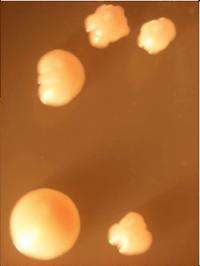
Five yeast cell colonies, all originating from one progenitor cell, show varied rates of growth caused by genetic mutations resembling those found in cancer tumors. The large yeast colony on the bottom left reveals accelerated cell proliferation, while the serrated colonies show heterogeneous growth, characteristics that are similar to human tumors. Image: Xin Li

Researchers have devised a scheme for identifying genes in yeast that could lead to the identification of new cancer genes in humans. The study is published online this week in the open-access journal PLoS Biology.

Cancers arise from the accumulation of mutations or genetic alterations resulting in the uncontrolled proliferation of cells. However, the number of mutations accumulated during the evolution of cancerous cells is large, making it difficult to identify which of the mutations are responsible for the cancer phenotypes. Identifying new genes that sustain cancerous growth is a major challenge in the campaign against cancers.

Aneuploidy, an abnormality in chromosome number and structure, is a hallmark of many cancer cells. One idea is that aneuploidy may cause cancer by changing the dosage or expression of oncogenes (cancer-causing genes). After decades of research, only a handful of human oncogenes have been identified, accounting for a tiny fraction of all cancers So methods of identifying new oncogenes through their association with aneuploidy has become an accepted strategy in the cancer field.

The Mcm4Chaos3 mutation causes a defect in an enzyme that unwinds DNA during and predisposes mice to mammary tumors. In this study, a team led by Bik Tye from Cornell University introduced the equivalent mutation in yeast. Yeast with this mutation generate and yield faster growing progeny, a situation reminiscent of what happens in tumors. Using the yeast genetics tools the researchers could show that improved growth is not linked to aneuploidy, but to point mutations in just a few genetic loci.

Pathways and genes that regulate proliferation rates are likely to be conserved in all eukaryotes. So, by identifying mutations that give cells a growth advantage in yeast, the simplest of eukaryotes, will help guide the search of cancer in humans.

More information: Li XC, Schimenti JC, Tye BK (2009) Aneuploidy and Improved Growth Are Coincident but Not Causal in a Model. PLoS Biol 7(7): e1000161.doi:10.1371/journal.pbio.1000161

Source: Public Library of Science (news : web)


print this article email this article download pdf blog this article bookmark this article     Stumble it Digg this share on Facebook retweet share on Reddit add to delicious
Rate this story - not rated yet


July 28, 2009 all stories

Comments: 0

not rated yet
  • Stumble this up

  • Digg this

  • share this

  • hide
  • Related Stories

  • Mutant mouse provides insights into breast cancer
    created Dec 11, 2006 | popularity not rated yet | comments 0
  • Researchers identify new drug targets for cancer
    created Dec 28, 2006 | popularity not rated yet | comments 0
  • CSHL researchers discover three new genes that cause lung cancer
    created Oct 08, 2007 | popularity not rated yet | comments 0
  • An alternative theory on cancer
    created Jun 27, 2007 | popularity not rated yet | comments 0
  • Cancer cells more likely to genetically mutate
    created Feb 19, 2007 | popularity not rated yet | comments 0


  • hide
  • Relevant PhysicsForums posts

  • What is transpulmonary pressure?
    created 16 hours ago
  • Is there a gay gene?
    created Nov 23, 2009
  • Super quick question about Starling forces?
    created Nov 22, 2009
  • Questions about diffusion
    created Nov 22, 2009
  • More from Physics Forums - Biology

Other News

Asian carp may have breached barrier protecting Lake Michigan

Biology / Ecology

created 3 hours ago | popularity 5 / 5 (3) | comments 0

Two feared species of Asian carp have zoomed beyond the $9 million electric barriers built to keep them out of Lake Michigan. Now, the only thing left between the carp and the Great Lakes is a lock and dam in southern Chicago.


Got a pain? -- Have a cup of Brazilian mint

Biology / Plants & Animals

created 5 hours ago | popularity 4.6 / 5 (5) | comments 0

For thousands of years it has been prescribed by traditional healers in Brazil to treat a range of ailments from headaches and stomach pain to fever and flu.


Opposites attract: Monkeys choose mating partners with different genes

Biology / Evolution

created 5 hours ago | popularity 5 / 5 (1) | comments 0

The world's largest species of monkey 'chooses' mates with genes that are different from their own to guarantee healthy and strong offspring, according to a new research study.


When is a stem cell really a stem cell?

When is a stem cell really a stem cell?

Biology / Biotechnology

created 6 hours ago | popularity 4.7 / 5 (3) | comments 0

(PhysOrg.com) -- Induced pluripotent stem (iPS) cells -- adult cells reprogrammed to look and function like versatile embryonic stem cells -- are of growing interest in medicine. They may provide a way to ...


Ice Cold: Cooler Than Being Cool

Ice Cold: Cooler Than Being Cool

Biology / Cell & Microbiology

created 7 hours ago | popularity 4.3 / 5 (8) | comments 0

(PhysOrg.com) -- Water expands when it freezes. Anyone who has ever left a can of soda or bottle of water in the freezer too long has witnessed this first hand. So how do plants and animals survive severe ...