Natural born killers -- how the body's frontline immune cells decide which cells to destroy
July 28, 2009
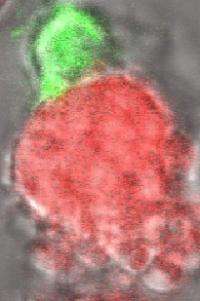
A Natural Killer cell attacks a diseased cell
(PhysOrg.com) -- The mechanism used by 'Natural Killer' immune cells in the human body to distinguish between diseased cells, which they are meant to destroy, and normal cells, which they are meant to leave alone, is revealed in new detail in research published today in PLoS Biology.
Understanding how this aspect of the body's natural defences works could help medical researchers develop new ways of boosting these defences to treat disease.
Natural Killer (NK) cells - a type of white blood cell - are a major component of the human body's innate immune system. Over 1,000 NK cells are found in every drop of blood. They provide a fast frontline defence against tumours, viruses and bacterial infections, by latching onto and killing cells in the human body that are cancerous or are infected with a virus or a bacterial pathogen.
On their journey round the human body NK cells regularly latch onto normal non-diseased cells too, before moving off, leaving them unharmed. Previously, the process by which NK cells made the right decision to kill or not kill another cell was unclear.
Now, a team of researchers from Imperial College London have used high speed microscopy imaging techniques to observe the NK cell decision making process in action. This has revealed striking differences in the behaviour of NK cells when interacting with healthy or diseased cells.
The outcome of the decision making process is determined by how receptors on the surface of the NK cell interact with proteins on the surface of the captured cell. Every NK cell has two types of surface receptors - activators, which turn the killing mechanism 'on' and inhibitors which turn the killing mechanism 'off'.
Professor Davis and his colleagues discovered that if a captured cell is diseased or cancerous, it interacts with a large number of the NK cell's activating receptors, which makes the NK cell stop dead in its tracks and spread out over the captured cell. During this spreading process the NK cell continuously reads the 'on' and 'off' signals from its surface contact with the captured cell. If the 'on' signals dominate, the NK cell prolongs contact with the captured cell and eventually kills it.
Conversely if the captured cell is healthy, it interacts with more of the NK cell's inhibiting receptors - and fewer of its activating receptors - meaning that the 'off' signals dominate and the 'stopping and spreading' process does not occur, allowing the NK cell to quickly move off in search of a new target.
Principal investigator of the new study, Professor Dan Davis from Imperial College London's Department of Life Sciences, explains:
"Scientists have known for a long time that the proteins on the surface on Natural Killer cells are involved in answering the 'to kill or not to kill?' question, but we've not known exactly how these molecular cues are translated into the correct response. Our research has shown that information gleaned from its surface receptors tells the Natural Killer cell whether to stop patrolling and commence killing, or to move off quickly, and harmlessly, in search of another target."
Dr Fiona Culley, lead author of the study from the National Heart and Lung Institute at Imperial, says that finding out how NK cells use this process to sift out diseased cells from normal ones paints a very clear picture of how these cells do their vital work:
"Considering that NK cells play such an important part in our immune response to cancer and disease, relatively little is known about their functionality - how exactly they work and how they interact with the cells they encounter inside us. This study adds significantly to our understanding of how Natural Killer cells distinguish between healthy and diseased cells."
-
New role for natural killers
Aug 27, 2008 |
not rated yet |
0
-
Researchers boost immune 'killer cells,' increase antibody effectiveness against cancer
Apr 18, 2007 |
not rated yet |
0
-
Some of your body's cells have a 'license to kill'
Feb 22, 2009 |
not rated yet |
0
-
Previously unknown immune cell may help those with Crohn's and colitis
Nov 03, 2008 |
not rated yet |
0
-
Researchers reveal how immune cells can be harnessed to target melanoma
Apr 10, 2009 |
not rated yet |
0
-
Engineers build first sub-10-nm carbon nanotube transistor
Feb 01, 2012 |
4.9 / 5 (33) |
30
-
Something old, something new: Evolution and the structural divergence of duplicate genes
Jan 31, 2012 |
4.6 / 5 (7) |
1
-
The hidden nanoworld of ice crystals: Revealing the dynamic behavior of quasi-liquid layers
Jan 30, 2012 |
5 / 5 (4) |
1
-
Stock market network reveals investor clustering
Jan 27, 2012 |
3.9 / 5 (23) |
8
-
Of microchemistry and molecules: Electronic microfluidic device synthesizes biocompatible probes
Jan 26, 2012 |
5 / 5 (2) |
0
-
Is Everyday Technology Killing Us?
Feb 08, 2012
-
Exercise and weight loss
Feb 08, 2012
-
Why do we have head aches? Our brains can't feel anything.
Feb 07, 2012
-
"The end of diseases" by David Agus, interview from Daily Show with Jon Stewart
Feb 04, 2012
-
Oncolytic adenovirus
Feb 04, 2012
-
Nutrition label stuffs and diets
Feb 02, 2012
- More from Physics Forums - Medical Sciences
More news stories
Overeating may double risk of memory loss
New research suggests that consuming between 2,100 and 6,000 calories per day may double the risk of memory loss, or mild cognitive impairment (MCI), among people age 70 and older. The study was released today and will be ...
Medicine & Health / Neuroscience
35 minutes ago |
not rated yet |
0
|
Injured boomers beware: Know when to see doctor
(AP) -- It happened to nurse Jane Byron years after an in-line skating fall, business owner Haralee Weintraub while doing "men's" push-ups, and avid cyclist Gene Wilberg while lifting a heavy box.
5 hours ago |
5 / 5 (1) |
0
Starve a virus, feed a cure? Findings show how some cells protect themselves against HIV
A protein that protects some of our immune cells from the most common and virulent form of HIV works by starving the virus of the molecular building blocks that it needs to replicate, according to research published online ...
4 hours ago |
5 / 5 (1) |
0
|
FDA-approved drug rapidly clears amyloid from the brain, reverses Alzheimer's symptoms in mice
Neuroscientists at Case Western Reserve University School of Medicine have made a dramatic breakthrough in their efforts to find a cure for Alzheimer's disease. The researchers' findings, published in the journal Science, show t ...
Medicine & Health / Neuroscience
Feb 09, 2012 |
4.9 / 5 (57) |
15
|
Green tea found to reduce disability in the elderly
(Medical Xpress) -- A lot of research has been done over the past several years looking into the health benefits of green tea. As a result, scientists have found that regular consumption of the beverage leads ...
Google might launch Drive for cloud storage soon
(PhysOrg.com) -- Google's next big move, according to the Wall Street Journal, is a cloud storage service called Drive. Hardly first to the plate, Google is simply catching up to introducing its cloud reposi ...
Scientists discover molecular secrets of 2,000-year-old Chinese herbal remedy
For roughly two thousand years, Chinese herbalists have treated Malaria using a root extract, commonly known as Chang Shan, from a type of hydrangea that grows in Tibet and Nepal. More recent studies suggest that halofuginone, ...
New method to examine batteries -- MRI from the inside
There is an ever-increasing need for advanced batteries for portable electronics, such as phones, cameras, and music players, but also to power electric vehicles and to facilitate the distribution and storage of energy derived ...
Lab study raises questions over nano-particle impact
Tests involving chickens have raised questions about the impact on health from engineered nano-particles, the ultra-fine grains commonly used in drugs and processed foods, scientists said on Sunday.
A mitosis mystery solved: How chromosomes align perfectly in a dividing cell
Although the process of mitotic cell division has been studied intensely for more than 50 years, Whitehead Institute researchers have only now solved the mystery of how cells correctly align their chromosomes during symmetric ...
Researchers find extensive RNA editing in human transcriptome
In a new study published online in Nature Biotechnology, researchers from BGI, the world's largest genomics organization, reported the evidence of extensive RNA editing in a human cell line by analysis of RNA-seq data, demons ...