Wildfires set to increase 50 percent by 2050
July 28, 2009 Scientists expect wildfires to increase as climate warms in the coming decades

Enlarge

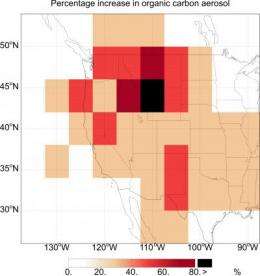
This graph shows the percentage increase in organic carbon particles at the surface, from the present-day to the 2050s, as calculated by the model of Spracklen et al. [2009] for the May-October fire season. The increase is due mainly to the simulated rise in wildfire frequency in the future, warmer climate. Credit: Loretta Mickley, Harvard School of Engineering and Applied Sciences

The area of forest burnt by wildfires in the United States is set to increase by over 50% by 2050, according to research by climate scientists.

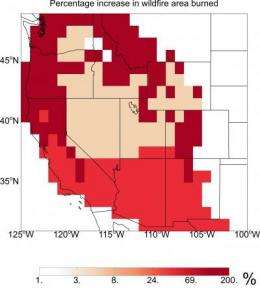
The study predicts that the worst affected areas will be the forests in the Pacific Northwest and the Rocky Mountains, where the area of forest destroyed by wildfire is predicted to increase by 78% and 175% respectively.

The research is based on a conservative of 1.6 degrees Celsius over the next 40 years.

Published in the Journal of Geophysical Research, scientists also say that the increase in wildfires will lead to significant deterioration of the in the western United States due to greater presence of smoke.
Scientists expect wildfires to increase as climate warms in the coming decades
Enlarge

This graph shows the percentage increase in area burned by wildfires, from the present-day to the 2050s, as calculated by the model of Spracklen et al. [2009] for the May-October fire season. The model follows a scenario of moderately increasing emissions of greenhouse gas emissions and leads to average global warming of 1.6 oCelsius (3oFahrenheit ) by 2050. Warmer temperatures can dry out underbrush, leading to more serious conflagrations in the future climate. Credit: Loretta Mickley, Harvard School of Engineering and Applied Sciences

"Wildfires, such as those in California earlier this year, are a serious problem in the United States and this research shows that climate change is going to make things significantly worse," says Dr Dominick Spracklen, from the School of Earth and Environment at the University of Leeds who is the lead author of the research.

"Our research shows that wildfires are strongly influenced by temperature. Hotter temperatures lead to dryer forests resulting in larger and more serious fires," explains Spracklen.

"In the Rocky Mountains we are predicting that the area burnt by wildfires will almost triple by 2050."

Scientists used data documenting the area of forest burned on federal land since 1980 along with weather data from the United States Department of Agriculture Forest Service, to construct a computer model that takes into account the factors that can best predict the area burned in each ecosystem in the western US.

Significantly, the research also predicts a 40% increase in the western United States in the concentration of tiny soot particles in the air, known to scientists as organic carbon aerosol. This will have important consequences on western US air quality and visibility.

"The US government has introduced legislation to try to improve air quality and visibility by 2064. Currently the main focus for environment agencies and campaigners is industry, but this research shows that, especially in the western US, wildfires will become an increasing source of air pollution," explains Dr Spracklen.

More information: The paper 'Impacts of from 2000 to 2050 on wildfire activity and carbonaceous aerosol concentrations in the western United States', published in the .

Source: University of Leeds (news : web)


Rate this story - 2.1 /5 (7 votes)

Rank Filter

Move the slider to adjust rank threshold, so that you can hide some of the comments.


Display comments: newest first

  • jonnyboy - Jul 29, 2009
    • Rank: 3 / 5 (2)
    more BS
  • RAL - Jul 29, 2009
    • Rank: not rated yet
    Should be easy enough to compare the average US termperature increase from say 1900-1998 and see if there has been an increase of this magnitude historically, or whether this these folks are just "blowing smoke". I strongly suspect the latter.

    Even better, let's look at the average temperature increase since the last ice age and marvel that there are any forests left unburned in the world.


July 28, 2009 all stories

Comments: 2

2.1 /5 (7 votes)

  • hide
  • Related Stories


  • hide
  • Relevant PhysicsForums posts

  • Carbon Dioxide emissions question
    created Feb 08, 2010
  • Photosynthesis vs. carbonization
    created Feb 07, 2010
  • Sheep's footprints
    created Feb 05, 2010
  • How did Victorians estimate the ages of fossils?
    created Feb 03, 2010
  • More from Physics Forums - Earth

Other News

Orion in a New Ligh

Orion in a New Ligh (w/ Video)

Space & Earth / Astronomy

created 27 minutes ago | popularity not rated yet | comments 0 | with audio podcast

(PhysOrg.com) -- The Orion Nebula reveals many of its hidden secrets in a dramatic image taken by ESO’s new VISTA survey telescope. The telescope’s huge field of view can show the full splendour of the whole ...


India announces long-range nuclear-capable missile test

Space & Earth / Space Exploration

created 1hour ago | popularity 5 / 5 (1) | comments 0

India will test a nuclear-capable missile with a range of over 5,000 kilometres (3,000 miles) within a year, its top military scientist said Wednesday, risking a rise in regional tensions.


Space shuttle Endeavour pulls in at space station (AP)

Space shuttle Endeavour pulls in at space station

Space & Earth / Space Exploration

created 6 hours ago | popularity 5 / 5 (1) | comments 0

(AP) -- Shuttle Endeavour arrived to a warm welcome at the International Space Station early Wednesday, delivering a new room and observation deck that will come close to completing construction 200 miles ...


Climate 'Tipping Points' May Arrive Without Warning, Says Top Forecaster

Space & Earth / Environment

created 16 hours ago | popularity 3.5 / 5 (11) | comments 11 | with audio podcast

(PhysOrg.com) -- A new University of California, Davis, study by a top ecological forecaster says it is harder than experts thought to predict when sudden shifts in Earth's natural systems will occur -- a worrisome finding ...


38 percent of world's surface in danger of desertification

38 percent of world's surface in danger of desertification

Space & Earth / Environment

created 13 hours ago | popularity 2 / 5 (4) | comments 6

A team of Spanish researchers has measured the degradation of the planet's soil using the Life Cycle Assessment (LCA), a scientific methodology that analyses the environmental impact of human activities, and ...