GOES-14 Satellite Takes First Full Disk Image
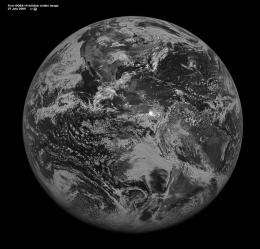
July 28, 2009 GOES-14 Satellite Takes First Full Disk Image

Enlarge

From approximately 35,786 km (22,236 miles) in space, NOAA's newest Geostationary Operational Environmental Satellite -- GOES-14 -- took its first full-disk visible image of the earth on July 27, 2009 at 2:00 p.m. EDT. GOES-14, launched on June 27, 2009, from Cape Canaveral, Fla., joins three other NOAA operational GOES spacecraft that help the agency's forecasters track life-threatening weather and solar activity that can impact the satellite-based electronics and communications industry. After five more months of tests, GOES-14 will be placed in orbital storage mode, ready for activation if any of NOAA's operational GOES spacecraft experiences trouble. Credit: NASA/GOES Project

(PhysOrg.com) -- The latest Geostationary Operational Environmental Satellite, GOES-14, provided its first visible full disk image of Earth on July 27, at 2:00 p.m. EDT. The prime instrument on GOES, called the Imager, is taking images of Earth with a 1 kilometer (km) or 0.62 mile resolution from an altitude of 36,000 km (22,240 miles) above Earth’s surface, equivalent to taking a picture of a dime from a distance of seven football fields.

"The first GOES-14 visible full disk image shows little activity in the Atlantic Ocean and two tropical waves located in the East Pacific Ocean with a low probability of becoming a tropical cyclone. Numerous thunderstorms are seen scattered along the east coast and western Atlantic Ocean, with more significant rains and thunderstorms in the southeast Oklahoma and northeast Texas area," remarked Thomas Renkevens, a User Services Coordinator from the National Oceanic and Atmospheric Administration's (NOAA) National Environmental Satellite, Data and Information Service, Camp Springs, Md. "NOAA will continue to follow the tropical waves and thunderstorms for possible further development."

The GOES satellite system aids forecasters in locating severe weather events and is instrumental in providing early warnings for residents located in the surrounding areas. "Being able to predict the path of a hurricane with reasonable certainty and only evacuating the areas at risk saves communities roughly a million dollars per mile," Renkevens stated.

"This GOES-14 image also shows a mostly cloud-free southwest United States, with a blanket of low along over the Pacific Ocean off the west coast," stated Renkevens.

The Imager was built by ITT Industries, Inc. in Fort Wayne, Ind. The Imager is mounted on an ultra-stable optical bench on a spacecraft built by Boeing Space & Intelligence Systems of El Segundo, Calif. Star trackers on the spacecraft provide the attitude reference in order to point the instruments and keep the images jitter-free.

"Capturing this first sharp image is a major milestone for our GOES team. It represents a culmination of this team’s hard work and dedication. We still have more to do but full mission success is clearly in our sights," stated Andre’ Dress, the NASA GOES N Series Deputy Project Manager, at NASA Goddard Space Flight Center, Greenbelt, Md.

Launched as GOES-O on June 27, 2009, the satellite was renamed GOES-14 after reaching geostationary orbit on July 8, 2009. The satellite is now approximately 22,300 miles above Earth’s surface located at 89.5 west longitude where it will remain during the 5 month checkout period.

Boeing Space and Intelligence Systems handed over engineering control of GOES-14 to NASA on July 18, at the NOAA Satellite Operations Facility in Suitland, Md.

On August 14, NASA plans to deploy the Imager and Sounder cooler doors that will allow the infrared detectors to take infrared images of Earth and soundings of atmospheric temperatures and water vapor levels. The Imager and Sounder data are also used for sea surface temperatures, fog and fire detection, volcanic eruption monitoring, and severe storm evaluations.

NASA expects to complete checkout of the satellite by mid-December and hand it over to NOAA for operational use. NOAA expects to store GOES-14 on-orbit at 105 west longitude until an operational need arises. NOAA also expects to deorbit GOES-10 within the next six months due to fuel depletion.

NOAA manages the GOES program, establishes requirements, provides all funding and distributes the environmental for the United States. NASA Goddard procures and manages the design, development and launch of the satellites and provides some ground station components for NOAA. Boeing Space and Intelligence Systems built GOES-O and provided the commercial launch services through Boeing Launch Services and the United Launch Alliance.

Provided by JPL/NASA (news : web)


print this article email this article download pdf blog this article bookmark this article     Stumble it Digg this share on Facebook retweet share on Reddit add to delicious
Rate this story - 4.8 /5 (8 votes)

Rank Filter

Move the slider to adjust rank threshold, so that you can hide some of the comments.


Display comments: newest first

  • Ivan2 - Jul 29, 2009
    • Rank: 1 / 5 (2)
    Black and white?!?!
  • jwflowersii - Jul 29, 2009
    • Rank: 4 / 5 (1)
    Black and white offer more resolution than color ever will. Besides they're looking at clouds, not taking pretty pictures.

July 28, 2009 all stories

Comments: 2

4.8 /5 (8 votes)
  • Stumble this up

  • Digg this

  • share this

  • hide
  • Related Stories

  • GOES-O satellite reaches orbit, renamed GOES-14
    created Jul 10, 2009 | popularity not rated yet | comments 0
  • Sophisticated weather satellite rockets into orbit
    created Jun 28, 2009 | popularity not rated yet | comments 0
  • NASA's Goes-N Satellite Ready for Launch
    created Jul 27, 2005 | popularity not rated yet | comments 0
  • GOES-O satellite arrives at KSC for final pre-launch testing
    created Mar 04, 2009 | popularity not rated yet | comments 0
  • New Environmental Satellite Successfully Launched
    created Feb 06, 2009 | popularity not rated yet | comments 0


  • hide
  • Relevant PhysicsForums posts

  • Question about 2-body gravity
    created Nov 24, 2009
  • life on Mars
    created Nov 24, 2009
  • Semi-major axis from cartesian co-ordinates
    created Nov 23, 2009
  • Primary Mirror grinding
    created Nov 23, 2009
  • More from Physics Forums - General Astronomy

Other News

Monster Waves on the Sun are Real

Monster Waves on the Sun are Real (w/ Video)

Space & Earth / Astronomy

created 1hour ago | popularity 5 / 5 (5) | comments 0

Sometimes you really can believe your eyes. That's what NASA's STEREO (Solar Terrestrial Relations Observatory) spacecraft are telling researchers about a controversial phenomenon on the sun known as the "solar ...


No Wheel Stall in Diagnostic Drive

Spirit Mars Rover: No Wheel Stall in Diagnostic Drive

Space & Earth / Space Exploration

created 1hour ago | popularity 5 / 5 (1) | comments 0

(PhysOrg.com) -- On Sol 2095 (Tuesday, Nov. 24), Spirit performed a set of diagnostic actions related to a stall of the right-rear wheel on the previous drive, three days earlier.


Cosmic 'dig' reveals vestiges of the Milky Way's building blocks

Cosmic 'Dig' Reveals Vestiges of the Milky Way's Building Blocks

Space & Earth / Astronomy

created 6 hours ago | popularity 5 / 5 (11) | comments 1

(PhysOrg.com) -- Peering through the thick dust clouds of our galaxy's "bulge" (the myriads of stars surrounding its center), a team of astronomers has unveiled an unusual mix of stars in the stellar grouping ...


Climate experts debate strategies for reducing atmospheric carbon and future warming

Climate experts debate strategies for reducing atmospheric carbon and future warming

Space & Earth / Environment

created 2 hours ago | popularity 3 / 5 (2) | comments 2

(PhysOrg.com) -- Reducing carbon dioxide to safe levels may require extracting carbon from the air, says Cornell climate researcher.


Oceanic crust formation is dynamic after all

Oceanic crust formation is dynamic after all

Space & Earth / Earth Sciences

created 5 hours ago | popularity 4 / 5 (1) | comments 0

Imagine the Earth's crust as the planet's skin: Some areas are old and wrinkled while others have a fresher, more youthful sheen, as if they had been regularly lathered with lotion.