Traditional Thai hill farmers help preserve genetic diversity of rice
July 28, 2009 By Melissae Fellet
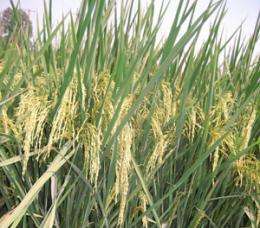
Traditional varieties of rice provide a genetically evolving pool of traits that can be tapped to improve crops worldwide, a new study suggests. Image: National Science Foundation
(PhysOrg.com) -- Rice is one of the most important crops worldwide, as it feeds over half of the world's population. Domesticated rice is an important supply of the world's rice. However, these strains are genetically static and cannot adapt to changing growing conditions. Traditional varieties, or landraces, of rice are genetically evolving and provide a pool of traits that can be tapped to improve crops worldwide.
Research from Barbara A. Schaal, Ph.D., the Mary-Dell Chilton Distinguished Professor of biology in Arts & Sciences at Washington University in St. Louis, and her colleagues at Chiang Mai University in Thailand shows how natural genetic drift and agricultural practices of the traditional farmers combine to influence the genetic diversity of a given landrace of rice.
Schaal is also involved in science policy, serving as vice president of the National Academy of Sciences and recently appointed to the President's Council of Advisors on Science and Technology.
Schaal and her colleagues studied a landrace of rice grown by the Karen people in Thailand. They compared the genetic variation among the same variety of rice grown in different fields and villages. The genetics of the rice population fits the isolation by distance model, much like a native plant species. The further apart fields are, the more genetically distinct they are.
The research, published in the Proceedings of the National Academy of Sciences, is funded by the McKnight Foundation and the Thailand Research Fund.
In the lowlands of Thailand, farmers grow modern high-yield rice. In the hills, the Karen people practice traditional agriculture, growing ancestral varieties of rice with traditional practices. Expert farmers play a role in maintaining their crop's genetic diversity by exchanging and choosing seeds to plant the following year.
"It's interesting to see how the expert farmers interact with the plants. For example, there was a purple mutation that occurred in one of the expert farmer's fields. He was very curious about it. He took the seeds and grew it off in a corner because he wanted to see what it looked like and tasted like. That's probably how humans domesticated plants, smart people were making smart choices in what to plant and grow," Schaal said.
Many crops grown today have been genetically optimized to consistently give a large yield. Seeds are purchased from a supplier and the plants are all genetically similar.
"Most modern varieties of crops, like corn in the Midwest or high-yield rice in the lowlands of Thailand, are artificial constructs developed by plant breeders. They are extraordinarily important in feeding the world. But they are static and not evolving in farmer's fields," Schaal said.
The rice that the Karen people grow is genetically dynamic, due to natural drift and the farmer's artificial selection. Each year, the farmers choose the seeds that grow best in their fields, which may differ in soil type, elevation, and temperature from other fields, to plant next season. Their crop is constantly evolving in response to local conditions.
"My colleagues believe that those local varieties bred within a village are better than any one single variety could be. Under these circumstances, the farmers have it right," Schaal said.
Although most agriculture in the United States focuses on growing high-yield crops to produce food for people living in cities, landraces of corn and other crops exist in seed banks.
"There is a movement among Native Americans in Arizona to grow ancestral varieties of crops. These varieties are important because they are adapted to hot and dry conditions, something that will become more prevalent as our climate changes," Schaal said.
Time will tell if those farmers "get it right" too.
-
Rice domestiction confiirmed genetically
Sep 08, 2006 |
not rated yet |
0
-
Research finds way to double rice crops in drought-stricken areas
Nov 20, 2008 |
not rated yet |
0
-
Gene's past could improve the future of rice
Jan 23, 2009 |
not rated yet |
0
-
Genomics Research Focuses on Rice Variety Improvement
Jul 01, 2008 |
not rated yet |
0
-
Arkansas rice farmers file a lawsuit
Aug 30, 2006 |
not rated yet |
0
-
Engineers build first sub-10-nm carbon nanotube transistor
Feb 01, 2012 |
4.9 / 5 (31) |
30
-
Something old, something new: Evolution and the structural divergence of duplicate genes
Jan 31, 2012 |
4.6 / 5 (7) |
1
-
The hidden nanoworld of ice crystals: Revealing the dynamic behavior of quasi-liquid layers
Jan 30, 2012 |
5 / 5 (3) |
1
-
Stock market network reveals investor clustering
Jan 27, 2012 |
3.9 / 5 (23) |
8
-
Of microchemistry and molecules: Electronic microfluidic device synthesizes biocompatible probes
Jan 26, 2012 |
5 / 5 (1) |
0
-
Mitosis
42 minutes ago
-
Stem cell question.
2 hours ago
-
Protease cleavage
8 hours ago
-
Pertubance in a model
14 hours ago
-
Cancer drugs and Alzheimer's, Oh my!
23 hours ago
-
Squishing cells
23 hours ago
- More from Physics Forums - Biology
More news stories
The power of estrogen -- male snakes attract other males
A new study has shown that boosting the estrogen levels of male garter snakes causes them to secrete the same pheromones that females use to attract suitors, and turned the males into just about the sexiest ...
13 hours ago |
4.8 / 5 (5) |
1
|
Grass to gas: Researchers' genome map speeds biofuel development
Researchers at the University of Georgia have taken a major step in the ongoing effort to find sources of cleaner, renewable energy by mapping the genomes of two originator cells of Miscanthus x giganteus, a large perenn ...
10 hours ago |
3.8 / 5 (5) |
0
|
Experts reveal how plants don't get sunburn
(PhysOrg.com) -- Experts at the University of Glasgow have discovered how plants survive the harmful rays of the sun.
13 hours ago |
4.7 / 5 (3) |
0
|
Miami battling invasion of giant African snails
No one knows how they got there. But an invasion of African giant snails has southern Florida in a panic over potential crop damage, disease and general yuckiness surrounding the slimy gastropods.
17 hours ago |
4 / 5 (1) |
4
Protein libraries in a snap
(PhysOrg.com) -- A Rice University undergraduate will depart with not only a degree but also a possible patent for his invention of an efficient way to create protein libraries, an important component of biomolecular ...
16 hours ago |
4.8 / 5 (4) |
0
|
Google users warned of threat to smartphone wallets
Users of Google smartphone wallets were being warned on Friday that there is a way to crack pass codes intended to thwart thieves from going on illicit shopping sprees.
Anonymous knocks CIA website offline (Update)
The website of the Central Intelligence Agency was inaccessible on Friday after the hacker group Anonymous claimed to have knocked it offline.
New error-correcting codes guarantee the fastest possible rate of data transmission
Error-correcting codes are one of the triumphs of the digital age. Theyre a way of encoding information so that it can be transmitted across a communication channel such as an optical fiber o ...
Complex wiring of the nervous system may rely on a just a handful of genes and proteins
Researchers at the Salk Institute have discovered a startling feature of early brain development that helps to explain how complex neuron wiring patterns are programmed using just a handful of critical genes. ...
Humans may have helped the decline of African rainforests 3000 years ago
(PhysOrg.com) -- Large areas of rainforests in Central Africa mysteriously disappeared over three thousand years ago, to be replaced by savannas. The prevailing theory has been that the cause was a change ...
New power source discovered
(PhysOrg.com) -- Researchers at the Massachusetts Institute of Technology (MIT) and RMIT University have made a breakthrough in energy storage and power generation.