First genetically-engineered malaria vaccine to enter human trials
July 28, 2009
First genetically-engineered malaria vaccine to enter human trials

Enlarge

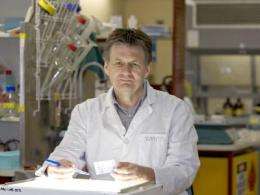
Professor Alan Cowman from the Walter and Eliza Hall Institute in Melbourne, Australia, has created the world's first genetically-modified strain of the malaria parasite that will be used as a live vaccine against the disease. The vaccine, developed in collaboration with researchers from the US, Japan and Canada, will be trialled in humans from early 2010. Credit: Walter and Eliza Hall Institute of Medical Research

Walter and Eliza Hall Institute scientists have created a weakened strain of the malaria parasite that will be used as a live vaccine against the disease. The vaccine, developed in collaboration with researchers from the US, Japan and Canada, will be trialled in humans from early next year.

Malaria kills more than one million people each year and destroys - through premature death and disability - the equivalent of at least 35 million years of healthy, productive human life every year.

Professor Alan Cowman, head of the institute's Infection and Immunity division, said in developing the the research team had deleted two key genes in the Plasmodium falciparum parasite - which causes the form of most deadly to humans. By removing the genes the is halted during its liver infection phase, preventing it from spreading to the blood stream where it can cause severe disease and death.

Their success in genetically modifying the parasite and thereby preventing its invasion of is published in the current issue of the USA.

Professor Cowman said similar vaccines had been tested in mice and offered 100 per cent protection against malaria infection. He said it was hoped the vaccine would produce similar results in humans. "Although two genes have been deleted the parasite is still alive and able to stimulate the body's protective immune system to recognize and destroy incoming mosquito-transmitted deadly parasites," Professor Cowman said.

This approach to vaccine development - using a weakened form of the whole organism that causes a particular disease - has proven successful in eradicating smallpox and controlling diseases such as flu and polio.

Professor Cowman said the research team, which includes Dr Matthew O'Neill and Dr Alex Maier from the institute as well as scientists from the Seattle Biomedical Research Institute, the Walter Reed Army Institute for Research and the University of Maryland, had used knowledge from several decades ago - when scientists proved that irradiated malaria parasites provide protection against subsequent malaria infection in animal models and humans - in developing the vaccine.

"Although vaccines are under development that use whole malaria parasites weakened by irradiation to protect against infection, their safety and effectiveness rely on a precise irradiation dose and trial results have been variable," Professor Cowman said. "We believe that our genetically attenuated parasite approach provides a safe and reproducible way of developing a whole organism malaria vaccine."

Professor Cowman said it was unlikely the weakened parasites used in the vaccine would regain their potency as the genes had been deleted from the genome and could not be recreated by the parasite. "In addition, the 'one-two punch' approach of deleting two essential genes make it extremely unlikely that the attenuated parasite vaccine could restore its capacity to multiply and lead to disease," he said.

The human trials of the vaccine will take place at the Walter Reed Army Institute of Research in Maryland, US. The genetically attenuated parasites to be used in the trial are being manufactured at the Walter and Eliza Hall Institute, which has the only facility worldwide capable of producing genetically-altered malaria parasites that comply with the good manufacturing practice guidelines required for human clinical trials.

Source: Walter and Eliza Hall Institute

Filter


Move the slider to adjust rank threshold, so that you can hide some of the comments.


Display comments: newest first

zilqarneyn
Jul 29, 2009

Rank: not rated yet
Personally, I favor the genomic-flexibility view. That is, micro-"evolution" strictly irrelevant to "macro-evolution."
http://www.imame.org/4/gf/

But knowing that macro-evolutionists believe in mutationgod, which might bring out anything, then I find the hopefulness of that professor, amazing. How would that two-genes mutation not happen, if evolutionist believe in even "convergent/parallel evolution" to somehow happen around the world?


From the point of view of genomic-flexibility, there might be problems, too. The same result might be computable by alternative genes. Just turning off the genes which seem to cause illness, might not be truly turning off all combinations of illness potential. (Like, 2 2=4 but 3 5-4=4, too.)

I wonder how they try all that in trials, if there is no way to ensure that on paper, as law.


I hope we will kill all mosquitoes. This might work, and takes less chances with anything. I propose the DIY contraption to first-invite-then-swat to kill mosquitoes. http://www.twitte...lqarneyn Better than the blinding-potential laser, or the terrible history of genetics and vaccines about malaria -- let alone the dengue fever, encephalitis (such as West Nile), or what else.
Rank not rated yet
Relevant PhysicsForums posts
  • We the immaterial soul
    created8 hours ago
  • Is Everyday Technology Killing Us?
    createdFeb 08, 2012
  • Exercise and weight loss
    createdFeb 08, 2012
  • Why do we have head aches? Our brains can't feel anything.
    createdFeb 07, 2012
  • "The end of diseases" by David Agus, interview from Daily Show with Jon Stewart
    createdFeb 04, 2012
  • Oncolytic adenovirus
    createdFeb 04, 2012
  • More from Physics Forums - Medical Sciences

More news stories

FDA-approved drug rapidly clears amyloid from the brain, reverses Alzheimer's symptoms in mice

Neuroscientists at Case Western Reserve University School of Medicine have made a dramatic breakthrough in their efforts to find a cure for Alzheimer's disease. The researchers' findings, published in the journal Science, show t ...

Medicine & Health / Neuroscience

created Feb 09, 2012 | popularity 4.9 / 5 (53) | comments 21 | with audio podcast

Green tea found to reduce disability in the elderly

(Medical Xpress) -- A lot of research has been done over the past several years looking into the health benefits of green tea. As a result, scientists have found that regular consumption of the beverage leads ...

Medicine & Health / Health

created Feb 07, 2012 | popularity 4.4 / 5 (14) | comments 11 | with audio podcast report

Teen school drop-outs three times as likely to be on benefits in later life

Teen school drop-outs are almost three times as likely to be on benefits in later life as their peers who complete their schooling, indicates research published online in the Journal of Epidemiology and Community Health.

Medicine & Health / Health

created Feb 06, 2012 | popularity not rated yet | comments 13

To perform with less effort, practice beyond perfection

Whether you are an athlete, a musician or a stroke patient learning to walk again, practice can make perfect, but more practice may make you more efficient, according to a surprising new University of Colorado Boulder study.

Medicine & Health / Neuroscience

created Feb 09, 2012 | popularity 4.4 / 5 (15) | comments 6 | with audio podcast

Anyone can learn to be more inventive, cognitive researcher says

There will always be a wild and unpredictable quality to creativity and invention, says Anthony McCaffrey, a cognitive psychology researcher at the University of Massachusetts Amherst, because an "Aha moment" is rare and ...

Medicine & Health / Psychology & Psychiatry

created Feb 09, 2012 | popularity 4.6 / 5 (11) | comments 5 | with audio podcast


Google might launch Drive for cloud storage soon

(PhysOrg.com) -- Google's next big move, according to the Wall Street Journal, is a cloud storage service called Drive. Hardly first to the plate, Google is simply catching up to introducing its cloud reposi ...

Latin America mining boom clashes with conservation

Latin America is experiencing a mining boom as prices rise fuelled by a hike in global demand, but the region is also being hit by a wave of violent protests, strikes and rallies by environmentalists.

Love a click away in Indonesia's Twitter Republic

He was a geeky kid from Yogyakarta, she a glamorous city girl in Jakarta. In a country with one of the world's most vibrant social networking scenes they fell in love on Twitter.

Europeans protest controversial Internet pact

Tens of thousands of people marched in protests in more than a dozen European cities Saturday against a controversial anti-online piracy pact that critics say could curtail Internet freedom.

Walney offshore wind farm is world's biggest (for now)

(PhysOrg.com) -- The Walney wind farm on the Irish Sea--characterized by high tides, waves and windy weather--officially opened this week. The farm is treated in the press as a very big deal as the Walney ...

Navy to begin tests on electromagnetic railgun prototype launcher

The Office of Naval Research (ONR)'s Electromagnetic (EM) Railgun program will take an important step forward in the coming weeks when the first industry railgun prototype launcher is tested at a facility ...