Study: Tanning beds definitely cause cancer
July 28, 2009 By MARIA CHENG , AP Medical Writer Tanning bed

Enlarge

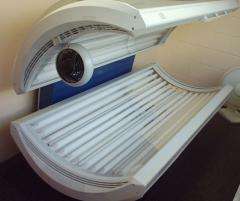
Tanning bed. Image: Wikimedia Commons.

(AP) -- International cancer experts have moved tanning beds and ultraviolet radiation into the top cancer risk category, deeming both to be as deadly as arsenic and mustard gas. For years, scientists have described tanning beds and ultraviolet radiation as "probable carcinogens."

A new analysis of about 20 studies concludes the risk of skin cancer jumps by 75 percent when people start using tanning beds before age 30. Experts also found that all types of ultraviolet radiation caused worrying mutations in mice, proof the radiation is carcinogenic. Previously, only one type of ultraviolet radiation was thought to be lethal.

The new classification means tanning beds and ultraviolet radiation are definite causes of cancer, alongside tobacco, the and chimney sweeping, among others.

The research was published online in the medical journal Lancet Oncology on Wednesday, by experts at the International Agency for Research on Cancer in Lyon, the cancer arm of the .

"People need to be reminded of the risks of sunbeds," said Vincent Cogliano, one of the cancer researchers. "We hope the prevailing culture will change so teens don't think they need to use sunbeds to get a tan."

Most lights used in tanning beds give off mainly , which cause skin and eye cancer, according to the International Agency for Cancer Research.

The classification of tanning beds as carcinogenic was disputed by Kathy Banks, chief executive of The Sunbed Association, a European trade association of tanning bed makers and operators.

"The fact that is continuously ignored is that there is no proven link between the responsible use of sunbeds and skin cancer," Banks said in a statement. She said most users of tanning beds use them less than 20 times a year.

But as use of tanning beds has increased among people under 30, doctors have seen a parallel rise in the numbers of young people with skin cancer. In Britain, melanoma, the deadliest kind of skin cancer, is now the leading cancer diagnosed in women in their 20s. Normally, rates are highest in people over 75.

Previous studies found younger people who regularly use tanning beds are eight times more likely to get melanoma than people who have never used them. In the past, WHO warned people younger than 18 to stay away from tanning beds. The American Society advises people to try bronzing or self-tanning creams instead of tanning beds.

---

On the Net:

http://www.lancet.com

©2009 The Associated Press. All rights reserved. This material may not be published, broadcast, rewritten or redistributed.


Rate this story - 4.7 /5 (12 votes)

Rank Filter

Move the slider to adjust rank threshold, so that you can hide some of the comments.


Display comments: newest first

  • Mercury_01 - Jul 29, 2009
    • Rank: 3 / 5 (4)
    Now study aspartame.
  • Egnite - Jul 29, 2009
    • Rank: 1 / 5 (1)
    Doubt the FDA will be too keen on that.

    Back in june 07, coca cola filed 27 patent applications to use a new natural sweetner "Rebiana", ofc by the ingredients still in coke we can see that failed. Rebiana (Stevia) is only approved as a dietry supplement and not a food additive.

    I wonder why a carcinogenic chemical is safe to use in food but a daisy extract isn't??

    http://www.foodna...weetener
  • marjon - Jul 29, 2009
    • Rank: not rated yet
    Dosage makes the poison.
    "The American Cancer Society advises people to try bronzing or self-tanning creams instead of tanning beds. "
    What is the cancer risk for such creams?

  • Mercury_01 - Jul 29, 2009
    • Rank: 5 / 5 (1)
    Why not just forget about manipulating the color of our skin just for the sake of vanity. There's a natural tanning mechanism already in place. People may remember it if they go outside and look up!
  • marjon - Jul 29, 2009
    • Rank: 1 / 5 (1)
    Why not just forget about manipulating the color of our skin just for the sake of vanity. There's a natural tanning mechanism already in place. People may remember it if they go outside and look up!


    Don't forget your spf 50 sunscreen! (Does that cause cancer?)
  • E_L_Earnhardt - Jul 29, 2009
    • Rank: 1 / 5 (1)
    "All rays are electrons"! Cosmic, X-ray, and breakaway Electrons from outer orbits of heated carbon atoms, (as in burning tobacco, ETC.)! It's the high-speed electron that accelerates mitosis and causes cancer! Even cold water would slow it!
  • Mercury_01 - Jul 29, 2009
    • Rank: not rated yet
    so we should filter the sunlight through water bongs?
  • Egnite - Jul 30, 2009
    • Rank: not rated yet
    Dosage makes the poison.

    "The American Cancer Society advises people to try bronzing or self-tanning creams instead of tanning beds. "

    What is the cancer risk for such creams?


    Yeah, doseage makes the poision so let me know how the cancer feels in 20years when you've ingested heaps of the said poision! Sun creams are stupid imo. They block out uv light which our bodies need to produce vitamin D. If you burn, stay in the shade or eat heaps of berries and gradually condition ur skin to handle the sunlight. Filtering out a necessary vitamin producing light will make your body unhealthy and prolly rot your mind, which is ideal for a consumer nation. Or ofc you can eat chemical supplements called multivitamins, again let me know how well that cancer developes in future years!
  • Soylent - Jul 31, 2009
    • Rank: 4 / 5 (1)
    Now study aspartame.


    Only if you pay for it.

    (Aspartame and glutamate are some of the most studied substances in history)

July 28, 2009 all stories

Comments: 9

4.7 /5 (12 votes)

  • hide
  • Related Stories

  • Skin cancer now top cancer among young women in UK
    created Apr 08, 2009 | popularity not rated yet | comments 0
  • More than skin deep: There's no such thing as a 'safe' suntan, researchers warn
    created Sep 18, 2008 | popularity not rated yet | comments 0
  • Indoor tanning lobby says tanning is good
    created Mar 28, 2008 | popularity not rated yet | comments 0
  • Frequent tanners may be addicted
    created May 16, 2006 | popularity not rated yet | comments 0
  • Women still tanning despite dangers
    created Jan 13, 2006 | popularity not rated yet | comments 0


  • hide
  • Relevant PhysicsForums posts

Other News

A common cholesterol drug fights cataracts, too

Medicine & Health / Medications

created 3 minutes ago | popularity not rated yet | comments 0

Statins, a class of drugs used to lower cholesterol levels, have been successfully fighting heart disease for years. A new study from Tel Aviv University has now found that the same drugs cut the risks of cataracts in men ...


Changes proposed in how psychiatrists diagnose

Medicine & Health / Psychology & Psychiatry

created 12 minutes ago | popularity not rated yet | comments 0

(AP) -- Don't say "mental retardation" - the new term is "intellectual disability." No more diagnoses of Asperger's syndrome - call it a mild version of autism instead. And while "behavioral addictions" will be new to doctors' ...


Intense sweets taste especially good to some kids

Medicine & Health / Health

created 19 minutes ago | popularity not rated yet | comments 0

New research from the Monell Center reports that children's response to intense sweet taste is related to both a family history of alcoholism and the child's own self-reports of depression.


IQ among strongest predictors of cardiovascular disease -- second only to cigarette smoking

Medicine & Health / Health

created 1hour ago | popularity not rated yet | comments 3 | with audio podcast

as reflected by low results on written or oral tests of IQ - have been associated with a raised risk of cardiovascular disease, no study has so far compared the relative strength of this association with other established ...


Communication breakdown: What happens to nerve cells in Parkinson's disease

Medicine & Health / Neuroscience

created 1hour ago | popularity not rated yet | comments 0 | with audio podcast

A new study from The Montreal Neurological Institute and Hospital - The Neuro - at McGill University is the first to discover a molecular link between Parkinson's disease and defects in the ability of nerve cells to communicate. ...