Invigorated muscle structure allows geese to brave the Himalayas: research
July 28, 2009 Invigorated muscle structure allows geese to brave the Himalayas: research

Enlarge

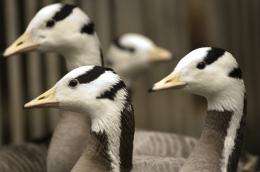
Credit: Martin Dee, UBC

A higher density of blood vessels and other unique physiological features in the flight muscles of bar-headed geese allow them to do what even the most elite of human athletes struggle to accomplish - assert energy at high altitudes, according to a new UBC study.

Named for the dark stripes on the backs of their heads, bar-headed geese are native to South and Central Asia. Often bred in captivity as domestic garden birds, they migrate annually in the wild between India and the plateaus in China and Mongolia, flying over the world's highest mountains on their way.

"They fly at altitudes up to 9,000 metres," says UBC Zoology PhD student Graham Scott. "That's the equivalent of humans running a marathon at the altitudes commercial airlines fly."

Scott and colleagues from UBC and the University of Birmingham in the UK compared the physiology of bar-headed geese to low-altitude waterfowl such as barnacle, pink-footed and greylag geese. Their findings are published today in the journal Proceedings of the Royal Society B: Biological Sciences.

"We found approximately six to 10 per cent more aerobic fibres in bar-headed geese compared to low altitude birds," says Scott. "There were also more capillaries - the body's smallest blood vessels - surrounding these fibres in bar-headed geese."

The team also found that the bar-headed geese's mitochondria - the cell's power sources - are distributed closer to the and therefore closer to capillaries.

"These traits allow oxygen to be carried and diffused more effectively to the flight muscles," says Scott. Since these physical traits are inherent even in bar-headed geese that are bred in captivity and have never flown, the researchers believe they've evolved over time specifically to survive and perform at high altitudes.

Scott had previously found that bar-headed geese also breathe more when oxygen is scarce than most other animals do, suggesting they are fine-tuned for flying high. These insights allow scientists to better understand the limitations of human physiology and potentially find ways to exceed them.

Source: University of British Columbia (news : web)


print this article email this article download pdf blog this article bookmark this article     Stumble it Digg this share on Facebook retweet share on Reddit add to delicious
Rate this story - not rated yet


July 28, 2009 all stories

Comments: 0

not rated yet
  • Stumble this up

  • Digg this

  • share this

  • hide
  • Related Stories


  • hide
  • Relevant PhysicsForums posts

  • Selenocysteine in pH=7
    created 5 hours ago
  • What is the formula for calculating the speed of thought?
    created 10 hours ago
  • What does word "absorption" mean in the intestine?
    created 10 hours ago
  • What is transpulmonary pressure?
    created Nov 24, 2009
  • More from Physics Forums - Biology

Other News

First-ever blueprint of a minimal cell is more complex than expected

First-ever blueprint of a minimal cell is more complex than expected

Biology / Cell & Microbiology

created 2 hours ago | popularity 5 / 5 (5) | comments 0

What are the bare essentials of life, the indispensable ingredients required to produce a cell that can survive on its own? Can we describe the molecular anatomy of a cell, and understand how an entire organism ...


Ecological speciation by sexual selection on good genes: Is speciation adaptive?

Biology / Ecology

created 2 hours ago | popularity not rated yet | comments 0

Darwin suggested that the action of natural selection can produce new species, but 150 years after the publication of his famous book, 'On the Origin of Species', debate still continues on the mechanisms of speciation. New ...


The six elephants in Sierra Leone were shot and "crudely butchered"

S.Leone elephants 'wiped out' by poachers: official

Biology / Ecology

created 4 hours ago | popularity 5 / 5 (2) | comments 2

Poachers "wiped out" the entire elephant herd in Sierra Leone's only wildlife park, wildlife managers said Thursday after police said they had arrested a gang of 10 poachers.


Knockouts in human cells point to pathogenic targets

Knockouts in human cells point to pathogenic targets

Biology / Cell & Microbiology

created 5 hours ago | popularity not rated yet | comments 0

(PhysOrg.com) -- Whitehead researchers have developed a new approach for genetics in human cells and used this technique to identify specific genes and proteins required for pathogens.


Whiteflies sabotage alarm system of plant in distress

Whiteflies sabotage alarm system of plant in distress

Biology / Plants & Animals

created 6 hours ago | popularity 5 / 5 (1) | comments 0

(PhysOrg.com) -- When spider mites attack a bean plant, the plant responds by producing odours which attract predatory mites. These predatory mites then exterminate the spider mite population, thus acting ...