Physicists develop multifunctional storage device for light
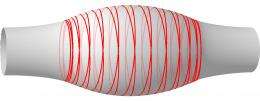
Light is intangible and, in addition, it travels at great velocity. Nevertheless, it can be confined to a very small space by controllably inserting light into a microscopic container surrounded by reflective walls. The light will then be stored by continuous reflections and cannot escape. In the scientific domain, such a small reflective microcavity is termed a microresonator. These microresonators find applications in all areas where the interaction between light and matter shall be enhanced and studied in a controlled manner. An important area of usage is, for example, the laser diode, which has revolutionized telecommunications and optical data storage in the past few decades.
Due to the high velocity of light - in just one second light travels more than seven times around the earth - the number of reflections per second in microresonators reaches up to a few trillion. If, in this situation, the light is to be captured for as little as a millionth of a second, each of the one million reflections that occur during this time may only induce a loss of about one millionth of the light power. An every-day metallic mirror loses a few percent of the light power per reflection and would thus fall short of this requirement by more than a factor of ten thousand.
A further property of microresonators can be explained best through comparison with a string of a musical instrument: akin to the way in which the latter can only vibrate at distinct frequencies which depend on their length, the dimensions of a microresonator determine the specific optical frequencies or colors it can store. However, if, like for the example of a laser, the stored light is to be coupled to atoms, its frequency has to be precisely tuned to the relevant atomic species. The lack of such a possibility of tuning a microresonator is thus a deficiency that impairs many important applications.
At the Johannes Gutenberg University Mainz, Germany, a team of physicists led by Professor Arno Rauschenbeutel have now for the first time realized a microresonator that combines all the desired properties, i.e., long storage time, small volume, and tunability to arbitrary optical frequencies, in a single monolithic device. As reported by the research team in the current edition of the scientific journal Physical Review Letters, to accomplish this feat, it is enough to heat and stretch a standard glass fiber until it reaches about half the diameter of a human hair and then to create a bulge-shaped structure with the help of a laser. Light within this structure is continually reflected at the surface of the fiber and thus travels in a spiral path around the fiber axis. In doing so, the light cannot escape along the fiber because the diameter of the fiber reduces on either side of the structure.
Similar to the motion of a charged particle stored in a magnetic bottle, i.e., a particular spatially varying magnetic field, the light oscillates back and forth along the fiber between two turning points. For this reason, this novel type of microresonator realized by the physicists in Mainz is referred to as a bottle resonator. Tuning the bottle resonator to a specific optical frequency can be accomplished by simply pulling both ends of the supporting glass fiber. The resulting mechanical tension changes the refractive index of the glass, so that depending on the tension, the round-trip of the light is lengthened or shortened.
Because of its exceptional characteristics and its simple design based on glass-fiber technology, the bottle resonator opens up numerous areas of application. “At Mainz University, we aim to use this novel multifunctional microresonator for coupling minute light fields, consisting of single photons, with single atoms,” explains Professor Rauschenbeutel from the QUANTUM, Quantum-, Atom-, and Neutron-Physics-Division at the Institute of Physics of Johannes Gutenberg University in Mainz. “If that were successful, one could realize, for example, a glass fiber based quantum interface between light and matter,” according to Rauschenbeutel. This would then be an important contribution towards quantum communication and the future realization of a quantum computer.
More information: M. Pollinger, D. O' Shea, F. Warken, and A. Rauschenbeutel: Ultrahigh-Q Tunable Whispering-Gallery-Mode Microresonator, in: Phys. Rev. Lett. 103, 053901 (2009), doi: 10.1103/PhysRevLett.103.053901
Source: University Mainz


