Bizarre walking bat has ancient heritage
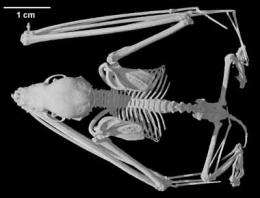
July 29, 2009 Mystacina tuberculata, New Zealand Short-tailed Bat

Mystacina tuberculata, New Zealand Short-tailed Bat. Image: Dr. Nancy Simmons - American Museum of Natural History

A bizarre New Zealand bat that is as much at home walking four-legged on the ground as winging through the air had an Australian ancestor 20 million years ago with the same rare ability, a new study has found.

The discovery overturns a long-held held view that the agile walking and climbing skills of the lesser short-tailed bat - Mystacina tuberculata - evolved in the absence of any ground-dwelling mammal competitors or predators, says an international team of researchers led by Dr Suzanne Hand, a bat expert at the University of New South Wales, Sydney.

Along with the American common vampire bat - Desmodus rotundus - the NZ bat is one of only two of 1,100 bat species worldwide that has a true four-legged walking gait when manoeuvring on the ground.

It uses its wings as forelegs. Its thumb and toe claws have a unique extra talon for extra grip, plus a system of adhesive, gecko-like grooves in the soft, deeply wrinkled soles of its feet,

The team has found that other special and adaptations were also present in one of its extinct rainforest-dwelling Australian ancestors, fossils of which have been found at the rich Riversleigh World Heritage Fossil Site in north-west Queensland, it says in a report published in the journal .

"The lesser short-tailed bat seems to be the sole survivor of an ancient Australian lineage now found only in New Zealand," says Dr Hand. "This study shows that, contrary to existing hypotheses, bats are not overwhelmingly absent from the ground because of competition from, or predation by, other mammals.

"Unlike for birds, there is currently no evidence that any bat has evolved a reduced capacity for flight as a result of isolation on islands.

"Rather, it would seem that walking is rare in bats because it has advantages for them only in special circumstances. Competition with other mammals and pressure from terrestrial predators does not deter modern vampire bats from walking. Likewise, the rich rainforest environment in which the ancestors of the mystacinid evolved in ancient Australia was teeming with ground-based competitors and predators."

A small secretive creature with velvety fur, the lesser short-tailed bat is New Zealand's only terrestrial mammal: it spends long periods on the ground in heavily forested areas, hunting insects and seeking out fruit, nectar and pollen.

It also appears to have evolved a special relationship as a pollinator for the Hades flower, or woodrose, a parasitic plant that produces nectar from blooms near ground level at the base of tree trunks.

Among other unusual traits, the bat is thought to use its teeth and claws to excavate roosting burrows and males appear to compete for mates by gathering for singing competitions in their breeding season.

More information: http://www.biomedcentral.com/1471-2148/9/169

Source: University of New South Wales (news : web)


print this article email this article download pdf blog this article bookmark this article     Stumble it Digg this share on Facebook retweet share on Reddit add to delicious
Rate this story - 4 /5 (4 votes)

Rank Filter

Move the slider to adjust rank threshold, so that you can hide some of the comments.


Display comments: newest first


July 29, 2009 all stories

Comments: 3

4 /5 (4 votes)
  • Stumble this up

  • Digg this

  • share this

  • hide
  • Related Stories

  • Some bat numbers up in Britain
    created Dec 31, 2006 | popularity not rated yet | comments 0
  • Study focuses on bats' hibernation periods
    created Jul 03, 2007 | popularity not rated yet | comments 0
  • Climate change reduces Queensland's bat numbers
    created Jul 09, 2007 | popularity not rated yet | comments 0
  • Bats More than Just Another Pretty Face
    created Oct 30, 2006 | popularity not rated yet | comments 0
  • Missing link shows bats flew first, developed echolocation later
    created Feb 13, 2008 | popularity not rated yet | comments 0


  • hide
  • Relevant PhysicsForums posts

  • What is transpulmonary pressure?
    created 23 hours ago
  • Is there a gay gene?
    created Nov 23, 2009
  • Super quick question about Starling forces?
    created Nov 22, 2009
  • Questions about diffusion
    created Nov 22, 2009
  • More from Physics Forums - Biology

Other News

Redback spiders were first spotted in Japan in 1995

Venomous Aussie redback spiders invading Japan

Biology / Ecology

created 1hour ago | popularity not rated yet | comments 0

Australia's venomous redback spiders are on the march in Japan, where they are believed to have arrived years ago as stowaways on cargo ships, a wildlife expert warned Wednesday.


Study explores violent world of raptors

Biology / Plants & Animals

created 1hour ago | popularity not rated yet | comments 0

A journey that started with a box of bird feet carried three Montana State University graduate students into the gruesome world of raptors and led to their findings being published in a prominent journal.


Asian carp may have breached barrier protecting Lake Michigan

Biology / Ecology

created 10 hours ago | popularity 5 / 5 (3) | comments 0

Two feared species of Asian carp have zoomed beyond the $9 million electric barriers built to keep them out of Lake Michigan. Now, the only thing left between the carp and the Great Lakes is a lock and dam in southern Chicago.


Got a pain? -- Have a cup of Brazilian mint

Biology / Plants & Animals

created 11 hours ago | popularity 4.6 / 5 (7) | comments 0

For thousands of years it has been prescribed by traditional healers in Brazil to treat a range of ailments from headaches and stomach pain to fever and flu.


Opposites attract: Monkeys choose mating partners with different genes

Biology / Evolution

created 11 hours ago | popularity 5 / 5 (1) | comments 0

The world's largest species of monkey 'chooses' mates with genes that are different from their own to guarantee healthy and strong offspring, according to a new research study.