Scientists discover Amazon river is 11 million years old
July 29, 2009 Amazon river

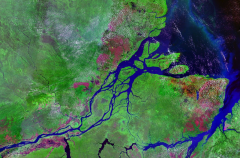
Satellite image of mouths of Amazon river in Brazil. Image: Wikimedia Commons

Researchers at the University of Liverpool have discovered that the Amazon river, and its transcontinental drainage, is around 11 million years old and took its present shape about 2.4 million years ago.

University of Liverpool researchers, in collaboration with the University of Amsterdam and Petrobras, the national oil company of Brazil, analysed sedimentary material taken from two boreholes near the mouth of the river to calculate the age of the Amazon river and the Amazon deep sea fan.

Prior to this study the exact age of the Amazon, one of the two largest rivers in the world, was not known. Until recently the Amazon Fan, a submarine sediment column around 10km thick, had proven difficult to penetrate. New exploration efforts by Petrobas, however, have lea to two new boreholes being drilled near the mouth of the Amazon - one 2.5miles (4.5km) below sea level - which resulted in new sedimentological and paleontological analysis of samples from the river sediment.

"River records provide a unique insight into the palaeoclimate and geography of the hinterland," said Jorge Figueiredo from the University's Department of and Sciences

"This new research has large implications for our understanding of South American paleogeography and the evolution of in Amazonia and on the Atlantic coast. The origin of the is a defining moment: a new ecosystem came into being at the same time as the uplifting Andes formed a geographic divide."

The study was published in the scientific journal, Geology, in July 2009.

Source: University of Liverpool (news : web)


Rate this story - 4.4 /5 (7 votes)

Rank Filter

Move the slider to adjust rank threshold, so that you can hide some of the comments.


Display comments: newest first

  • RayCherry - Jul 29, 2009
    • Rank: not rated yet
    I wonder if any human(oid) remains can be found amongst all that sediment where ancient peat 'bogs' formed. With all the vegetation so assist the formation of peat, and the river to attract all forms of animal life, some evidence should remain and could be as valuable, and as old, as that found in Africa in the last decade.
  • Klaus - Jul 29, 2009
    • Rank: 5 / 5 (2)
    Humans hadn't migrated to the West until about 20,000 - 30,000 years ago.

  • ThomasS - Jul 30, 2009
    • Rank: 3 / 5 (1)
    Was this not on physorg before? Im quite sure..
  • twango - Jul 30, 2009
    • Rank: 4 / 5 (1)
    And yet another story (2006) states uncategorically that "Amazon River Once Flowed in Opposite Direction" during a period "between 65 million and 145 million years ago."

    Science journalism doesn't do anyone a favor when it treats hypotheses as FACT. Failing to address such contradictions within 'news' only serves to confuse, discourage, and skeptify the public about science.

July 29, 2009 all stories

Comments: 4

4.4 /5 (7 votes)

  • hide
  • Related Stories

  • The Amazon River is 11 million years old
    created Jul 07, 2009 | popularity not rated yet | comments 0
  • Amazon River Once Flowed in Opposite Direction
    created Oct 24, 2006 | popularity not rated yet | comments 0
  • Earth's crust pulsates in the Amazon basin
    created Sep 17, 2005 | popularity not rated yet | comments 0
  • Amazonian amphibian diversity traced to Andes
    created Mar 10, 2009 | popularity not rated yet | comments 0
  • Amazon.com in $850M deal for Web shoe store Zappos
    created Jul 23, 2009 | popularity not rated yet | comments 0


  • hide
  • Relevant PhysicsForums posts

  • Carbon Dioxide emissions question
    created Feb 08, 2010
  • Photosynthesis vs. carbonization
    created Feb 07, 2010
  • Sheep's footprints
    created Feb 05, 2010
  • How did Victorians estimate the ages of fossils?
    created Feb 03, 2010
  • More from Physics Forums - Earth

Other News

Climate 'Tipping Points' May Arrive Without Warning, Says Top Forecaster

Space & Earth / Environment

created 7 hours ago | popularity 3.4 / 5 (5) | comments 5 | with audio podcast

(PhysOrg.com) -- A new University of California, Davis, study by a top ecological forecaster says it is harder than experts thought to predict when sudden shifts in Earth's natural systems will occur -- a worrisome finding ...


Rho Ophiuchus cloud

Professor: We have a 'moral obligation' to seed universe with life

Space & Earth / Astronomy

created 18 hours ago | popularity 3.2 / 5 (23) | comments 47 | with audio podcast report

(PhysOrg.com) -- Eventually, the day will come when life on Earth ends. Whether that’s tomorrow or five billion years from now, whether by nuclear war, climate change, or the Sun burning up its fuel, the last ...


A new 3-D map of the interstellar gas within 300 parsecs from the sun

A new 3D map of the interstellar gas within 300 parsecs from the Sun

Space & Earth / Astronomy

created 10 hours ago | popularity 5 / 5 (4) | comments 0 | with audio podcast

(PhysOrg.com) -- Astronomy & Astrophysics is publishing new 3D maps of the interstellar gas in the local area around our Sun. A French-American team of astronomers presents new absorption measurements toward ...


38 percent of world's surface in danger of desertification

38 percent of world's surface in danger of desertification

Space & Earth / Environment

created 4 hours ago | popularity 2.3 / 5 (3) | comments 4

A team of Spanish researchers has measured the degradation of the planet's soil using the Life Cycle Assessment (LCA), a scientific methodology that analyses the environmental impact of human activities, and ...


Russian Soyuz TMA-17 rocket blasts off to the International Space Station

Russia wants to charge more for rides to space: report

Space & Earth / Space Exploration

created 21 hours ago | popularity 5 / 5 (2) | comments 5

Russia, which is set to hold a monopoly on flights to the international space station (ISS), wants to charge more for rides on its Soyuz rocket, the space agency head said Tuesday.