150 years later, Darwin vindicated... by jellyfish: Researchers link tiny sea creatures to large-scale ocean mixing
July 29, 2009
Caltech researchers link tiny sea creatures to large-scale ocean mixing

Enlarge

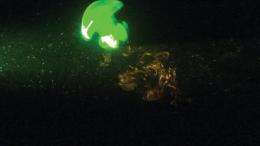
This is an image of planar laser induced fluorescence measurement of a Mastigias sp. jellyfish during a night dive in Jellyfish Lake, Palau. Credit: Monty Graham and Kakani Katija

(PhysOrg.com) -- Creatures large and small may play an important role in the stirring of ocean waters, according to a study released Wednesday that confirms a theory advanced by Charles Darwin.

Using a combination of theoretical modeling, energy calculations, and field observations, researchers from the California Institute of Technology (Caltech) have for the first time described a mechanism that explains how some of the ocean's tiniest swimming animals can have a huge impact on large-scale ocean mixing.

Their findings are being published in the July 30 issue of the journal Nature.

"We've been studying swimming animals for quite some time," says John Dabiri, a Caltech assistant professor of aeronautics and bioengineering who, along with Caltech graduate student Kakani Katija, discovered the new mechanism. "The perspective we usually take is that of how the ocean—by its currents, temperature, and chemistry—is affecting the animals. But there have been increasing suggestions that the inverse is also important—how the animals themselves, via swimming, might impact the ocean environment."

Specifically, Dabiri says, scientists have increasingly been thinking about how and whether the animals in the ocean might play a role in larger-scale ocean mixing, the process by which various layers of water interact with one another to distribute heat, nutrients, and gasses throughout the oceans.
Caltech researchers link tiny sea creatures to large-scale ocean mixing
Enlarge

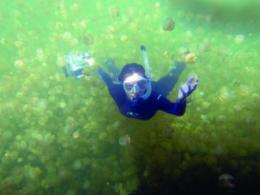
This is an image of a diver in aggregation of Mastigias sp. jellyfish in Jellyfish Lake, Palau. Credit: Photo courtesy Monty Graham.

Dabiri notes that oceanographers have previously dismissed the idea that animals might have a significant effect on ocean mixing, saying that the viscosity of water would damp out any turbulence created, especially by small planktonic animals. "They said that there was no mechanism by which these animals could impact large-scale ocean mixing," he notes.

But Dabiri and Katija thought there might be a mechanism that had been overlooked—a mechanism they call Darwinian mixing, because it was first discovered and described by Charles Darwin. (No, not that Darwin; his grandson.)

"Darwin's grandson discovered a mechanism for mixing similar in principle to the idea of drafting in aerodynamics," Dabiri explains. "In this mechanism, an individual organism literally drags the surrounding water with it as it goes."

Using this idea as their basis, Dabiri and Katija did some mathematical simulations of what might happen if you had many small animals all moving at more or less the same time, in the same direction. After all, each day, billions of tiny krill and copepods migrate hundreds of meters from the depths of the ocean toward the surface. Darwin's mechanism would suggest that they drag some of the colder, heavier bottom water up with them toward the warmer, lighter water at the top. This would create instability, and eventually, the water would flip, mixing itself as it went.

What the Caltech researchers also found was that the water's viscosity enhances Darwin's mechanism and that the effects are magnified when you're dealing with such minuscule creatures as krill and copepods. "It's like a human swimming through honey," Dabiri explains. "What happens is that even more fluid ends up being carried up with a copepod, relatively speaking, than would be carried up by a whale."

"This research is truly reflective of the type of exciting, without-boundaries research at which Caltech engineering professors excel—in this case a deep analysis of the movement of fluid surrounding tiny ocean creatures leading to completely revelatory insights on possible mechanisms of global ocean mixing," says Ares Rosakis, chair of the Division of Engineering and Applied Science at Caltech.

Caltech researchers link tiny sea creatures to large-scale ocean mixing
Enlarge

This image shows dye measurement of induced fluid drift caused by a Mastigias sp. jellyfish in Jellyfish Lake, Palau. Credit: Monty Graham and Kakani Katija

To verify the findings from their simulations, Katija and collaborators Monty Graham (from the Dauphin Island Sea Laboratory), Jack Costello (from Providence College), and Mike Dawson (from the University of California, Merced) traveled to the island of Palau, where they studied this animal-led transport of water--otherwise known as induced drift--among jellyfish, which are the focus of much of Dabiri's work.

"From a fluid mechanics perspective, this study had less to do with the fact that they're jellyfish, and more to do with the fact that they're solid objects moving through water," Dabiri explains.

Katija's jellyfish experiments involved putting fluorescent dye in the water in front of the sea creatures, and then watching what happened to that dye—or, to be more specific, to the water that took up the dye—as the jellyfish swam. And, indeed, rather than being left behind the jellyfish—or being dissipated in turbulent eddies—the dye travelled right along with the swimming creatures, following them for long distances.

These findings verified that, yes, swimming animals are capable of carrying bottom water with them as they migrate upward, and that movement indeed creates an inversion that results in ocean mixing. But what the findings didn't address was just how much of an impact this type of ocean mixing—performed by impossibly tiny sea creatures—could have on a large scale.

After a series of calculations, Dabiri and Katija were able to estimate the impact of this so-called biogenic ocean mixing. And, Dabiri says, it's quite a significant impact.

"There are enough of these animals in the ocean," he notes, "that, on the whole, the global power input from this process is as much as a trillion watts of energy—comparable to that of wind forcing and tidal forcing."

In other words, the amount of power that copepods and krill put into ocean mixing is on the same scale as that of winds and tides, and thus their impact is expected to be on a similar scale as well.

And while these numbers are just estimates, Dabiri says, they are likely to be conservative estimates, having been "based on the fluid transport induced by individual animals swimming in isolation." In the ocean, these individual contributions to fluid transport may actually interact with one another, and amplify how far the ocean waters can be pulled upward.

In addition, says Dabiri, they have yet to consider the effects of such things as fecal pellets and marine snow (falling organic debris), which no doubt pull surface water with them as they drift downward. "This may have an impact on carbon sequestration on the ocean floor," says Dabiri. "It's something we need to look at in the future."

Dabiri says the next major question to answer is how these effects can be incorporated into computer models of the global ocean circulation. Such models are important for simulations of global climate-change scenarios.

Source: California Institute of Technology

4.6 /5 (22 votes)  

Filter


Move the slider to adjust rank threshold, so that you can hide some of the comments.


Display comments: newest first

Mandan
Jul 29, 2009

Rank: 5 / 5 (3)
James Lovelock, Lynn Margulis--

Gaia is alive and welling.
QubitTamer
Jul 29, 2009

Rank: 1 / 5 (4)
wow more common sense physics verified by needless experiments... Wow they discovered that drag does indeed DRAG!!!
Fakeer
Jul 29, 2009

Rank: 5 / 5 (3)
Yea #2, it's so ridiculously elementary that I guess is the reason why it's being published in such a two-bit tabloid journal called Nature. I hear peer review there is a joke . . .
Mauricio
Jul 29, 2009

Rank: 4 / 5 (4)
The title has little to do with the content, very inappropriate.
Velanarris
Jul 30, 2009

Rank: 5 / 5 (1)
The title has little to do with the content, very inappropriate.

What? The title is just about on the money. You're just angry you were fooled as to which Darwin they were referring to.
RayCherry
Jul 30, 2009

Rank: not rated yet
Your head is connected to your neck, but also to your toe.

The Mississippi is connected to the Dead Zone in the Gulf of Mexico, but also to the food chain of the Atlantic, and maybe (by some strange consequence) to the temperature and direction of the Gulf Stream that affects the weather in Europe and the Arctic where the ice sheet is shrinking and adding (cold?) water to the Pacific.

El Ninõ starts in Alabama? Tennessee? Canada?

"mi casa es su casa" :)
galoot
Jul 30, 2009

Rank: 3 / 5 (2)
Its not 150 years on if it isn't the original Darwin...therefore Title is completely wrong.
Velanarris
Jul 31, 2009

Rank: not rated yet
Its not 150 years on if it isn't the original Darwin...therefore Title is completely wrong.

Charles Darwin Sr. developed the theory that organisms of all size impact their environment in extraordinary ways. His grandson, also named Charles Darwin discovered Darwiniian mixing. So I don't see why you're having issues with the title.
galoot
Jul 31, 2009

Rank: not rated yet
The article is about ocean mixing therefore the title is wrong. Its not 150 years.
jimbo92107
Aug 03, 2009

Rank: not rated yet
wow more common sense physics verified by needless experiments... Wow they discovered that drag does indeed DRAG!!!


We are pleased to announce that life is, in fact, a drag.
Rank 4.6 /5 (22 votes)
Relevant PhysicsForums posts
  • Do some geologists actually act a lot like Randy Marsh?
    createdFeb 11, 2012
  • Discrepancy between oxygen and carbon-dioxide levels
    createdFeb 09, 2012
  • where gems are found in the world
    createdFeb 09, 2012
  • Wind Waves in Reservoir ~ Wind run-up and Wind set-up
    createdFeb 08, 2012
  • Balance of oxygen in the atmosphere
    createdFeb 01, 2012
  • The case for a methanol-based economy
    createdJan 30, 2012
  • More from Physics Forums - Earth

More news stories

Climate change causes harmful algal blooms in North Atlantic: study

Warming oceans and increases in windiness could be causing of an abundance of harmful algal blooms in the North Atlantic Ocean and North Sea, according to new research.

Space & Earth / Environment

created 44 minutes ago | popularity not rated yet | comments 0

Latin America mining boom clashes with conservation

Latin America is experiencing a mining boom as prices rise fuelled by a hike in global demand, but the region is also being hit by a wave of violent protests, strikes and rallies by environmentalists.

Space & Earth / Environment

created 23 hours ago | popularity 5 / 5 (1) | comments 1

Salvage workers begin pumping fuel from Italian shipwreck

Salvage workers Sunday began pumping fuel from the shipwrecked Italian cruise liner Costa Concordia, a day ahead of schedule, officials said.

Space & Earth / Environment

created 15 hours ago | popularity 5 / 5 (2) | comments 0

Political leaders play key role in how worried Americans are by climate change: study

More than extreme weather events and the work of scientists, it is national political leaders who influence how much Americans worry about the threat of climate change, new research finds.

Space & Earth / Environment

created Feb 06, 2012 | popularity 5 / 5 (8) | comments 76

NASA budget will axe Mars deal with Europe: scientists

US President Barack Obama's budget proposal to be submitted next week for 2013 will cut NASA's budget by 20 percent and eliminate a major partnership with Europe on Mars exploration, scientists said Thursday.

Space & Earth / Space Exploration

created Feb 10, 2012 | popularity 5 / 5 (4) | comments 58


Rapunzel, Leonardo and the physics of the ponytail

(PhysOrg.com) -- New research provides the first mathematical understanding of the shape of a ponytail and could have implications for the textile industry, computer animation and personal care products.

Cognitive impairment in older adults often unrecognized in the primary care setting

A new study published in the Journal of the American Geriatrics Society reveals that brief cognitive screenings combined with offering further evaluation increased new diagnoses of cognitive impairment in older veterans two to ...

Hacker claims porn site users compromised

A hacker claims to have compromised the personal information of more than 350,000 users after breaking into a disused website operated by pornography provider Brazzers.

Primary care program helps obese teen girls manage weight, improve body image and behavior

Teenage girls gained less weight, improved their body image, ate less fast food, and had more family meals after participating in a 6- month program that involved weekly peer meetings, consultations with primary care providers ...

AT&T customers surprised by 'unlimited data' limit

(AP) -- Mike Trang likes to use his iPhone 4 as a GPS device, helping him get around in his job. Now and then, his younger cousins get ahold of it, and play some YouTube videos and games.

Scientists discover molecular secrets of 2,000-year-old Chinese herbal remedy

For roughly two thousand years, Chinese herbalists have treated Malaria using a root extract, commonly known as Chang Shan, from a type of hydrangea that grows in Tibet and Nepal. More recent studies suggest that halofuginone, ...