Scientists create energy-burning brown fat in mice
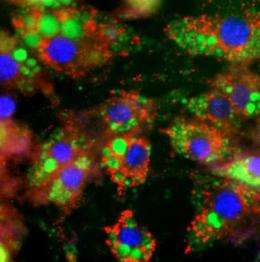
(PhysOrg.com) -- Researchers at Dana-Farber Cancer Institute have shown that they can engineer mouse and human cells to produce brown fat, a natural energy-burning type of fat that counteracts obesity. If such a strategy can be developed for use in people, the scientists say, it could open a novel approach to treating obesity and diabetes.
A team led by Bruce Spiegelman, PhD, has identified both parts of a molecular switch that normally causes some immature muscle cells in the embryo to become brown fat cells. With this switch in hand, the scientists showed they could manipulate it to force other types of cells in the laboratory to produce brown fat, known as Brown Adipose Tissue (BAT). Their findings are being reported in the journal Nature on its Web site as an advanced online publication on July 29.
The scientists then transplanted these synthetic brown fat precursors, known as eBAT (engineered BAT), into adult mice to augment their innate stores of brown fat. Tests showed that the brown fat transplants were burning caloric energy at a high rate -- energy that otherwise would have been stored as fat in white adipose tissue.
"Since brown fat cells have very high capacity to dissipate excess energy and counteract obesity, eBAT has a very high potential for treating obesity," said Shingo Kajimura, PhD, lead author of the paper. "We are currently working on this."
Excess caloric energy in the diet is stored in white fat calls that pile up in the body, particularly in the thighs and abdomen. The accumulated fat content in overweight people puts stress on these cells, which give out signals that cause inflammation in body organs and the circulatory system, creating risks of heart disease and diabetes.
Brown fat, by contrast, works in an opposite fashion; it evolved to protect animals from cold conditions and prevent obesity. Brown fat cells are equipped with a large supply of mitochondria -- tiny organelles that use oxygen to burn sugar from the diet to generate heat, rather than store the energy as fat.
Scientists have long thought that brown fat was present in young animals and human newborns but virtually absent in human adults. Recently, however, researchers have used modern PET (positron emission tomography) scanners -- which detect tissue that is actively absorbing sugar -- to search for deposits of brown fat in adults. Such experiments have revealed unexpectedly large amounts of brown fat scattered through the neck and chest areas.
In 2007, Spiegelman's team, led by Patrick Seale, PhD, who is the second author of the new Nature paper, discovered a protein, PRDM16, that serves as a switch that determines whether immature muscle cells will develop into mature muscle cells or become brown fat cells.
But this was not the whole story. The scientists suspected that PRDM16 worked with another unknown protein to initiate brown fat development. This proved to be the case. In the new experiments, the Spiegelman group found that PRMD16 works in tandem with the protein C/EBP-beta, and only as a two-part unit are they sufficient to jump-start brown fat development in several types of cells.
To find out if the PRDM16-C/EBP-beta switch could change the identity of other types of cells, forcing them to become brown fat cells, the researchers used viruses to transfer the switch into embryonic mouse connective tissue cells called fibroblasts. They also installed the switch into adult mouse skin cells, and into human skin cells isolated from foreskins removed from newborns during circumcision.
In all three cases, the fibroblasts produced mature brown fat cells. The scientists then transplanted the cells into mice, where they produced brown fat tissue. PET scans confirmed that the new brown fat tissue was burning excess energy in the animals, as they should. The experiments did not test whether the extra brown fat actually protected the mice from becoming obese.
Spiegelman said the results "give a lot more credence" to efforts to manipulate the brown fat switch as a potential means of treating people with obesity and diabetes. One strategy would be to remove some tissue from the patient, add the PRDM16-C/EBP switch, and return it to the patient where it would manufacture additional brown fat.
A more conventional possibility, Spiegelman said, would be to administer a drug to the patient that would ramp up the production of brown fat without the need for a transplant. "If we can find a hormone that does that, it's reasonable to think that it might provide a direct anti-obesity treatment."
Source: Dana-Farber Cancer Institute


