Nanotubes take flight: Scientists use nanomaterials to grow flying carpets, 'odako' kites
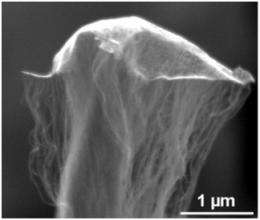
(PhysOrg.com) -- With products that range from carpets to kites, you’d think Rice University chemist Bob Hauge was running a department store. What he's really running is a revolution in the world of carbon nanotechnology.
In a paper published this month in Nano Research, Hauge's Rice University team describes a method for making "odako," bundles of single-walled carbon nanotubes (SWNT) named for the traditional Japanese kites they resemble. It may lead to a way to produce meter-long strands of nanotubes, which by themselves are no wider than a piece of DNA.
Hauge, a distinguished faculty fellow in chemistry at Rice's Richard E. Smalley Institute for Nanoscale Science and Technology, and his co-authors, graduate students Cary Pint and Noe Alvarez, explained the odako after which the bundles are named are gigantic kites that take many hands to fly, hence the many lines that trail from them.
In this case, the lines are nanotubes, hollow cylinders of pure carbon. Individually, they're thousands of times smaller than a living cell, but Hauge's new method creates bundles of SWNTs that are sometimes measured in centimeters, and he said the process could eventually yield tubes of unlimited length.
Large-scale production of nanotube threads and cables would be a godsend for engineers in almost every field. They could be used in lightweight, superefficient power-transmission lines for next-generation electrical grids, for example, and in ultra-strong and lightning-resistant versions of carbon-fiber materials found in airplanes. Hauge said the SWNT bundles may also prove useful in batteries, fuel cells and microelectronics.
To understand how Hauge makes nanokites, it helps to have a little background on flying carpets.
Last year, Hauge and colleagues found they could make compact bundles of nanotubes starting with the same machinery the U.S. Treasury uses to embed paper money with unique markings that make the currency difficult to counterfeit.
Hauge and his team -- which included senior research fellow Howard Schmidt and Professor Matteo Pasquali, both of Rice's Department of Chemical and Biomolecular Engineering; graduate students Pint and Sean Pheasant; and Kent Coulter of San Antonio's Southwest Research Institute -- used this printing process to create thin layers of iron and aluminum oxide on a Mylar roll. They then removed the layers and ground them into small flakes.
Here's where the process took off. In a mesh cage placed into a furnace, the metallic flakes would lift off and "fly" in a flowing chemical vapor. As they flew, arrays of nanotubes grew vertically from the iron particles in tight, forest-like formations. When done cooking and viewed under a microscope, the bundles looked remarkably like the pile of a carpet.
While other methods used to grow SWNTs had yielded a paltry 0.5 percent ratio of nanotubes to substrate materials, Hauge's technique brought the yield up to an incredible 400 percent. The process could facilitate large-scale SWNT growth, Pint said.
In the latest research, the team replaced the Mylar with pure carbon. In this setup, the growing nanotubes literally raise the roof, lifting up the iron and aluminum oxide from which they’re sprouting while the other ends stay firmly attached to the carbon. As the bundle of tubes grows higher, the catalyst becomes like a kite, flying in the hydrogen and acetylene breeze that flows through the production chamber.
Hauge and his team hope to follow up their work on flying carpets and nanokites with the holy grail of nanotube growth: a catalyst that will not die, enabling furnaces that churn out continuous threads of material.
"If we could get these growing so they never stop - so that, at some point, you pull one end out of the furnace while the other end is still inside growing - then you should be able to grow meter-long material and start weaving it," he said.
More information:
Read "Odako growth of dense arrays of single-walled carbon nanotubes attached to carbon surfaces" here: tinyurl.com/nanokite
Read "Synthesis of High Aspect-Ratio Carbon Nanotube 'Flying Carpets' from Nanostructured Flake Substrates" here: tinyurl.com/nanocarpet
Read "Role of Water in Super Growth of Single-Walled Carbon Nanotube Carpet" here: tinyurl.com/nanowater
Provided by Rice University (news : web)


