Breaking the Planck's law, at the nanoscale
July 29, 2009 by David L. Chandler
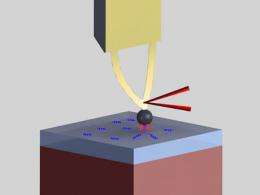
A diagram of the setup, including a cantilever from an atomic force microscope, used to measure the heat transfer between objects separated by nanoscale distances. Courtesy / Sheng Shen
(PhysOrg.com) -- A well-established physical law describes the transfer of heat between two objects, but some physicists have long predicted that the law should break down when the objects are very close together. Scientists had never been able to confirm, or measure, this breakdown in practice. For the first time, however, MIT researchers have achieved this feat, and determined that the heat transfer can be 1,000 times greater than the law predicts.
The new findings could lead to significant new applications, including better design of the recording heads of the hard disks used for computer data storage, and new kinds of devices for harvesting energy from heat that would otherwise be wasted.
Planck's blackbody radiation law, formulated in 1900 by German physicist Max Planck, describes how energy is dissipated, in the form of different wavelengths of radiation, from an idealized non-reflective black object, called a blackbody. The law says that the relative thermal emission of radiation at different wavelengths follows a precise pattern that varies according to the temperature of the object. The emission from a blackbody is usually considered as the maximum that an object can radiate.
The law works reliably in most cases, but Planck himself had suggested that when objects are very close together, the predictions of his law would break down. But actually controlling objects to maintain the tiny separations required to demonstrate this phenomenon has proved incredibly difficult.
"Planck was very careful, saying his theory was only valid for large systems," explains Gang Chen, MIT's Carl Richard Soderberg Professor of Power Engineering and director of the Pappalardo Micro and Nano Engineering Laboratories. "So he kind of anticipated this [breakdown], but most people don't know this."
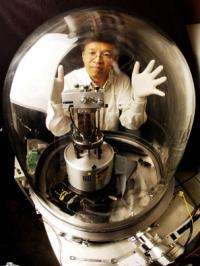
Professor Gang Chen with the vacuum chamber used in this research. Courtesy / Gang Chen
Part of the problem in measuring the way energy is radiated when objects are very close is the mechanical difficulty of maintaining two objects in very close proximity, without letting them actually touch. Chen and his team, graduate student Sheng Shen and Columbia University Professor Arvind Narayaswamy, solved this problem in two ways, as described in a paper to be published in the August issue of the journal Nano Letters (available now online). First, instead of using two flat surfaces and trying to maintain a tiny gap between them, they used a flat surface next to a small round glass bead, whose position is easier to control. "If we use two parallel surfaces, it is very hard to push to nanometer scale without some parts touching each other," Chen explains, but by using a bead there is just a single point of near-contact, which is much easier to maintain. Then, they used the technology of the bi-metallic cantilever from an atomic-force microscope to measure the temperature changes with great precision.
"We tried for many years doing it with parallel plates," Chen says. But with that method, they were unable to sustain separations of closer than about a micron (one millionth of a meter). By using the glass (silica) beads, they were able to get separations as small as 10 nanometers (10 billionths of a meter, or one-hundredth the distance achieved before), and are now working on getting even closer spacings.
Professor Sir John Pendry of Imperial College London, who has done extensive work in this field, calls the results "very exciting," noting that theorists have long predicted such a breakdown in the formula and the activation of a more powerful mechanism.
"Experimental confirmation has proved elusive because of the extreme difficulty in measuring temperature differences over very small distances," Pendry says. "Gang Chen's experiments provide a beautiful solution to this difficulty and confirm the dominant contribution of near field effects to heat transfer."
In today's magnetic data recording systems - such as the hard disks used in computers - the spacing between the recording head and the disk surface is typically in the 5 to 6 nanometer range, Chen says. The head tends to heat up, and researchers have been looking for ways to manage the heat or even exploit the heating to control the gap. "It's a very important issue for magnetic storage," he says. Such applications could be developed quite rapidly, he says, and some companies have already shown a strong interest in this work
The new findings could also help in the development of new photovoltaic energy conversion devices to harness photons emitted by a heat source, called thermophovoltaic, Chen says. "The high photon flux can potentially enable higher efficiency and energy density thermophovoltaic energy converters, and new energy conversion devices," he says.
The new findings could have "a broad impact," says Shen. People working with devices using small separations will now have a clear understanding that Planck's law "is not a fundamental limitation," as many people now think, he says. But further work is needed to explore even closer spacings, Chen says, because "we don't know exactly what the limit is yet" in terms of how much heat can be dissipated in closely spaced systems. "Current theory will not be valid once we push down to 1 nanometer spacing."
And in addition to practical applications, he says, such experiments "might provide a useful tool to understand some basic physics."
More information: Nano Letters paper.
Provided by Massachusetts Institute of Technology (news : web)
-
Nano-tip could play integral part in heat-assisted data storage devices
Jun 09, 2006 |
not rated yet |
0
-
Taming tiny, unruly waves for nano optics
Oct 08, 2007 |
not rated yet |
0
-
Scientists show quantum systems could flout physics law
Jun 02, 2008 |
not rated yet |
0
-
Thermoelectric materials are 1 key to energy savings
Nov 20, 2007 |
not rated yet |
0
-
Discovery Captures, Converts Heat
Apr 06, 2005 |
not rated yet |
0
-
Engineers build first sub-10-nm carbon nanotube transistor
Feb 01, 2012 |
4.9 / 5 (33) |
30
-
Something old, something new: Evolution and the structural divergence of duplicate genes
Jan 31, 2012 |
4.6 / 5 (7) |
1
-
The hidden nanoworld of ice crystals: Revealing the dynamic behavior of quasi-liquid layers
Jan 30, 2012 |
5 / 5 (4) |
1
-
Stock market network reveals investor clustering
Jan 27, 2012 |
3.9 / 5 (23) |
8
-
Of microchemistry and molecules: Electronic microfluidic device synthesizes biocompatible probes
Jan 26, 2012 |
5 / 5 (2) |
0
-
what is electricity???
4 hours ago
-
Can Plasma Be Solid
5 hours ago
-
What is delta Δ ?
5 hours ago
-
Need some help understanding HertzĀKnudsen formula
6 hours ago
-
Anatomy of Fat man: implosion-critical bomb
8 hours ago
-
what makes two sounds similar???
8 hours ago
- More from Physics Forums - General Physics
More news stories
Explained: Sigma
It's a question that arises with virtually every major new finding in science or medicine: What makes a result reliable enough to be taken seriously? The answer has to do with statistical significance -- but ...
Feb 09, 2012 |
5 / 5 (20) |
76
Quantum physicist explains $100K offer for proof scaled-up quantum computing is impossible
(PhysOrg.com) -- MIT researcher Scott Aaronson has certainly riled the physics community with his offer this past Friday, of $100,000 to anyone who can prove that scaled-up quantum computing is impossible. ...
Diamond light, brighter than the sun
Its the size of five football pitches and generates light 10 billion times brighter than the sun. As the Diamond Light Source celebrates its tenth anniversary this year, Penny Bailey visits one of the ...
Feb 07, 2012 |
4.1 / 5 (10) |
18
|
Physicists 'record' magnetic breakthrough
An international team of scientists has demonstrated a revolutionary new way of magnetic recording which will allow information to be processed hundreds of times faster than by current hard drive technology.
Feb 07, 2012 |
4.6 / 5 (43) |
15
|
Hints of the Higgs - papers are submitted
Back in December 2011, the ATLAS and CMS experiments at CERN presented some exciting results that provided tantalising hints of the Higgs boson.
Feb 08, 2012 |
4.3 / 5 (8) |
10
Scientists discover molecular secrets of 2,000-year-old Chinese herbal remedy
For roughly two thousand years, Chinese herbalists have treated Malaria using a root extract, commonly known as Chang Shan, from a type of hydrangea that grows in Tibet and Nepal. More recent studies suggest that halofuginone, ...
New method to examine batteries -- MRI from the inside
There is an ever-increasing need for advanced batteries for portable electronics, such as phones, cameras, and music players, but also to power electric vehicles and to facilitate the distribution and storage of energy derived ...
Google might launch Drive for cloud storage soon
(PhysOrg.com) -- Google's next big move, according to the Wall Street Journal, is a cloud storage service called Drive. Hardly first to the plate, Google is simply catching up to introducing its cloud reposi ...
A mitosis mystery solved: How chromosomes align perfectly in a dividing cell
Although the process of mitotic cell division has been studied intensely for more than 50 years, Whitehead Institute researchers have only now solved the mystery of how cells correctly align their chromosomes during symmetric ...
Lab study raises questions over nano-particle impact
Tests involving chickens have raised questions about the impact on health from engineered nano-particles, the ultra-fine grains commonly used in drugs and processed foods, scientists said on Sunday.
Starve a virus, feed a cure? Findings show how some cells protect themselves against HIV
A protein that protects some of our immune cells from the most common and virulent form of HIV works by starving the virus of the molecular building blocks that it needs to replicate, according to research published online ...

Jul 29, 2009
Rank: not rated yet
"By using the glass (silica) beads, they were able to get separations as small as 10 nanometers (10 billionths of a meter, or one-hundredth the distance achieved before), and are now working on getting even closer spacings."
However, later on we learn:
"...the spacing between the recording head and the disk surface is typically in the 5 to 6 nanometer range"
So if a hard disk head has a spacing two times closer than they could manage with the glass bead, why didn't they just use a hard drive in their experiments?
Jul 29, 2009
Rank: 5 / 5 (2)
Considering that the hard disk head is flying at enormous speed over the surface of the disk platter, I quess it would be next to impossible to measure heat energy transfer between the head and the platter. Also I think that the 'wind' created by the flying is not helping any with that said measuring.
Jul 29, 2009
Rank: not rated yet
I'm sure this is correct. When a hard drive is not spinning, the heads are resting against the platters using springs. It's only when the hard drive spins up that a film of air, created by the Bernoulli effect (which also helps generate lift for aircraft), lifts and actually 'flies' the heads just above the spinning platters. I would think it would be impossible to make the required heat transfer measurements when one surface is rotating at something like 100 feet per second...
Jul 29, 2009
Rank: not rated yet
Jul 30, 2009
Rank: not rated yet
Jul 30, 2009
Rank: 1 / 5 (1)
Utter bullshit.
Planck called it his backbody THEORY. What fool called it a LAW? What complete dogmatic imbecile working at an academic engineering 'corporation' first called it a law? Find that asshole and you find a man who colors theories into laws. Hold that man down and slap him about until near death. Maybe he might get the hint that anchoring things that are theories into law is a severe detriment to the advancement of science, as it makes people think that theories are inescapable, when in fact, many will fail under scrutiny.
Some of the so called 'laws of science' or physics even have 100's and up to thousands of anomalies that they don't deal with. If you feel that is false-start looking------- you will find them.
The idea of allowing dogmatic religious standards into science really needs to be eradicated. The act of calling a theory a law, which is very common in science..this is religion. Dogmatism. Never forget that, and banish the ideas of 'Theories as Laws' out of your thinking. Forever. Otherwise, science will never advance.
In essence, the idea of calling any scientific theory a law needs to be abolished.
Completely.
Jul 30, 2009
Rank: not rated yet
Is a form of conductive heat exchange.
Planck's Theory addresses radiative heat transfer. This can only be accurately measured in a vacuum. The same applies even more so to Chen's work.
Jul 30, 2009
Rank: not rated yet
I don't think any proper "pure" scientist, i.e. someone motivated by thirst of knowledge alone, actually gives a damn whether his observations are called laws, rules, theories, magic formulas or whatnot. I say maintain the confusion. Anybody unwilling to relinquish false certainty should be left to their ignorance.
Jul 30, 2009
Rank: 1 / 5 (2)
Aug 10, 2009
Rank: 1 / 5 (1)
It is a critical point. It creates the initial mindset and then follows through into 'groupthink', or the '100th monkey syndrome'. Which is part and parcel of how and why it has been ushered into science. Science, by most, be they in or outside science, do not put as much discerning powers that they should into their musings on such subjects.
Thus, the whole idea of open ended science is curtailed at the subliminal level. At the initial and base training level and throughout the system like a cancer that never ends. It castrates the thinking before it even begins in the budding thinkers that may and do attempt to get involved.
This is crucial,and of utmost and fundamental importance.
Think about it. Ie, muse and discern.
Even this article itself perfectly outlines and states the danger CLEARLY. It states that due to people not being aware that Planck stated it covered the concept of large bodies ONLY... well they did not dig deeper. After all, it's a LAW, isn't it?
Loose the law connotation and be absolutely sure to introduce and talk only 'theories'. Every time you hear a friend in science or physics us the term 'law'....CORRECT THEM.
Aug 10, 2009
Rank: not rated yet
Huh...Bit early in the thread for Godwin's Law.
LE: Caught your edit after I posted.
"Every time you hear a friend in science or physics us the term 'law'....CORRECT THEM."
That sounds like a law to me.