Graphene Shows High Current Capacity and Thermal Conductivity
July 29, 2009 by John Toon
Graphene Shows High Current Capacity and Thermal Conductivity

Enlarge

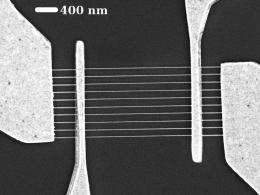
Scanning electron microscope image shows ten graphene nanoribbons between each pair of electrodes.

(PhysOrg.com) -- Recent research into the properties of graphene nanoribbons provides two new reasons for using the material as interconnects in future computer chips. In widths as narrow as 16 nanometers, graphene has a current carrying capacity approximately a thousand times greater than copper—while providing improved thermal conductivity.

The current-carrying and heat-transfer measurements were reported by a team of researchers from the Georgia Institute of Technology. The same team had previously reported measurements of resistivity in graphene that suggest the material’s conductance would outperform that of copper in future generations of nanometer-scale interconnects.

"Graphene nanoribbons exhibit an impressive breakdown current density that is related to the resistivity,” said Raghunath Murali, a senior research engineer in Georgia Tech’s Research Center. “Our measurements show that these graphene nanoribbons have a current carrying capacity at least two orders of magnitude higher than copper at these size scales.”

Measurements of thermal conductivity and breakdown current density in narrow graphene nanoribbons were reported June 19 in the journal . The research was supported by the Semiconductor Research Corporation/DARPA through the Interconnect Focus Center and by the Nanoelectronics Research Initiative through the Institute for Nanoelectronics Discovery and Exploration (INDEX).

The unique properties of graphene—which is composed of thin layers of graphite—make it attractive for a wide range of potential electronic devices. Murali and his colleagues have been studying graphene as a potential replacement for copper in on-chip interconnects, the tiny wires that are used to connect transistors and other devices on integrated circuits. Use of graphene for these interconnects, they believe, would help extend the long run of performance improvements in integrated circuit technology.

"Our measurements show that graphene nanoribbons have a current carrying capacity of more than 108 AMps per square centimeter, while a handful of them exceed 109 AMps per square centimeter,” Murali said. “This makes them very robust in resisting electromigration and should greatly improve chip reliability.”

Electromigration is a phenomenon that causes transport of material, especially at high current density. In on-chip interconnects, this eventually leads to a break in the wire, which results in chip failure.

"We are learning a lot of new things about this material, which will lead researchers to consider other potential applications,” said Murali. “In addition to the high current carrying capacity, graphene nanoribbons also have excellent thermal conductivity.”

Because heat generation is a significant cause of device failure, the researchers also measured the ability of the graphene nanostructures to conduct heat away from devices. They found that graphene nanoribbons have a thermal conductivity of more than 1,000 watts per meter Kelvin for structures less than 20 nanometers wide.

"This high could allow graphene interconnects to also serve as heat spreaders in future generations of ,” said Murali.

To study the properties of graphene interconnects, Murali and collaborators Yinxiao Yang, Kevin Brenner, Thomas Beck and James Meindl began with flakes of multi-layered graphene removed from a graphite block and placed onto an oxidized silicon substrate. They used electron beam lithography to construct four electrode contacts, then used lithography to fabricate devices consisting of parallel nanoribbons of widths ranging between 16 and 52 nanometers and lengths of between 0.2 and 1 micron.

The breakdown current density of the nanoribbons was then studied by slowly applying an increasing amount of current to the electrodes on either side of the parallel nanoribbons. A drop in current flow indicated the breakdown of one or more of the nanoribbons.

In their study of 21 test devices, the researchers found that the breakdown current density of graphene nanoribbons has a reciprocal relationship to the resistivity.

Because graphene can be patterned using conventional chip-making processes, manufacturers could make the transition from copper to graphene without a drastic change in chip fabrication.

" has very good electrical properties,” Murali said. “The data we have developed so far looks very promising for using this material as the basis for future on-chip interconnects.”

Provided by Georgia Institute of Technology

4.9 /5 (14 votes)  

Filter


Move the slider to adjust rank threshold, so that you can hide some of the comments.


Display comments: newest first

poi
Jul 30, 2009

Rank: 3.3 / 5 (3)
Marvels and dismay... it's so hard to invest on a new system now available in the market that improves 20% on your last when you could have these they talk about here at a thousands degree yet know that they cant put them on shelves until another 5~10 years. Just amazingly frustrating... how the market limits its own progress.
But one day, jumps will happen again - 20% to 100 fold increase in improvement, disrespecting transitions altogether.
Anyone with the balls to do it?
Rank 4.9 /5 (14 votes)
Relevant PhysicsForums posts
  • polymer nanocomposites
    createdFeb 10, 2012
  • Corrosion Tests on Magnesium
    createdFeb 09, 2012
  • polyethylene copper nanocomposite
    createdFeb 09, 2012
  • Output of xrd analysis
    createdFeb 08, 2012
  • Transport phenomena problem based on problems 18.B11 and 19B.6 from Bird, stewart, lw
    createdFeb 06, 2012
  • Help with material selection - Car Piston
    createdFeb 05, 2012
  • More from Physics Forums - Materials & Chemical Engineering

More news stories

Lab study raises questions over nano-particle impact

Tests involving chickens have raised questions about the impact on health from engineered nano-particles, the ultra-fine grains commonly used in drugs and processed foods, scientists said on Sunday.

Nanotechnology / Bio & Medicine

created 9 hours ago | popularity 5 / 5 (6) | comments 0

New kind of solar cell could capture significantly more energy than current cells

New solar cells could increase the maximum efficiency of solar panels by over 25%, according to scientists from the University of Cambridge.

Nanotechnology / Nanophysics

created Feb 08, 2012 | popularity 4.5 / 5 (13) | comments 14 | with audio podcast

Nanoshell whispering galleries improve thin solar panels

Visitors to Statuary Hall in the U.S. Capitol Building may have experienced a curious acoustic feature that allows a person to whisper softly at one side of the cavernous, half-domed room and for another on ...

Nanotechnology / Nanomaterials

created Feb 07, 2012 | popularity 4.4 / 5 (7) | comments 6 | with audio podcast

'Dark plasmons' transmit energy

Microscopic channels of gold nanoparticles have the ability to transmit electromagnetic energy that starts as light and propagates via "dark plasmons," according to researchers at Rice University.

Nanotechnology / Nanophysics

created Feb 09, 2012 | popularity 4.8 / 5 (10) | comments 1 | with audio podcast

Revealing how a battery material works

Since its discovery 15 years ago, lithium iron phosphate (LiFePO4) has become one of the most promising materials for rechargeable batteries because of its stability, durability, safety and ability to deliver ...

Nanotechnology / Nanomaterials

created Feb 08, 2012 | popularity 5 / 5 (6) | comments 0 | with audio podcast


Scientists discover molecular secrets of 2,000-year-old Chinese herbal remedy

For roughly two thousand years, Chinese herbalists have treated Malaria using a root extract, commonly known as Chang Shan, from a type of hydrangea that grows in Tibet and Nepal. More recent studies suggest that halofuginone, ...

New method to examine batteries -- MRI from the inside

There is an ever-increasing need for advanced batteries for portable electronics, such as phones, cameras, and music players, but also to power electric vehicles and to facilitate the distribution and storage of energy derived ...

Google might launch Drive for cloud storage soon

(PhysOrg.com) -- Google's next big move, according to the Wall Street Journal, is a cloud storage service called Drive. Hardly first to the plate, Google is simply catching up to introducing its cloud reposi ...

A mitosis mystery solved: How chromosomes align perfectly in a dividing cell

Although the process of mitotic cell division has been studied intensely for more than 50 years, Whitehead Institute researchers have only now solved the mystery of how cells correctly align their chromosomes during symmetric ...

Starve a virus, feed a cure? Findings show how some cells protect themselves against HIV

A protein that protects some of our immune cells from the most common and virulent form of HIV works by starving the virus of the molecular building blocks that it needs to replicate, according to research published online ...

Researchers find extensive RNA editing in human transcriptome

In a new study published online in Nature Biotechnology, researchers from BGI, the world's largest genomics organization, reported the evidence of extensive RNA editing in a human cell line by analysis of RNA-seq data, demons ...