Scientists to unlock Great Barrier Reef genome
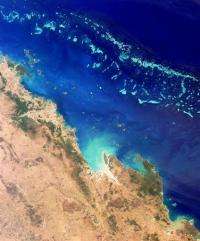
July 30, 2009 The reef is one of Australia's top tourist attractions

Enlarge

This file photo shows the 345,000-square-kilometre Great Barrier Reef which runs along the northeastern coast of Australia. Australian scientists have announced a ground-breaking genome-mapping project that could help the Great Barrier Reef fight off the twin threats of climate change and toxic farm chemicals.

Australian scientists on Thursday announced a ground-breaking genome-mapping project that could help the Great Barrier Reef fight off the twin threats of climate change and toxic farm chemicals.

Geneticists said they would unlock the secrets of the colourful 'acropora millepora' coral, one of the main components of the northeastern tourist attraction, the growth of which has slowed markedly in recent years.

"This gene-mapping project has both practical and scientific significance," said professor David Miller of Australia's Centre of Excellence for Coral Reef Studies and James Cook University.

"It will help us to understand how corals build reefs -- and why they fail to do so when they are under stress."

The project, Australia's first attempt to gene-sequence a complex animal, is expected to yield insights into why the Reef's growth has been hampered by warmer sea temperatures and chemical run-off.

The World Heritage-listed, 345,000-square-kilometre (133,000-square-mile) reef is one of Australia's top attractions and has been short-listed in a competition to find the world's seven natural wonders.

However, the reef has come under growing threat from and chemical run-off with Australia announcing a crackdown in January on farmers who let pesticides and fertilisers leak into the sea.

(c) 2009 AFP


Rate this story - 3 /5 (3 votes)


July 30, 2009 all stories

Comments: 0

3 /5 (3 votes)

  • hide
  • Related Stories

  • Scientists: Great Barrier Reef in danger
    created Jan 31, 2006 | popularity not rated yet | comments 0
  • Save our reef, save our heritage
    created Jul 19, 2007 | popularity not rated yet | comments 0
  • Corals facing 'biggest impact in history'
    created Jun 19, 2006 | popularity not rated yet | comments 0
  • Larry's cool change good for reef
    created Mar 22, 2006 | popularity not rated yet | comments 0
  • Ongoing collapse of coral reef shark populations
    created Dec 04, 2006 | popularity not rated yet | comments 0


  • hide
  • Relevant PhysicsForums posts

  • Do we lose weight by respiration ? (Losing carbons)
    created 1hour ago
  • Sleeping habits and the risk of cancer
    created Feb 08, 2010
  • Pressure in chambers of the heart
    created Feb 07, 2010
  • Primordial soup canned?
    created Feb 07, 2010
  • More from Physics Forums - Biology

Other News

Benefits of badger culling not long lasting for reducing cattle TB, says study

Benefits of badger culling not long lasting for reducing cattle TB, says study

Biology / Ecology

created 11 minutes ago | popularity not rated yet | comments 0

(PhysOrg.com) -- Badger culling is unlikely to be a cost-effective way of helping control cattle TB in Britain, according to research published today in PLoS ONE.


Scientists release Key Largo wood rats in first test of restocking experiment

Biology / Ecology

created 54 minutes ago | popularity not rated yet | comments 0

The seven pioneers spent the week preparing for their upcoming ordeal in North Key Largo, sampling berries and other local fare, redecorating homes with sticks, leaves and whatever else they got their little paws on, and ...


giant oarfish

Bizarre giant oarfish filmed (w/ Video)

Biology / Plants & Animals

created 1hour ago | popularity 5 / 5 (1) | comments 0 | with audio podcast report

(PhysOrg.com) -- A rare giant oarfish, probably the largest bony fish in the ocean, has been filmed off the Gulf of Mexico. This is possibly the first time the fish has been observed in its natural environment.


Great tits: birds with character

Great tits: birds with character

Biology / Plants & Animals

created 14 hours ago | popularity 5 / 5 (3) | comments 3 | with audio podcast

(PhysOrg.com) -- In humans and animals alike, individuals differ in sets of traits that we usually refer to as personality. An important part of the individual difference in personality is due to variation ...


Cells can read damaged DNA without missing a beat

Biology / Cell & Microbiology

created 13 hours ago | popularity 5 / 5 (1) | comments 0 | with audio podcast

Scientists have shown that cells' DNA-reading machinery can skim through certain kinds of damaged DNA without skipping any letters in the genetic "text." The studies, performed in bacteria, suggest a new mechanism that can ...