Model predicts evolution of Mediterranean landscape following fires
July 30, 2009
Model predicts evolution of Mediterranean landscape following fires

Enlarge

An international research team has developed a mathematical and cartographical model that make it possible to view how Mediterranean landscapes evolve in the aftermath of forest fires. In order to carry out this research study, published recently in the journal Environmental Modelling & Software, the authors studied a Special Protection Area for Birds to the south west of Madrid.

"We have developed a model that shows on maps how various types of plants develop in a Mediterranean landscape, with the role of fire included as an integral feature in Mediterranean vegetation dynamics", Raúl Romero Calcerrada, a researcher in the Department of Chemical and Environmental Technology at the King Juan Carlos University in Madrid, and co-author of the study published online in the journal Environmental Modelling & Software, tells SINC.

The area studied was Special Protection Area for Birds (SPAB) number 56, which covers the Holm oak woodland along the Alberche and Cofio rivers to the south west of Madrid. "Although these results could also be extrapolated to other Mediterranean regions", Romero points out.

The model is an original one, which predicts the most probable way in which vegetation will develop according to the variables introduced. It takes into consideration parameters such as the dispersal of plants (by shoots or seeds), their distribution over space and time, and the resources they compete for (primarily light and water).

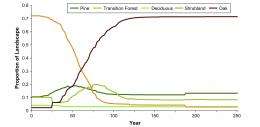
Such ecosystems can generally evolve from grassland to scrubland (with rock rose, lavender and broom), later to transitional woodland (with pines, juniper and some Holm oaks) and finally to a Holm oak forest over a period of around 100 years. However, this evolution may be affected by a range of factors.

The results show, for example, that if the ground is dry, or there is a lack of Holm oak acorns, a burned area can turn into a pine forest within 30 years. However, in good water and soil conditions, the ecosystem could develop into a deciduous chestnut and melojo oak forest.

"The intensity and number of fires have a direct effect on how the vegetation evolves and the types of plants that grow", says Romero, who also points to the significant influence of humans on this and other factors affecting Mediterranean areas. In fact, this research study is part of a broader study into changes in soil use in rural areas, and will be incorporated into other models to help decision making about land use in these areas.

Cellular automata to represent fire

"We used 'cellular automata' to represent how fires spread, bearing in mind the flammability of the ground cover, the gradient of the land, wind speed and moisture levels of the vegetation", the lead author of the study, James D. A. Millington, from Michigan State University in the United States, tells SINC. 'Cellular automata' are mathematical tools used in artificial intelligence to track the movement of linked objects within a grid (in this case a map).

Millington says this model is able to represent landscapes over areas in excess of 1,000 hectares on a map with high spatial resolution (of 0.01 - 10 ha) and over timescales ranging from annual to more than a century.

Aside from these two researchers, other scientists from the University of Auckland (New Zealand), and Sheffield University and King's College in London, in the United Kingdom, also took part in the study.

More information: James D. A. Millington, John Wainwright, George L. W. Perry, Raul Romero-Calcerrada y Bruce D. Malamud. “Modelling Mediterranean landscape succession-disturbance dynamics: A landscape fire-succession model”. Environmental Modelling & Software 24 (10): 1196-1208, 2009

Source: AlphaGalileo

4.5 /5 (4 votes)  

Rank 4.5 /5 (4 votes)
Relevant PhysicsForums posts
  • Do some geologists actually act a lot like Randy Marsh?
    createdFeb 11, 2012
  • Discrepancy between oxygen and carbon-dioxide levels
    createdFeb 09, 2012
  • where gems are found in the world
    createdFeb 09, 2012
  • Wind Waves in Reservoir ~ Wind run-up and Wind set-up
    createdFeb 08, 2012
  • Balance of oxygen in the atmosphere
    createdFeb 01, 2012
  • The case for a methanol-based economy
    createdJan 30, 2012
  • More from Physics Forums - Earth

More news stories

Latin America mining boom clashes with conservation

Latin America is experiencing a mining boom as prices rise fuelled by a hike in global demand, but the region is also being hit by a wave of violent protests, strikes and rallies by environmentalists.

Space & Earth / Environment

created 6 hours ago | popularity not rated yet | comments 0

Political leaders play key role in how worried Americans are by climate change: study

More than extreme weather events and the work of scientists, it is national political leaders who influence how much Americans worry about the threat of climate change, new research finds.

Space & Earth / Environment

created Feb 06, 2012 | popularity 5 / 5 (6) | comments 72

NASA budget will axe Mars deal with Europe: scientists

US President Barack Obama's budget proposal to be submitted next week for 2013 will cut NASA's budget by 20 percent and eliminate a major partnership with Europe on Mars exploration, scientists said Thursday.

Space & Earth / Space Exploration

created Feb 10, 2012 | popularity 5 / 5 (3) | comments 55

Humans may have helped the decline of African rainforests 3000 years ago

(PhysOrg.com) -- Large areas of rainforests in Central Africa mysteriously disappeared over three thousand years ago, to be replaced by savannas. The prevailing theory has been that the cause was a change ...

Space & Earth / Environment

created Feb 10, 2012 | popularity 4.1 / 5 (14) | comments 20 | with audio podcast report

Study shows global glaciers, ice caps, shedding billions of tons of mass annually

Earth's glaciers and ice caps outside of the regions of Greenland and Antarctica are shedding roughly 150 billion tons of ice annually, according to a new study led by the University of Colorado Boulder.

Space & Earth / Earth Sciences

created Feb 08, 2012 | popularity 4.4 / 5 (9) | comments 14 | with audio podcast


Google might launch Drive for cloud storage soon

(PhysOrg.com) -- Google's next big move, according to the Wall Street Journal, is a cloud storage service called Drive. Hardly first to the plate, Google is simply catching up to introducing its cloud reposi ...

Love a click away in Indonesia's Twitter Republic

He was a geeky kid from Yogyakarta, she a glamorous city girl in Jakarta. In a country with one of the world's most vibrant social networking scenes they fell in love on Twitter.

Europeans protest controversial Internet pact

Tens of thousands of people marched in protests in more than a dozen European cities Saturday against a controversial anti-online piracy pact that critics say could curtail Internet freedom.

Walney offshore wind farm is world's biggest (for now)

(PhysOrg.com) -- The Walney wind farm on the Irish Sea--characterized by high tides, waves and windy weather--officially opened this week. The farm is treated in the press as a very big deal as the Walney ...

Navy to begin tests on electromagnetic railgun prototype launcher

The Office of Naval Research (ONR)'s Electromagnetic (EM) Railgun program will take an important step forward in the coming weeks when the first industry railgun prototype launcher is tested at a facility ...

Explained: Sigma

It's a question that arises with virtually every major new finding in science or medicine: What makes a result reliable enough to be taken seriously? The answer has to do with statistical significance -- but ...