Douglas-fir, geoducks make strange bedfellows in studying climate change

Scientists are comparing annual growth rings of the Pacific Northwest's largest bivalve and its most iconic tree for clues to how living organisms may have responded to changes in climate.
Analyzed by themselves, the rings from a single tree or mollusk may sometimes reflect conditions that are either favorable or unfavorable for growth. When scientists look at numerous individuals of the same species, however, the consistency of the ring patterns allows them to build a model and compare that to known climatic measurements.
But when you add in a second species - and compare the growth rings of geoducks and Douglas-firs, for example - the reliability of the data increases significantly, according to Bryan Black, a dendrochonologist at Oregon State University. Black has been applying tree-ring techniques to the growth increments of long-lived marine and freshwater species.
"When we associate rings from one species with known sea surface temperatures, we can account for almost 50 percent of the variability in the instrument records," Black said. "But when we add the data from a second species, we can increase that number to 70 percent or more. And that's important because it is allowing us to go back and create more accurate models of sea surface temperatures and at time scales more than twice the length of the instrument measurements.
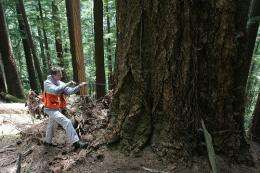
"Each species brings its own 'perspective' of past climate, such that their combination provides a more accurate account," Black added.
Results of the study are being published in the professional journal, Palaeogeography, Palaeoclimatology, Palaeoecology. Other authors include Carolyn Copenheaver of Virginia Tech, David Frank of the Swiss Federal Institute for Forest, Snow and Landscape Research, and Matthew Stuckey and Rose Kormanyos of OSU's Hatfield Marine Science Center.
Sea surface temperatures are an important factor in analyzing the effects of climate change, said Black, a researcher at OSU's Hatfield Marine Science Center in Newport and lead author on the study. Any methodology that improves scientists' ability to estimate their past variability is met with interest in the research community. This new study has enabled scientists to develop an improved model of sea surface temperatures in the northeastern Pacific Ocean dating back to 1880.
When Black first began publishing comparisons of tree rings and the otoliths - or ear bones - of long-lived fish, he attracted the attention of climate change scientists.
"We found that chronologies for rockfish living at the 300-meter depth in the Pacific strongly related to tree-ring chronologies in the Cascade Mountains as well as to Pacific geoduck along the coast," Black said.
That study, recently published by Black in the professional journal Marine Ecology-Progress Series, showed that climate synchronized the growth of organisms from the continental shelf to alpine forests.
"The next step was to use the longest-lived organisms - trees and the geoduck - to tell us about climate prior to the start of instrumental records," Black pointed out.
Sea surface temperatures affect climate on land and when there is a spike in average yearly temperatures, such as during an El Nino year, it can have a profound impact on both trees and marine life. In general, Black said, warmer temperatures boost metabolism in geoduck and result in greater growth rates. Warm sea surface temperatures also mean less snow in the Cascade Mountains and a longer growing season for Douglas-firs and other trees, which are reflected in wider growth rings.
The limiting factor in using growth rings to study climate change is the age of the geoduck specimens. Old-growth evergreens may reach 500 to 1,000 years in age, but geoducks rarely exceed 150 years.
"Scientists at the Canadian Department of Fisheries and Oceans are dredging up shells of dead geoducks from the ocean floor," Black said, "and we hope we can append their growth patterns to chronology developed from live individuals. If so, it may be possible to extend geoduck chronologies over several centuries and greatly extend our climate histories."
Black is working with Jason Dunham, an ecologist with the U.S. Geological Survey in Corvallis, and OSU graduate student Brett Blundon to apply tree ring techniques to freshwater mussels, which also show annual growth through rings. They recently discovered that wider growth rings reflect low river flows during that year, which is another valuable piece of climate information.
"We're not sure why low river flows are associated with good growth in freshwater mussels," Black said. "High-flow events may damage the mussel, while low-flow events may be associated with higher food levels. But it is another example of how aquatic organisms can provide valuable information on climate impacts and history."
Source: Oregon State University (news : web)


