Stress rewires the brain to make rats creatures of habit
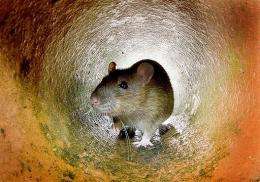
Chronic stress rewires the brains of rats to make them creatures of habit who make rote decisions instead of changing their behavior to gain rewards, a study published Thursday has found.
Every day we make a multitude of decisions based on the consequences of our actions (goal-orientated responses). In an always changing environment this capacity is crucial but, because it is complex, it also requires a lot from the brain. So repeated actions - like to press the elevator button to our floor - become linked to other type of neural responses, which are automatic and so less demanding. And if necessary it is always possible to switch back to the first kind of response.
But research by Portuguese scientists to be published on the 31st of July in the journal Science now reveals that chronic stress - too many times a feature of modern life - interfere with this switching capacity, by freezing individuals into automatic/habit responses mode. This effect is associated with morphological changes in the brain, where areas linked to habitual responses are enlarged and have thus potentially better neural connectivity, and the opposite - atrophy and less connections - occurs in those areas mediating goal-orientated responses.
The discovery of these stress effects have important implications: to understand better the pathology of stress-related disorders and how the brain works in general but also to a variety of more “real” issues from understanding the impact of modern life styles or how to prevent bad choices in situations where constant stress seems to be unavoidable.
Chronic stress is major issue in today’s society and is known to lead to a variety of health problems from ulcers to hypertension. We all also have experienced how our decision making can become affected by stress and how many wrong choices we have made as result. How exactly this occurs is the question behind the work now published by Eduardo Dias-Ferreira, Nuno Sousa and colleagues from the University of Minho in Portugal and the National Institutes of Health, Bethesda, USA.
The researchers looked into goal-orientated decisions (so those where consequences are taken into account) and automatic decisions (so those resulting from habit) as well as the switch between the two, and how this was affected by chronic stress.
To answer that Ferreira and colleagues used rats exposed to chronic stress and, together with normal control rats, put them through training to learn to press a lever in order to obtain food rewards. Both stressed and control rats responded very similarly, rising the number of pressings with time as they learned that this would increase the rewards obtained.
But when the situation was changed by feeding the animals on the side, so making the food rewards less appealing, while control rats were able to re-evaluate the situation and diminish the number of pressings, stressed rats continued to push the lever constantly despite the effort this required. This suggested that once a habit was established stressed animals were no longer capable of switching the response back.
To assure that these results were not simply a consequence of a particular predilection for the food supplied, other rats were instead trained to press different levers to achieve different rewards but the same conclusion was reached: chronic stress predisposes animals to switch rapidly from goal-orientated to automatic kind of responses and make them incapable of switching back when new conditions required it.
Ferreira, Sousa and colleagues also looked into the stressed rats brain to access if this behavioural dysfunctionality could be associated with changes in this organ. For that the researchers analysed the dorsomedial striatum (DMS) and the dorsolateral striatum (DLS), which are brain areas previously associated to goal-orientated actions and habit formation respectively.
And in fact major changes were found with the stressed brain showing an atrophied DMS with a reduced number of connections between neurons, and an enlarged DLS with increased neural connectivity when compared with the brain of non-stressed control mice.
A proper response to a constant changing environment gives individuals an important advantage in life. But the elaborated brain response that this demands requires a lot of energy to maintain, so to switch to automatic responses when possible, helps to save time and brain resources and can always be switched back if necessary. Chronic stress is here shown to affect this capability of switching the responses according to need by restructuring the neural connectivities of the brain areas linked to the two responses. It is known that inactivation of DMS or DLS can bias behaviour towards the other type of response which suggests that the behavioural effects of stress result from a competition between the two areas, with the enlarged, better connected, DLS “winning”.
Ferreira, Sousa and colleagues’ study has several implications as it can, for example, help to explain why so many times stress-related diseases are associated with addictive or compulsive behaviour. But also, in a stress-dominated society like ours, to understand how constant stress can directly affect our choices can help to develop mechanism to deal with it, a particularly important issue, for example, for army personnel in war zones
And in fact Nuno Sousa, the head to the research group involved in the work says when asked about future work “We are now focusing our research efforts in unravelling the molecular and functional mechanisms underlying these findings, in order to develop in the future new strategies that can revert these stress-induced bias in decision-making processes”
More information: Science - 31st July 2009 Advance Online Publication “Chronic Stress Causes Frontostriatal Reorganization and Affects Decision-Making”
Provided by


