Researchers Shed Light on Muscle Growth Regulator
July 30, 2009
Researchers Shed Light on Muscle Growth Regulator

Enlarge

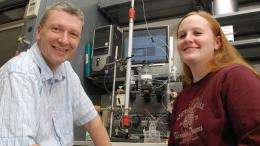
Tom Thompson, PhD, and Jennifer Cash

(PhysOrg.com) -- Research at the University of Cincinnati has led to the first published structure of myostatin, a protein that regulates muscle growth in animals, offering hope for major advances in the fight against muscle-wasting diseases.

Corresponding author Tom Thompson, PhD, an assistant professor and structural biologist in the , biochemistry and microbiology department, detailed his research team’s findings, headed by first author and graduate student Jennifer Cash, in a peer-reviewed article for the , a publication of the European Molecular Biology Organization.

The article presents the atomic crystal structure of myostatin in complex with the natural inhibitor follistatin and uncovers important features of myostatin that pertain to how it signals and is degraded, or neutralized.

Neutralization of an animal’s naturally occurring myostatin results in a marked increase in muscle mass. Therefore, therapeutics that target myostatin and stop it from working would stimulate muscle growth, offering a benefit to patients with muscle-wasting diseases such as , cancer and sarcopenia, the age-related loss of muscle mass, strength and function.

“Understanding the features that are unique to myostatin is important to discovering how to inhibit myostatin without unwanted side effects,” says Thompson. “The structure will allow us to manipulate protein inhibitors such as follistatin and help in the identification of small molecules that specifically disrupt myostatin activity.”

Armed with new insights into myostatin’s structure, Thompson will work with the Drug Discovery Center at UC’s Genome Research Institute to identify drug-like inhibitors to myostatin.

Thompson has been working with the aid of more than $1.5 million in grants, including a $1.15 million National Institutes of Health (NIH) R01 grant and a $300,000 Muscular Dystrophy Association grant, both awarded in 2008. He previously was awarded a four-year, $260,000 grant from the American Heart Association (AHA).

In addition, Cash was awarded a two-year AHA fellowship to support her work on the project.

Provided by University of Cincinnati (news : web)


Rank 5 /5 (2 votes)
Related Stories
Relevant PhysicsForums posts
  • Factors affecting beet root cell membrane
    created3 hours ago
  • Stem cell question.
    createdFeb 10, 2012
  • Protease cleavage
    createdFeb 10, 2012
  • Pertubance in a model
    createdFeb 10, 2012
  • Cancer drugs and Alzheimer's, Oh my!
    createdFeb 09, 2012
  • Squishing cells
    createdFeb 09, 2012
  • More from Physics Forums - Biology

More news stories

Entire genome of extinct human decoded from fossil

(PhysOrg.com) -- In 2010, Svante Pääbo and his colleagues presented a draft version of the genome from a small fragment of a human finger bone discovered in Denisova Cave in southern Siberia. The ...

Biology / Biotechnology

created Feb 07, 2012 | popularity 4.7 / 5 (58) | comments 47 | with audio podcast

Why are there so few fish in the Earth's oceans?

(PhysOrg.com) -- A Stony Brook University researcher has found that, contrary to popular belief, there are not plenty of fish in the sea.

Biology / Plants & Animals

created Feb 08, 2012 | popularity 4.3 / 5 (17) | comments 26 | with audio podcast

Miami battling invasion of giant African snails

No one knows how they got there. But an invasion of African giant snails has southern Florida in a panic over potential crop damage, disease and general yuckiness surrounding the slimy gastropods.

Biology / Ecology

created Feb 10, 2012 | popularity 4.7 / 5 (3) | comments 5

Deciding to go left or right: Researchers use device to determine that lower animals can navigate too

For decades, scientists have associated binary decision making — opting to go left or right — with higher-ranking animals, including humans. A team of Harvard researchers, however, is rewriting that ...

Biology / Plants & Animals

created Feb 09, 2012 | popularity 4 / 5 (1) | comments 4 | with audio podcast

Study shows chimps able to understand needs of others

(PhysOrg.com) -- By setting up a unique experiment, a small team of researchers has found that chimpanzees are able to understand need in other chimps, despite their general disinclination to offer aid when ...

Biology / Plants & Animals

created Feb 07, 2012 | popularity 5 / 5 (2) | comments 4 | with audio podcast report


Injured boomers beware: Know when to see doctor

(AP) -- It happened to nurse Jane Byron years after an in-line skating fall, business owner Haralee Weintraub while doing "men's" push-ups, and avid cyclist Gene Wilberg while lifting a heavy box.

Google might launch Drive for cloud storage soon

(PhysOrg.com) -- Google's next big move, according to the Wall Street Journal, is a cloud storage service called Drive. Hardly first to the plate, Google is simply catching up to introducing its cloud reposi ...

Latin America mining boom clashes with conservation

Latin America is experiencing a mining boom as prices rise fuelled by a hike in global demand, but the region is also being hit by a wave of violent protests, strikes and rallies by environmentalists.

Love a click away in Indonesia's Twitter Republic

He was a geeky kid from Yogyakarta, she a glamorous city girl in Jakarta. In a country with one of the world's most vibrant social networking scenes they fell in love on Twitter.

Europeans protest controversial Internet pact

Tens of thousands of people marched in protests in more than a dozen European cities Saturday against a controversial anti-online piracy pact that critics say could curtail Internet freedom.

Walney offshore wind farm is world's biggest (for now)

(PhysOrg.com) -- The Walney wind farm on the Irish Sea--characterized by high tides, waves and windy weather--officially opened this week. The farm is treated in the press as a very big deal as the Walney ...