Prototype, 7-foot-tall sanitizer automates disinfection of hard-to-clean hospital equipment
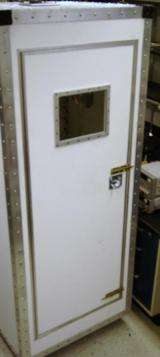
Johns Hopkins experts in applied physics, computer engineering, infectious diseases, emergency medicine, microbiology, pathology and surgery have unveiled a 7-foot-tall, $10,000 shower-cubicle-shaped device that automatically sanitizes in 30 minutes all sorts of hard-to-clean equipment in the highly trafficked hospital emergency department. The novel device can sanitize and disinfect equipment of all shapes and sizes, from intravenous line poles and blood pressure cuffs, to pulse oximeter wires and electrocardiogram (EKG) wires, to computer keyboards and cellphones.
The invention, nicknamed "SUDS" for self-cleaning unit for the decontamination of small instruments, has already been shown to initially disinfect noncritical equipment better than manual cleaning, they report in the Annals of Surgical Innovation and Research online July 30.
Study senior author and surgeon Bolanle Asiyanbola, M.D., says the four-year SUDS project was initially sparked by the rapid rise in use of expensive disposable items, a trend linked to efforts to prevent bacterial infections among and between patients in hospitals.
Drawing on her experience in the operating room, where many batches of surgical clamps, retractors and scalpels have been sterilized, decontaminated and safely re-used for decades, Asiyanbola put together a team to end what she calls the "wasteful and unnecessary" practice of wiping down a lot of heavily used items with disinfectants and applying a lot of elbow grease. "If we can safely re-use equipment in the operating room, then we can do it elsewhere in the hospital for non-critical equipment," she says.
In the study, the Johns Hopkins team showed that SUDS was able to disinfect some 90 pieces of used emergency-room equipment, placing as many as 15 items in the device and "fogging" the equipment with an aerosolized, commercially available disinfectant chemical, or biocide, called Sporicidin. None of the electronic circuitry appeared to be damaged by the decontamination process. Instruments tested were of the type that comes in direct contact with a patient's skin, the body's key barrier to infection.
Repeated swabbing and lab culture testing of each decontaminated instrument showed that all items remained free of so-called gram-positive bacteria for two full days after cleaning, even after the equipment was returned to the emergency department and re-used. On the bacteria-free list were such potentially dangerous superbugs as methicillin-resistant Staphylococcus aureus (MRSA) and vancomycin-resistant Enterococcus (VRE).
By contrast, testing of an equal number of similar items that were manually scrubbed down with a disinfectant solution, called Airex, showed that 25 percent of the devices had bacterial growth after two days, including growth of potentially dangerous gram-positive bacteria, such as MRSA and VRE, as well as gram-negative type bacteria, most notably, Pseudomonas aeruginosa, and Acinetobacter baumannii, plus some types of fungi.
"Our study results with the prototype offer strong evidence that more can be done to disinfect noncritical equipment through automated decontamination processes in heavily trafficked areas of the hospital," says Asiyanbola, an assistant professor at the Johns Hopkins University School of Medicine. "We believe this SUDS device has the potential to further protect our patients and staff from hospital infections and save health care dollars by making it possible to clean and re-use more kinds of hospital equipment."
The Hopkins inventors, who have patent applications pending, say more studies must be done to determine if SUDS is effective for other hospital superbugs, notably, Clostridium difficile.
Source: Johns Hopkins Medical Institutions


