The Perseids are Coming
July 31, 2009 The Perseids are Coming

Enlarge

Earth is entering a stream of dusty debris from Comet Swift-Tuttle, the source of the annual Perseid meteor shower. Although the shower won't peak until August 11th and 12th, the show is already getting underway.

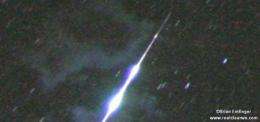
Brian Emfinger of Ozark, Arkansas, photographed this early Perseid just after midnight on Sunday, July 26th (see above).

"I used an off-the-shelf digital camera to capture this fireball and its smoky trail," says Emfinger. "It was a bright one!"

Don't get too excited, cautions Bill Cooke of NASA's Meteoroid Environment Office. "We're just in the outskirts of the debris stream now. If you go out at night and stare at the sky, you'll probably only see a few Perseids per hour."

This will change, however, as August unfolds.

"Earth passes through the densest part of the debris stream sometime on August 12th. Then, you could see dozens of meteors per hour."

For sky watchers in North America, the watch begins after nightfall on August 11th and continues until sunrise on the 12th. Veteran observers suggest the following strategy: Unfold a blanket on a flat patch of ground. (Note: The middle of your street is not a good choice.) Lie down and look up. Perseids can appear in any part of the sky, their tails all pointing back to the shower's radiant in the constellation Perseus. Get away from city lights if you can.

There is one light you cannot escape on August 12th. The 55% gibbous Moon will glare down from the constellation Aries just next door to the shower's radiant in Perseus. The Moon is beautiful, but don't stare at it. Bright moonlight ruins night vision and it will wipe out any faint Perseids in that part of the sky.

The Moon is least troublesome during the early evening hours of August 11th. Around 9 to 11 p.m. local time (your local time), both Perseus and the will be hanging low in the north. This low profile reduces lunar glare while positioning the shower's radiant for a nice display of Earthgrazers.

"Earthgrazers are meteors that approach from the horizon and skim the atmosphere overhead like a stone skipping across the surface of a pond," explains Cooke. "They are long, slow and colorful—among the most beautiful of meteors." He notes that an hour of watching may net only a few of these at most, but seeing even one can make the whole night worthwhile.

The Perseids are coming. Enjoy the show.

Source: Science@NASA, by Dr. Tony Phillips


print this article email this article download pdf blog this article bookmark this article     Stumble it Digg this share on Facebook retweet share on Reddit add to delicious
Rate this story - 4.3 /5 (12 votes)

Rank Filter

Move the slider to adjust rank threshold, so that you can hide some of the comments.


Display comments: newest first

  • Nartoon - Aug 01, 2009
    • Rank: 5 / 5 (1)
    Don't forget the bug spray!
  • RayCherry - Aug 04, 2009
    • Rank: 5 / 5 (1)
    :-) Good advice about the blanket, location and bug spray. I also recommend a flask of tea and a box of sandwiches, low power binoculars, an LED torch and a sky map indicating where the meteors are coming from.

    Note that if you use the binoculars too much, you will miss the meteors that light up in the periphery of your vision, and your arms will ache like hell the next day!

    Hope you have a great show.

July 31, 2009 all stories

Comments: 2

4.3 /5 (12 votes)
  • Stumble this up

  • Digg this

  • share this

  • hide
  • Related Stories

  • The 2008 Perseid Meteor Shower
    created Jul 22, 2008 | popularity not rated yet | comments 0
  • Perseid Earthgrazers
    created Aug 08, 2006 | popularity not rated yet | comments 0
  • The 2004 Perseid Meteor Shower is Promising to Be Unusually Good
    created Aug 10, 2004 | popularity not rated yet | comments 0
  • Mars Joins The Perseid Meteor Shower For A Beautiful Display On August 12th.
    created Jul 26, 2005 | popularity not rated yet | comments 0
  • August brings the Perseid meteors and a cluster of planets
    created Aug 01, 2008 | popularity not rated yet | comments 0


  • hide
  • Relevant PhysicsForums posts

  • Question about 2-body gravity
    created Nov 24, 2009
  • life on Mars
    created Nov 24, 2009
  • Semi-major axis from cartesian co-ordinates
    created Nov 23, 2009
  • Primary Mirror grinding
    created Nov 23, 2009
  • More from Physics Forums - General Astronomy

Other News

Ships warned about icebergs headed for New Zealand (AP)

Ships warned about icebergs headed for New Zealand

Space & Earth / Earth Sciences

created 26 minutes ago | popularity not rated yet | comments 0

(AP) -- Ships are on alert and maritime authorities are monitoring the movements of hundreds of menacing icebergs drifting toward New Zealand in the southern Pacific Ocean, officials said.


Cutting greenhouse pollutants could directly save millions of lives worldwide

Space & Earth / Environment

created 1hour ago | popularity 1 / 5 (2) | comments 0

Tackling climate change by reducing carbon dioxide and other greenhouse emissions will have major direct health benefits in addition to reducing the risk of climate change, especially in low-income countries, according to ...


Small faults in Southeast Spain reduce earthquake risk of larger ones

Small faults in Southeast Spain reduce earthquake risk of larger ones

Space & Earth / Earth Sciences

created 2 hours ago | popularity not rated yet | comments 0

A team of Spanish scientists, studying recent, active deformations in the Baetic mountain range, have shown that the activity of smaller tectonic structures close to larger faults in the south east of the ...


It's not just dirt!

Space & Earth / Environment

created 1hour ago | popularity 5 / 5 (1) | comments 0

Soil is the linchpin of the environment, where atmosphere, biosphere, and hydrosphere meet. Despite that, many students see soil as "just dirt" - a place to grow plants, but nothing more. Soil science educators are challenged ...


Mars Reconnaissance Orbite

Mars Reconnaissance Orbite Team Plans Uplink of Protective Files

Space & Earth / Space Exploration

created 4 hours ago | popularity 5 / 5 (1) | comments 0

(PhysOrg.com) -- The team operating NASA's Mars Reconnaissance Orbiter plans to uplink protective files to the spacecraft next week as one step toward resuming the orbiter's research and relay activities.