The guiding of light: A new metamaterial device steers beams along complex pathways
July 31, 2009 The guiding of light: A new metamaterial device steers beams along complex pathways

Enlarge

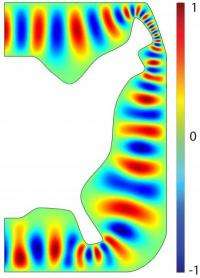
Boston College researchers report developing a device that can bend light along complex pathways. An illustration shows a simulated electromagnetic wave propagation. Guided by a set of instructions delivered by the device, the wave curves around the profile of the eastern US while behaving as if traveling in a straight line. Credit: Optics Express

Using a composite metamaterial to deliver a complex set of instructions to a beam of light, Boston College physicists have created a device to guide electromagnetic waves around objects such as the corner of a building or the profile of the eastern seaboard.

As directed by the researchers' novel device, these beams continue to behave as if traveling in a straight line. In one computer simulation, Assistant Professor of Physics Willie J. Padilla and researcher Nathan Landy revealed the device could steer a beam of along the boundary of the US, stretching from Michigan to Maine, down the seaboard, around Florida and into the Louisiana bayou, according to research published in the research journal .

The researchers accomplished their feat by developing a much more precise set of instructions, which create a grid-like roadmap capable of twisting and turning a beam of light around objects or space. Their discovery is an extension of earlier metamaterial "cloaking" techniques, which have conjured up images of the Harry Potter character disappearing beneath his invisibility cloak.

Padilla and Landy report developing a space-mapping technique that delivers greater precision and efficiency guiding light along pathways that previously were too complex to sustain - from 90-degree angles to the rugged coastal profile of Maine. Furthermore, they've built this new device using relatively common dielectric materials, such as silicon.

"Our method combines the novel effects of transformational optics with the practicality of dielectric construction," Padilla and Landy report. "We show that our structures are capable of guiding light in an almost arbitrary fashion over an unprecedented range of frequencies."

The discovery builds upon a decade-long revolution in electromagnetics brought about by the emergence of . Constructed from artificial composites, metamaterials have exhibited effects such as directing light at a negative index of refraction.

Researchers have combined metamaterials with artificial optical devices - also known as transformational optics - to demonstrate the "" effect, essentially directing light around a space and effectively masking its existence. In addition, other researchers have used a method known as quasi-conformal mapping and very complex metamaterials to issue a somewhat imprecise set of instructions that create another space-cloaking effect.

Source: Boston College (news : web)


print this article email this article download pdf blog this article bookmark this article     Stumble it Digg this share on Facebook retweet share on Reddit add to delicious
Rate this story - 4.5 /5 (18 votes)

Rank Filter

Move the slider to adjust rank threshold, so that you can hide some of the comments.


Display comments: newest first

  • mvg - Jul 31, 2009
    • Rank: 3 / 5 (2)
    "effectively masking its existence."


    Now masking the entire Eastern Seaboard might be a bit much--maybe they could go for a smaller goal, like masking Jersey City. (That would be an improvement!)
  • MorganW - Jul 31, 2009
    • Rank: 2.7 / 5 (3)
    to be sure I understand, can this physically mask tangible objects - such as people or machines? And does it only apply to visible light or does it render invisibility to other spectrums (i.e. radar, UV, etc)?
  • Anyone - Jul 31, 2009
    • Rank: 5 / 5 (1)
    Famous last words:

    "My computer SAID it would work!!"
  • gmurphy - Aug 01, 2009
    • Rank: 5 / 5 (1)
    MorganW, the work described here is concerned with channelling light, not invisibility. Invisibility (as we know it today) attempts to mask objects by allowing light to flow around their surface, rather than reflect off their surface. This work appears to investigate the plausibility of redirecting light around an arbitrary path, the ultimate mirage
  • otto1923 - Aug 01, 2009
    • Rank: 5 / 5 (1)
    "Also known as 'Project Rainbow', the Philadelphia Experiment was allegedly conducted by the U.S. Navy in 1943, as part of the military's initiative to render one of their ships invisible. The incident is said to have occurred at Philadelphia, Pennsylvania's Naval Shipyard on the USS Eldridge in front of witnesses who claim that the ship was invisible for a brief period. The U.S. Navy, however, denies that the experiment occurred.

    "There are various contradictory reports surrounding the Philadelphia Experiment... The most widely-told version of events is that test phases of the experiment first occurred during the summer of 1943 when the USS Eldridge first achieved partial invisibility. On 28 October 1943, the ship not only achieved complete invisibility, according to reports, but also teleported to Norfolk..."

    -I dont know about you all but I'm getting a little nervous ...
  • ThomasS - Aug 03, 2009
    • Rank: 1 / 5 (2)
    Invisibility devices will never be a reality.
  • MorganW - Aug 03, 2009
    • Rank: 3 / 5 (2)
    Is this how the aliens avoid our detection? Admit it - you were thinking it! :)
  • Birthmark - Aug 20, 2009
    • Rank: not rated yet
    Very interesting.

July 31, 2009 all stories

Comments: 8

4.5 /5 (18 votes)
  • Stumble this up

  • Digg this

  • share this

  • hide
  • Related Stories

  • Team develops new metamaterial device
    created Feb 24, 2009 | popularity not rated yet | comments 0
  • An Invisible Cloak for Magnetism
    created Mar 31, 2008 | popularity not rated yet | comments 0
  • Scientists one more step closer to realising invisible technology
    created May 09, 2007 | popularity not rated yet | comments 0
  • Invisibility Cloak Blurs Line Between Magic and Science (w/Video)
    created May 01, 2009 | popularity not rated yet | comments 0
  • New Metamaterial a 'Perfect' Absorber of Light
    created Jun 03, 2008 | popularity not rated yet | comments 0


  • hide
  • Relevant PhysicsForums posts

Other News

Restored machine to explore mysteries of Big Bang (AP)

Restored machine to explore mysteries of Big Bang

Physics / General Physics

created 16 hours ago | popularity 4.4 / 5 (14) | comments 9

(AP) -- Scientists are preparing the world's largest atom smasher to explore the depths of matter after successfully restarting the $10 billion machine following more than a year of repairs.


nuclear power plant

Doubts raised on nuclear industry viability

Physics / General Physics

created Nov 19, 2009 | popularity 3.1 / 5 (20) | comments 19

(PhysOrg.com) -- The investment in nuclear power has been growing around the world over the last few years, being viewed as a means for countries to control their energy security, avoid the price fluctuations ...


Researchers Find Innate Correlations Among Different Power Law Phenomena

Researchers Find Innate Correlations Among Different Power Law Phenomena

Physics / General Physics

created Nov 17, 2009 | popularity 4.3 / 5 (15) | comments 14

(PhysOrg.com) -- Studying the patterns that emerge in natural and social phenomena is a popular area of research, although usually individual phenomena are studied separately from each other. In a recent study, ...


Scientists demonstrate 'universal' programmable quantum processor

Scientists demonstrate 'universal' programmable quantum processor

Physics / Quantum Physics

created Nov 15, 2009 | popularity 4.6 / 5 (21) | comments 11

Physicists at the National Institute of Standards and Technology have demonstrated the first "universal" programmable quantum information processor able to run any program allowed by quantum mechanics -- th ...


Proton's party pals may alter its internal structure

Proton's party pals may alter its internal structure

Physics / General Physics

created Nov 18, 2009 | popularity 4.6 / 5 (20) | comments 9

A recent experiment at the DOE's Thomas Jefferson National Accelerator Facility has found that a proton's nearest neighbors in the nucleus of the atom may modify the proton's internal structure.