Study shows how college major and religious faith affect each other
July 31, 2009
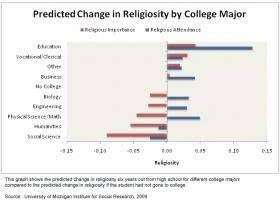
This graph shows the predicted change in religiosity six years out from high school for different college majors compared to the predicted change in religiosity if the student had not gone to college. Source: University of Michigan Institute for Social Research, 2009
(PhysOrg.com) -- College students who major in the social sciences and humanities are likely to become less religious, while those majoring in education are likely to become more religious.
But students majoring in biology and physical sciences remain just about as religious as they were when they started college.
Those are among key findings of a University of Michigan study on the connection between college attendance, college major and religiosity released this week (July 27) by the National Bureau of Economic Research. The study, funded by the John Templeton Foundation, is based on long-term data from the Monitoring the Future Study conducted by the U-M Institute for Social Research (ISR).
"Education majors are clearly safe havens for the religious," said U-M economist Miles Kimball, who co-authored the study. "Highly religious people seem to prefer education majors, tend to stay in that major, and tend to become more religious by the time they graduate."
For the study, Kimball and colleagues Colter Mitchell, Arland Thornton and Linda Young DeMarco analyzed data on approximately 26,200 individuals who graduated from high school between 1976 and 1996. They reviewed information on religious attitudes and college attendance and major for a period of six years.
Among the questions participants were asked: How often do you attend religious services? How important is religion in your life? How good or bad a job is being done for the country as a whole by churches and religious organizations?
Of those who did not attend college right away, those who were more religious were more likely to attend college eventually. One of the reasons for this might be a "nagging effect" of church friends who ask repeatedly about college attendance plans, the researchers speculate.
For the analysis of impact of college major on religiosity, the researchers used business majors as a reference point. "We wanted a major that was culturally neutral and that attracted a large number of students," Kimball said. "The content of most business courses does not touch on values."
The authors theorize that three powerful streams of thought interact with choice of college majors to amplify the impact on religiosity. These are science, developmentalism (the belief in progress), and postmodernism (the belief that everything is relative).
"There are important differences among the college majors in world views and overall philosophies of life," Kimball said. "At the same time, students recognize to some degree the differences among majors and chose a major based, at least in part, on religiosity.
"Our results suggest that it is Postmodernism, not Science, that is the bête noir of religiosity. One reason may be that the key ideas of Postmodernism are newer than the key scientific ideas that challenge religion. For example, religions have had 150 years to develop resistance or tolerance for the late 19th century idea of Evolution, but much less time to develop resistance or tolerance for the key ideas of Postmodernism, which gained great strength over the course of the 20th century."
-
Spirituality protects against depression better than church attendance
Oct 23, 2008 |
not rated yet |
0
-
Study suggests attending religious services sharply cuts risk of death
Nov 20, 2008 |
not rated yet |
0
-
Study: High school teachers influence student views of evolution, creationism
May 01, 2009 |
not rated yet |
0
-
Study: Religious belief declines in Britain
Aug 18, 2005 |
not rated yet |
0
-
Attending religious services predictive of fidelity
Apr 10, 2008 |
not rated yet |
0
-
Engineers build first sub-10-nm carbon nanotube transistor
Feb 01, 2012 |
4.9 / 5 (31) |
30
-
Something old, something new: Evolution and the structural divergence of duplicate genes
Jan 31, 2012 |
4.6 / 5 (7) |
1
-
The hidden nanoworld of ice crystals: Revealing the dynamic behavior of quasi-liquid layers
Jan 30, 2012 |
5 / 5 (3) |
1
-
Stock market network reveals investor clustering
Jan 27, 2012 |
3.9 / 5 (23) |
8
-
Of microchemistry and molecules: Electronic microfluidic device synthesizes biocompatible probes
Jan 26, 2012 |
5 / 5 (1) |
0
-
Can I forget a language?
14 hours ago
-
The Biggest Lie Ever
Feb 09, 2012
-
What are the limits of learning?
Feb 06, 2012
-
Isn't that grammatically wrong?
Feb 06, 2012
-
What does it mean when traders are indifferent?
Feb 04, 2012
-
Peak of Our Civilization
Feb 04, 2012
- More from Physics Forums - Social Sciences
More news stories
A frank discussion of the power law and linking correlation to causation
(PhysOrg.com) -- Michael Stumpf a mathematics professor at Imperial College in London, and Mason Porter a lecturer at Oxford have teamed together to write and publish a perspective piece in Science regarding the in ...
Employers feel no love for unscrupulous practice of 'service sweethearting'
A new study led by two Florida State University marketing professors finds that some frontline service employees who are rewarded for hikes in customer loyalty and satisfaction also may engage in "service ...
Other Sciences / Economics & Business
11 hours ago |
4 / 5 (1) |
4
The question of life in the ancient world
Theres a general feeling that we dont get the Greeks ancient or modern. Many, including heads of state like Angela Merkel, visibly shake their head in exasperation, rightly or wrongly, at ...
Other Sciences / Archaeology & Fossils
16 hours ago |
1.3 / 5 (3) |
4
Sonic Cradle lands spot in TED exhibition
A Simon Fraser University graduate student project that melds music, meditation and modern technology has landed a rare spot as an exhibit at TEDActive 2012 in Palm Springs, California this month.
13 hours ago |
not rated yet |
0
Chilean miners' rescue capsule on show in London
The capsule used to rescue Chilean miners trapped underground for two months goes on display Saturday at the Science Museum in London -- the first time it has been seen in Europe.
15 hours ago |
not rated yet |
0
Google users warned of threat to smartphone wallets
Users of Google smartphone wallets were being warned on Friday that there is a way to crack pass codes intended to thwart thieves from going on illicit shopping sprees.
Anonymous knocks CIA website offline (Update)
The website of the Central Intelligence Agency was inaccessible on Friday after the hacker group Anonymous claimed to have knocked it offline.
New error-correcting codes guarantee the fastest possible rate of data transmission
Error-correcting codes are one of the triumphs of the digital age. Theyre a way of encoding information so that it can be transmitted across a communication channel such as an optical fiber o ...
Humans may have helped the decline of African rainforests 3000 years ago
(PhysOrg.com) -- Large areas of rainforests in Central Africa mysteriously disappeared over three thousand years ago, to be replaced by savannas. The prevailing theory has been that the cause was a change ...
New power source discovered
(PhysOrg.com) -- Researchers at the Massachusetts Institute of Technology (MIT) and RMIT University have made a breakthrough in energy storage and power generation.
Complex wiring of the nervous system may rely on a just a handful of genes and proteins
Researchers at the Salk Institute have discovered a startling feature of early brain development that helps to explain how complex neuron wiring patterns are programmed using just a handful of critical genes. ...
Jul 31, 2009
Rank: not rated yet
Jul 31, 2009
Rank: not rated yet
Or is it just a case of GIGO?
Jul 31, 2009
Rank: 5 / 5 (3)
Religious proselytizers go into secular education so they can become teachers, and once they become teachers, they begin to teach the scriptures, rather than facts. Who is to stop them? They have tax-free buildings to use on Sundays, and tax-paid ones on Monday through Fricay. With such six day per week preparation of the minds of the children, who could be surprised that it is only when they reach the relative freedom to think and exposure to alternative ways of thinking-- in the arts and sciences departments-- that the move away from religious indoctrination can begin.
And still they cry persecution whenever anyone shines a light on their superstitions and myths.
Jul 31, 2009
Rank: not rated yet
Aug 01, 2009
Rank: not rated yet
As a person who fell for both the born-again/evangelical world view in my youth, and then the standard social science model later on at University, all I can say is that the standard social science model at least allows for greater room for intellectual exploration and development, as opposed to the two thousand year window from Abraham to Jesus possible for those who accept a literalist Biblical interpretation and teach it in public, tax-payer funded schools, in contravention of the first amendment separation of church and state.
The SSS Model is incorrect at its core, and the blank slate is as big a myth as Eve eating the fruit in explaining human nature, but it at least provides a spring board from which further analysis and expansion of thinking can occur, such as into comparative anthropology, archaeology, cognitive neuroscience, and evolutionary psychology. Just as Copernicus only had to change one thing to get the solar system model roughly correct-- placing the sun at the center-- so it is only necessary to discard Jean Jaques Rousseau and the blank slate foolishness for the social sciences to begin having a chance at accurately understanding history, philosophy, political science, sociology, psychology, and anthropology in a truly scientific context.
Aug 01, 2009
Rank: 3 / 5 (2)
I find fundamentalists/literalists and fervent atheists equally narrow-minded. It makes sense that both come from backgrounds that have nothing to do with science, or plain practicality. Neither one bothers to look at their object of study in a lucid, selfless way. Alas, a wise man points at the moon and all the fools stare at his finger...
Aug 03, 2009
Rank: not rated yet
Do you really think that's true? A significant majority of the members of the National Academy of Sciences do not believe in a god. On the other hand, a striking minority of the general world population does not believe in a god. So in general it certainly appears that there is a strong direct correlation between scientific education and atheism.
Sources:
http://www.stephe...002.html
https://www.cia.g...122.html
Aug 03, 2009
Rank: 1 / 5 (1)
Also, there's a difference between not believing in a god and being a devout atheist, so to speak. Buddhism, for instance, has no gods whatsoever. See, most atheists simply reject religious teachings/principles solely on the basis of "hey, it says a guy rose from the dead, which is impossible, so there's nothing to learn from this book". For me, looking at a story, or any piece of information, and inferring nothing further than what common sense tells you implies a lack of imagination and desire to know more, qualities which are absolutely necessary(though not sufficient) in any scientific activity.
As for the Nature article you quote, it's exactly what I'm talking about. The survey was done by a psychologist and the questions are, again, profoundly biased, limiting religious experience to a monotheistic God and a vague concept of immortality, not to mention the fact that somehow America is made an etalon for the entire world.
As a closing statement, consider Einstein's views on spirituality and the religiousness of most great scientists before 1950.
Aug 03, 2009
Rank: 5 / 5 (1)
You seem to be equating "narrow-minded" with "the atheist extreme." It's not at all clear to me why or how atheism would be narrow-minded. Is not believing in Zeus narrow-minded? What I extremely don't believe in Zeus? Careful with your response - it may reveal if you're a militant, narrow-minded, a-Zeusian heretic.
I think you misunderstand what atheism is. Or what devout means, for that matter.
That's right, Buddhism is a non-theistic religion. So one can be a Buddhist and an athiest *at the same time*. Which is why your next sentence doesn't really make sense:
I'm curious how you have come to know the attitude of "most athiests." It might be more productive for you to address specific ideas and positions rather than the imaginary attitudes of imaginary people. Also, as stated above, atheism isn't a rejection of religion; it's a disbelief in a god. As you noted, one can have religion without a god.
I'm not sure what you're trying to get at here. If it's the Bible you're referring to, you should know that there exist agnostic and athiestic Biblical scholars who have extracted fascinating insights from that document. Bart Ehrman is a well-known example.
So do you categorically reject psychology, or just psychologists who presume to do surveys? That smacks of Scientology. Hmm. Anyway, although one can be religious without believing in a god, the two are nevertheless highly correlated. According to the CIA factbook I linked to above, 54% of the world's population claims to be either Christian or Muslim. The 11.78% "other religions" is probably the hundreds or thousands of various tribal religions that believe in some kind of deity. So conflating religion with a belief in a god is a jump, but hardly a "profound bias".
Einstein was an agnostic, deist, or athiest:
"It was, of course, a lie what you read about my religious convictions, a lie which is being systematically repeated. I do not believe in a personal God and I have never denied this but have expressed it clearly. If something is in me which can be called religious then it is the unbounded admiration for the structure of the world so far as our science can reveal it." - from a letter Einstein wrote in English, dated 24 March 1954.
But what does that matter? Einstein was a smart guy, but even if he had loved Jesus and prayed to Mary, that wouldn't make Catholicism true. As a closing statement, consider the atheism of most scientists since the great advances in pretty much all areas of knowledge since 1950.
Aug 03, 2009
Rank: not rated yet
Believing or not believing is beside the point, the problems arise when declaring one's (lack of) faith and making a big fuss out of it. And, ultimately, everybody believes in something, that is to say they are quite, yet never 100%, certain of some causal links. To be narrow-minded is to refuse to accept the possibility that you could be wrong and someone else might be right. I equate this with any extreme belief in anything.
In regards to Buddhism and belief in a God, I was again refering to how the questions of the NAS survey were inadequately formulated. The research tools of those who study society and large groups of humans are not only inaccurate, but due to results being widely broadcast, they also affect future measurement by artificially defining zeitgeist, stereotypes and common knowledge. The first NAS survey was done in 1914, another one in 1933 and the latest in 1998. The number of "smart people" who "say no to Jesus" have gone up each time. Incidentally, mass-media coverage went up as well. Oh, and people still like to be smart, always have.
In light of that argument, I reserve the right to use expressions such as "most", "some" etc. when discussing human behaviour. I prefer them to "highly correlated", "statistically significant" or exact numbers.
So, yes, most atheists I know of, obviously outspoken ones otherwise I wouldn't have known of them, target specific information in the Bible and not the overall idea. They do the whole "why God and not Zeus, or the Great Juju" routine, or go for the miracles or, if they're smart, for the fact that religious texts have been modified over time. They attack facts, not ideas. And any discussion on the ideas is doomed, like any philosophical debate, to aporia.
I'll try to sum up the points I've been trying to make: 1.social sciences are not yet sciences;
2.any form of belief can lead to zealotry and therefore narrow-mindedness;
3.great scientists from before 1950(arbitrary year here) have always sought knowledge both rational and spiritual, and adherence to a religion or plain spirituality never interfered destructively with reason;
Aug 03, 2009
Rank: not rated yet
Aug 04, 2009
Rank: not rated yet
About Six day creation -- Even before Jesus, Rabbis began writing comments about Moses books. They understood that there were other ways to understand Genesis. By the time Paul wrote Romans the notion the six day creation was an allegorical tale, or a prophetic vision was believed by many Jews and Christians, Paul been one of the most obvious defenders of the prophetic view. Read very carefully Romans (%u201Cthe letter kills...%u201D %u201Cfor the man in the flesh... madness%u201D ), Galatians (%u201Cshadow of the things to come...%u201D), Corinthians (quotes Leviticus, 'thou shall not put a muzzle in the ox%u2026' then asks: 'do you think God cares about oxen...'). If you think the Six day creation should be taken literally, take this test and discover something about yourself, answer the following questions:
Is there a tree somewhere in Iran, that if Hitler, Saddam or Bin Laden would eat its fruit, they would become eternal gods? Now read the story of Adam and Eve again.
What is an image or a resemblance? Is God plural and in the shape of a man and a woman? Read the sixth day again.
And last, are you telling me your god get tired and needs rest? Seventh day...
About the mix-up with Evolution and %u201CTheory of Natural Selection%u201D: Evolution is an observed fact, supported by the Himalayas and the Andes worth of fossils %u2013 literally! The Theory of Natural Selection is a theory about how this evolution came to be, and as any other scientific theory, it is continuously improved and revisited, and could even one day may be thought as obsolete. It is not meant to prove or disprove the existence of a higher being.
Aug 09, 2009
Rank: not rated yet
The "God rested" thing is most likely a poke at the folks who worked their slaves 24/7 (well, at least "7").... Not so much he needed the rest, as "well, let's look at other things for a bit", perhaps?
I'm not going to say "All", but, IMHO, "Most" of this stuff was written to make a point in more real world terms. And, we probably read a good deal into it, too, because of our own views/beliefs, etc.
(Dozens of Christian "explainers" pored over the Old Testament looking for prophecy. "It's talking about 'sheep', so it's got to be a 'Lamb of God' reference, and...." Sure....)
I've got a BA in The Psychology of Religion. I consider myself religious, but rarely attend services, although a good chunk of my ill-spent youth taught me pretty much the entire content of the prayerbook.
Over the decades, I decided that it was largely a style show, and the Rabbi's sermons were almost as bad a joke as Reverend Lovejoy's on "The Simpsons".... We're on the second Rabbi who's capable of writing a sermon that only he and I understand, but that's an inside joke. What's wrong with this picture is the guy who, in a world where everything was coming apart at the seams, did a twenty minute talk on "Sin".... I almost walked out. (I'm still not sure why I was there....)
So, it's "supportive, but not particularly active"....
Works for me....
(I've got a minor in History, and one in Law Enforcement. Seriously eclectic, but way off the map for the study we're talking about. If nothing else, my education gave me a much better understanding. It also killed the idea of mindless repetition. That makes staying away easier....)
Regards