Micro flying robots can fly more effectively than flies
August 1, 2009
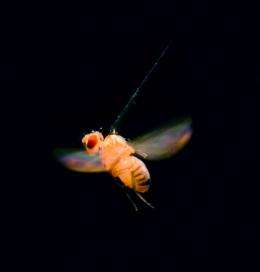
A fruit fly with a wingspan of 5 mm inspires the design of flying micro robots. Photo: Dickinson lab
There is a long held belief among engineers and biologists that micro flying robots that fly like airplanes and helicopters consume much more energy than micro robots that fly like flies. A new study now shows that a fly wing that spins like a helicopter blade generates the same amount of lift as a flapping fly wing while consuming only half the energy to move the wing. This finding can inspire the design of efficient micro flying robots with spinning fly-like wings.
Engineers have long been stymied in their attempts to fabricate micro aerial robots that can match the amazing flight capabilities of nature’s most advanced flying insects -- flies. Such robot flies -- if they could be made efficient enough for long missions -- could be used for a variety of tasks, from spying, to mine detection to search and rescue missions in collapsed buildings.
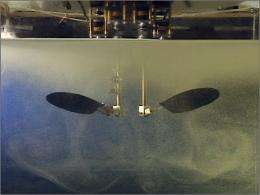
RoboFly a robot model of fruit fly wings that is 100 times larger than a fruit fly. It is submerged in oil to simulate the viscosity of the sticky air around the wing of a real fruit fly. Photo: Dickinson lab
There is a long held belief among engineers and biologists that micro flying robots that fly like airplanes and helicopters consume much more energy than micro robots that fly like advanced insects such as flies. The previous thinking was that basic flapping wings at the small scale of insects waste less energy while generating lift. This idea, which has become integral to the development of fly-sized flying robots, now has been tested rigorously by a Dutch aerospace engineer, David Lentink at Wageningen University (Netherlands), who joined forces with a leading expert on insect flight, biologist Michael Dickinson at the California Institute of Caltech.Together they used a giant robot fly submerged in a tank of oil to test whether flies consume less energy to hover than a micro helicopter outfitted with a fly wing. To their surprise, they found that a spinning fly wing generated the same amount of lift as a flapping fly wing while consuming only half the energy to keep the wing moving. The study shows that robots that hover like flies can save up to 50% energy if they swing an insect wing around like a helicopter blade. This finding can result in new, more energy efficient micro flying robot designs inspired by both the effective wing shape of insects and the energy efficient spinning motion of helicopter blades.
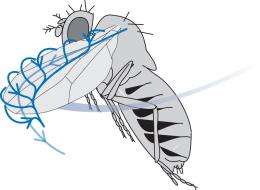
Leading Edge Vortex on top of a fruit fly wing. Image: David Lentink & Michael Dickinson
Flapping wings waste a lot of energy accelerating the air back and forth,’ explains Lentink. "That is why spinning insect wings consume less energy than flapping wings." So what does all this mean for engineers keen on designing micro fliers? "Engineers have been thinking that fly sized flying machines would have to fly like a fly to be energy efficient," says Lentink, but he now realizes that is not the case. The reason being that both spinning and flapping insect wings can generate much more lift than predicted by aerodynamic theory -- up to twice as much. The extra lift is generated by a stable ’tornado-like’ vortex that runs parallel to the leading edge of the wing. This vortex lowers the pressure over the wing and sucks it upward, lifting the insect's weight into the air. It was already known that both spinning and flapping insect wings can generate such a lift boosting vortex.The new work shows which wing motion generates high lift most effectively -- the insect wing that spins around similar to a helicopter blade. Nevertheless, we still have much to learn from flies, says Dickinson. These tiny animals have evolved into some of nature’s best fliers and whereas the micro batteries of humans can keep their fly-sized robots aloft for mere seconds or minutes, flies can fly effortlessly for hours. ‘With such an effective form of energy storage and motors, flies are much less dependent on energy efficiency than our best robot flies," says Dickinson> "We can still learn from nature how to improve our flying robot designs, but not without a better understanding of why flies fly so well."
More information:
Published on the 31th of July in two Research Articles in the Journal of Experimental Biology:
- Lentink, D. and Dickinson, M.H. (2009) Rotational accelerations stabilize leading edge vortices on revolving fly wings. J. Exp. biol. 16.
- Lentink, D. and Dickinson, M.H. (2009) Biofluidynamic scaling of flapping, spinning and translating fins and wings. J. Exp. biol. 16.
Provided by Wageningen University
-
Deciphering the Mystery of Bee Flight
Nov 30, 2005 |
not rated yet |
0
-
Maple seeds and animals exploit the same trick to fly (w/Video)
Jun 11, 2009 |
not rated yet |
0
-
Bird sized airplane to fly like a swift
Jul 18, 2007 |
not rated yet |
0
-
Flies provide aerodynamic model for tiny flying vehicles
Aug 28, 2006 |
not rated yet |
0
-
Cyclogyro Flying Robot Improves its Angles of Attack
Jan 22, 2009 |
not rated yet |
0
-
Engineers build first sub-10-nm carbon nanotube transistor
Feb 01, 2012 |
4.9 / 5 (31) |
30
-
Something old, something new: Evolution and the structural divergence of duplicate genes
Jan 31, 2012 |
4.6 / 5 (7) |
1
-
The hidden nanoworld of ice crystals: Revealing the dynamic behavior of quasi-liquid layers
Jan 30, 2012 |
5 / 5 (3) |
1
-
Stock market network reveals investor clustering
Jan 27, 2012 |
3.9 / 5 (23) |
8
-
Of microchemistry and molecules: Electronic microfluidic device synthesizes biocompatible probes
Jan 26, 2012 |
5 / 5 (1) |
0
-
Calling function with no input argument
14 hours ago
-
Force free body diagram problem on gym equipment
15 hours ago
-
Empirical data regarding shower heads and water
23 hours ago
-
feed hold button on CNC lathe
Feb 09, 2012
-
RFAC in Fortran
Feb 09, 2012
-
dynamics 2/32
Feb 08, 2012
- More from Physics Forums - General Engineering
More news stories
Google users warned of threat to smartphone wallets
Users of Google smartphone wallets were being warned on Friday that there is a way to crack pass codes intended to thwart thieves from going on illicit shopping sprees.
7 hours ago |
5 / 5 (2) |
0
Anonymous knocks CIA website offline (Update)
The website of the Central Intelligence Agency was inaccessible on Friday after the hacker group Anonymous claimed to have knocked it offline.
8 hours ago |
5 / 5 (9) |
13
New error-correcting codes guarantee the fastest possible rate of data transmission
Error-correcting codes are one of the triumphs of the digital age. Theyre a way of encoding information so that it can be transmitted across a communication channel such as an optical fiber o ...
Technology / Computer Sciences
17 hours ago |
4.9 / 5 (8) |
6
|
New power source discovered
(PhysOrg.com) -- Researchers at the Massachusetts Institute of Technology (MIT) and RMIT University have made a breakthrough in energy storage and power generation.
Technology / Energy & Green Tech
16 hours ago |
4.8 / 5 (26) |
8
|
Small modular reactor design could be a 'SUPERSTAR'
(PhysOrg.com) -- Though most of today's nuclear reactors are cooled by water, we've long known that there are alternatives; in fact, the world's first nuclear-powered electricity in 1951 came from a reactor ...
Technology / Energy & Green Tech
16 hours ago |
4.3 / 5 (12) |
22
|
Humans may have helped the decline of African rainforests 3000 years ago
(PhysOrg.com) -- Large areas of rainforests in Central Africa mysteriously disappeared over three thousand years ago, to be replaced by savannas. The prevailing theory has been that the cause was a change ...
Complex wiring of the nervous system may rely on a just a handful of genes and proteins
Researchers at the Salk Institute have discovered a startling feature of early brain development that helps to explain how complex neuron wiring patterns are programmed using just a handful of critical genes. ...
The power of estrogen -- male snakes attract other males
A new study has shown that boosting the estrogen levels of male garter snakes causes them to secrete the same pheromones that females use to attract suitors, and turned the males into just about the sexiest ...
Putting the squeeze on planets outside our solar system
(PhysOrg.com) -- Using high-powered lasers, scientists at Lawrence Livermore National Laboratory and collaborators discovered that molten magnesium silicate undergoes a phase change in the liquid state, abruptly ...
Could Venus be shifting gear?
(PhysOrg.com) -- ESAs Venus Express spacecraft has discovered that our cloud-covered neighbour spins a little slower than previously measured. Peering through the dense atmosphere in the infrared, the ...
Fool's gold may prove an unlikely alternative to overexploited catalytic materials
Catalytic materials, which lower the energy barriers for chemical reactions, are used in everything from the commercial production of chemicals to catalytic converters in car engines. However, with current catalytic materials ...


Aug 02, 2009
Rank: 1 / 5 (3)
Aug 02, 2009
Rank: 1 / 5 (1)
Aug 03, 2009
Rank: 5 / 5 (1)