Finding the Right Connection after Spinal Cord Injury
August 2, 2009 By Debra Kain Finding the right connection after spinal cord injury

Enlarge

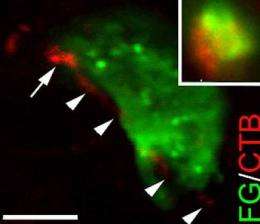
This image shows a target cell in the brain (green) contacted by an axon (red) regenerating into the brain from the spinal cord. Credit: UC San Diego School of Medicine

In a major step in spinal cord injury research, scientists at the University of California, San Diego School of Medicine have demonstrated that regenerating axons can be guided to their correct targets and re-form connections after spinal cord injury. Their findings will be published in the advance online edition of the journal Nature Neuroscience on August 2.

In the last few years, researchers have shown that the severed wires of the spinal cord, called axons, can be induced to regenerate into and beyond sites of experimental spinal cord injury. But a key question has been how these regenerating axons, on reaching the end of an injury site, can be guided to a correct cell target when faced with millions of potential targets. Further, can regenerating axons form functional, electrical connections called synapses?

"The ability to guide regenerating axons to a correct target after spinal cord injury has always been a point of crucial importance in contemplating translation of regeneration therapies to humans," said senior author Mark Tuszynski, MD, PhD, professor of neurosciences and director of the Center for Neural Repair at UC San Diego, and neurologist at the Veterans Affairs San Diego Health System. "While our findings are very encouraging in this respect, they also highlight the complexity of restoring function in the injured spinal cord."

The UC San Diego study looked at regenerating sensory axons in rat models of spinal cord injury. Sensory systems of the body send axons - long, slender projections of the neuron - into the spinal cord to convey information regarding touch, position, and pain. Many sensory axons are covered by an insulating myelin sheath which helps these impulses travel efficiently to the brain.

In certain , the axons are severed and the myelin sheath damaged. Loss of these systems results in an inability to feel or sense the body. The axons can no longer link to their targets in the brain, which blocks the electrical impulses from reaching the central nervous system.

The UC San Diego scientists showed that regenerating axons can be guided to correct targets using a type of chemical hormone called a growth factor. The team utilized a type of chemical hormone, a nervous system growth factor called neurotrophin-3 (NT-3), to guide regenerating sensory axons to the appropriate target and support synapse formation. Regeneration required two other treatments at the same time: placing a cell bridge in the spinal cord injury site to support axon growth, and a "conditioning" stimulus to the injured neuron that turned on regeneration genes for new growth.

When the growth factor was placed in the correct target as a guidance cue, axons regenerated into it and formed synapses. When the growth factor was placed in the wrong target, axons also followed the growth factor and grew into the wrong region.

Using high-resolution imaging systems, the scientists showed that regenerating axons guided to the correct cell formed synapses that were precisely on target. These axons contained rounded vesicles - small packets at the end of the axon, packed with the chemical messengers needed to support electrical activity in the newly formed circuit.

Nonetheless, the connections were not electrically active. Additional study revealed the likely reason for this: the regenerating axons were not covered in myelin, the insulating material of the nervous system.

"Restoring axonal circuitry is complex, requiring several concurrent therapies to achieve axonal regeneration into and beyond a lesion site," said Tuszynski. "But, just as an electrical circuit needs insulation so it doesn't short-circuit, it appears that these regenerating axons require restoration of the myelin sheath to ultimately restore function." This will be the next step in the team's research.

In earlier research (reported in PNAS April 6), the UC San Diego team achieved the first corticospinal motor axon regeneration by genetically engineering injured neurons to over-express receptors for another type of nervous system growth factor called brain-derived neurotrophic factor (BDNF). The growth factor was delivered to a brain lesion site in injured rats, where axons responded and regenerated into the injury site.

Source: University of California - San Diego (news : web)


print this article email this article download pdf blog this article bookmark this article     Stumble it Digg this share on Facebook retweet share on Reddit add to delicious
Rate this story - 5 /5 (5 votes)

Rank Filter

Move the slider to adjust rank threshold, so that you can hide some of the comments.


Display comments: newest first

  • meisdug - Aug 02, 2009
    • Rank: not rated yet
    ooo ooo, do me next. I have a spinal cord injury. I'll be a guinea pig.
  • Jacques10 - Aug 03, 2009
    • Rank: not rated yet
    I was involved in serious rugby injury in 2007,the doctors gave me 4% to recover and gain use of my limbs. Parallesis was caused by a injury on level C3-4. Since I have almost fully recovered but still have a lack of sensation in my lower limbs, as well as small limitations in m right hand and of course balance is still a problem with the legs not being as strong as they should be. Is there anything that can be done to maybe improve and what are the costs involved just for interest sake

August 2, 2009 all stories

Comments: 2

5 /5 (5 votes)
  • Stumble this up

  • Digg this

  • share this

  • hide
  • Related Stories

  • Researchers regenerate axons necessary for voluntary movement
    created Apr 06, 2009 | popularity not rated yet | comments 0
  • Promising new nanotechnology for spinal cord injury
    created Apr 02, 2008 | popularity not rated yet | comments 0
  • New research reveals critical knowledge about the nervous system
    created Nov 06, 2007 | popularity not rated yet | comments 0
  • Silencing growth inhibitors could help recovery from brain injury
    created Nov 06, 2008 | popularity not rated yet | comments 0
  • Sole use of impaired limb improves recovery in spinal cord injury
    created Sep 16, 2008 | popularity not rated yet | comments 0


  • hide
  • Relevant PhysicsForums posts

  • 23 Years in a Vegetative State....or not?
    created Nov 25, 2009
  • Has the H1N1 vaccine been scientifically proven to work?
    created Nov 24, 2009
  • nesfatin
    created Nov 22, 2009
  • Obsessive Compulsive Disorder
    created Nov 20, 2009
  • West's zone 2 starling resistor respiratory physiology
    created Nov 18, 2009
  • 50-0-50 rule
    created Nov 18, 2009
  • More from Physics Forums - Medical Sciences

Other News

Implant-based cancer vaccine is first to eliminate tumors in mice

Implant-based cancer vaccine is first to eliminate tumors in mice

Medicine & Health / Cancer

created 13 hours ago | popularity 4.9 / 5 (19) | comments 4

(PhysOrg.com) -- A cancer vaccine carried into the body on a carefully engineered, fingernail-sized implant is the first to successfully eliminate tumors in mammals, scientists report this week in the journal ...


Brain's endocannabinoid signaling pathway kept in check by two enzymes

Medicine & Health / Research

created 11 hours ago | popularity 5 / 5 (2) | comments 0

(PhysOrg.com) -- A research team has shown that blocking the degradation of two naturally occurring cannabinoids in the endocannabinoid signaling pathway of the brain produces marijuana-like behavioral effects in mice, according ...


Scale of justice

fMRI scans used in murder trial sentencing

Medicine & Health / Other

created 21 hours ago | popularity 1 / 5 (1) | comments 4

(PhysOrg.com) -- Functional Magnetic Resonance Imaging (fMRI) scans have been used, possibly for the first time, in the sentencing phase of a murder trial in Chicago in the US.


Scientists find emotion-like behaviors, regulated by dopamine, in fruit flies

Medicine & Health / Neuroscience

created 15 hours ago | popularity 5 / 5 (3) | comments 0

Scientists at the California Institute of Technology have uncovered evidence of a primitive emotion-like behavior in the fruit fly, Drosophila melanogaster. Their findings, which may be relevant to the relationship betwee ...


Study sheds light on brain's fear processing center

Medicine & Health / Research

created 15 hours ago | popularity 5 / 5 (3) | comments 1

Breathing carbon dioxide can trigger panic attacks, but the biological reason for this effect has not been understood. A new study by University of Iowa researchers shows that carbon dioxide increases brain acidity, which ...