New microchip technology performs 1,000 chemical reactions at once
August 3, 2009 New microchip technology performs 1,000 chemical reactions at once

Enlarge

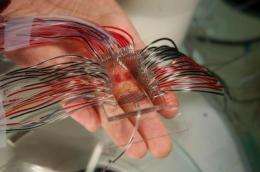
This is a microfluidic device held in the palm of the hand. Credit: UCLA

(PhysOrg.com) -- Flasks, beakers and hot plates may soon be a thing of the past in chemistry labs. Instead of handling a few experiments on a bench top, scientists may simply pop a microchip into a computer and instantly run thousands of chemical reactions, with results -- literally shrinking the lab down to the size of a thumbnail.

Toward that end, UCLA researchers have developed technology to perform more than a thousand chemical reactions at once on a stamp-size, PC-controlled microchip, which could accelerate the identification of potential drug candidates for treating diseases like cancer.

Their study appears in the Aug. 21 edition of the journal and is currently available online.

A team of UCLA chemists, biologists and engineers collaborated on the technology, which is based on microfluidics — the utilization of miniaturized devices to automatically handle and channel tiny amounts of liquids and chemicals invisible to the eye. The chemical reactions were performed using in situ click chemistry, a technique often used to identify potential drug molecules that bind tightly to protein enzymes to either activate or inhibit an effect in a cell, and were analyzed using mass spectrometry.
New microchip technology performs 1,000 chemical reactions at once
Enlarge

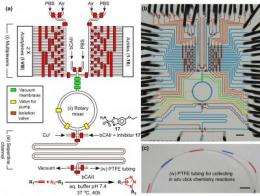
This is the design of the second generation integrated microfluidic device. Credit: UCLA

While traditionally only a few could be produced on a chip, the research team pioneered a way to instigate multiple reactions, thus offering a new method to quickly screen which drug molecules may work most effectively with a targeted protein enzyme. In this study, scientists produced a chip capable of conducting 1,024 reactions simultaneously, which, in a test system, ably identified potent inhibitors to the enzyme bovine carbonic anhydrase.

A thousand cycles of complex processes, including controlled sampling and mixing of a library of reagents and sequential microchannel rinsing, all took place on the microchip device and were completed in just a few hours. At the moment, the UCLA team is restricted to analyzing the reaction results off-line, but in the future, they intend to automate this aspect of the work as well.

"The precious enzyme molecules required for a single in situ click reaction in a traditional lab now can be split into hundreds of duplicates for performing hundreds of reactions in parallel, thus revolutionizing the laboratory process, reducing reagent consumption and accelerating the process for identifying potential drug candidates," said study author Hsian-Rong Tseng, a researcher at UCLA's Crump Institute for Molecular Imaging, an associate professor molecular and medical pharmacology at the David Geffen School of Medicine at UCLA, and a member of the California NanoSystems Institute at UCLA.

Kym F. Faull, director of the Pasarow Mass Spectrometry Lab at UCLA, helped the team with several challenges, including reducing the amount of chemicals needed for reactions on the chip, enhancing test sensitivity and speeding up reaction analysis.

"The system allows researchers to not only test compounds quicker but uses only tiny amounts of materials, which greatly reduces lab time and costs," said Faull, a professor of psychiatry and biobehavioral sciences at the Geffen School of Medicine.

Next steps for the team include exploring the use of this microchip technology for other screening reactions in which chemicals and material samples are in limited supply — for example, with a class of protein enzymes called kinases, which play critical roles in the malignant transformation of cancer.

According to the researchers, the technology may open up many areas for biological and medicinal study.

Source: University of California - Los Angeles


print this article email this article download pdf blog this article bookmark this article     Stumble it Digg this share on Facebook retweet share on Reddit add to delicious
Rate this story - 5 /5 (11 votes)

Rank Filter

Move the slider to adjust rank threshold, so that you can hide some of the comments.


Display comments: newest first

  • getgoa - Aug 03, 2009
    • Rank: 1 / 5 (1)
    Am I understanding this right, all the wires stand for a different chemical triggering what chemicals or wires in this case will react with one another and thereby giving results instantaneoulsy to the computer?
  • El_Nose - Aug 03, 2009
    • Rank: not rated yet
    good article -- informative --- but why is it that headlines now tie into the first paragraph of the article??
  • thales - Aug 03, 2009
    • Rank: 5 / 5 (1)
    I'm excited for the applications this could mean for genetic algorithms. One major limitation of GAs is the ability to apply a real-world fitness test quickly, as noted here:
    http://web.duke.e...problems

    With a quick way to test thousands of candidate solutions in the "real world," a GA approach would be incredibly powerful.

August 3, 2009 all stories

Comments: 3

5 /5 (11 votes)
  • Stumble this up

  • Digg this

  • share this

  • hide
  • Related Stories

  • New Microlab on Chip for Medical Imaging Biomarkers
    created Dec 16, 2005 | popularity not rated yet | comments 0
  • 'Designer enzymes' created by chemists
    created Mar 19, 2008 | popularity not rated yet | comments 0
  • Flow of tiny bubbles mimics computer circuitry
    created Feb 08, 2007 | popularity not rated yet | comments 0
  • Chip simulates metabolism of medicine in human body
    created Apr 24, 2009 | popularity not rated yet | comments 0
  • High-pressure chemistry in ultra small pressure cooker
    created Apr 13, 2007 | popularity not rated yet | comments 0


  • hide
  • Relevant PhysicsForums posts

  • Putting every element in a box
    created Nov 25, 2009
  • a question in Lewis structure???
    created Nov 25, 2009
  • Paint Technology
    created Nov 24, 2009
  • About pH, Metallic electrodes
    created Nov 24, 2009
  • Rate Laws
    created Nov 21, 2009
  • why oxygen, cannot act as a pi-donor while NO can?
    created Nov 20, 2009
  • More from Physics Forums - Chemistry

Other News

Research sheds light on workings of anti-cancer drug

Chemistry / Analytical Chemistry

created 12 hours ago | popularity not rated yet | comments 0

(PhysOrg.com) -- The copper sequestering drug tetrathiomolybdate (TM) has been shown in studies to be effective in the treatment of Wilson disease, a disease caused by an overload of copper, and certain metastatic cancers. ...


New chemical reaction offers opportunities for drug development

Chemistry / Biochemistry

created 16 hours ago | popularity not rated yet | comments 2

Researchers led by Conway Fellow, Professor Pat Guiry have solved a chemistry problem that has stumped researchers worldwide for more than a decade. The results have earned the group the cover story of the leading scientific ...


Sandia CR5

Machine Converts CO2 into Gasoline, Diesel, and Jet Fuel

Chemistry / Biochemistry

created Nov 23, 2009 | popularity 4.6 / 5 (30) | comments 20

(PhysOrg.com) -- Researchers at Sandia National Laboratories have built a machine that uses the sun's energy to convert carbon dioxide waste from power plants into transportation fuels such as gasoline, diesel, ...


New hydrogen-storage method discovered

New hydrogen-storage method discovered

Chemistry / Materials Science

created Nov 22, 2009 | popularity 4.3 / 5 (42) | comments 15

Scientists at the Carnegie Institution have found for the first time that high pressure can be used to make a unique hydrogen-storage material. The discovery paves the way for an entirely new way to approach ...


New on-off 'switch' triggers and reverses paralysis in animals with a beam of light

New on-off 'switch' triggers and reverses paralysis in animals with a beam of light (w/ Video)

Chemistry / Biochemistry

created Nov 18, 2009 | popularity 4.8 / 5 (5) | comments 4

In an advance with overtones of Star Trek phasers and other sci-fi ray guns, scientists in Canada are reporting development of an internal on-off "switch" that paralyzes animals when exposed to a beam of ultraviolet ...