A 'super sensor' for cancer and CSIs
August 3, 2009 A 'super sensor' for cancer and CSIs

Enlarge

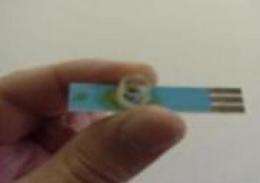
Tel Aviv University's "super sensor" sniffs out disease and pollution. Credit: AFTAU

Like the sensitive seismographs that can pick up tremors of impending earthquakes long before they strike, a similar invention from Tel Aviv University researchers may change the face of molecular biology.

Coupling biological materials with an electrode-based device, Prof. Judith Rishpon of TAU's Department of and Biotechnology is able to quickly and precisely detect pathogens and pollution in the environment - and infinitesimally small amounts of disease biomarkers in our blood. About the size of a stick of gum, the new invention may be applied to a wide range of environments and situations. The aim is for the device to be disposable and cost about $1.

"Biosensors are important for the bio-terror industry, but are also critical for detecting pathogens in water, for the food industry, and in medical diagnostics," says Prof. Rishpon. Her latest research appeared in the journals Nanomedicine: Nanotechnology Biology and Medicine, Electroanalysis and Bioelectrochemistry.

What makes this particular invention particularly appealing is its small size and the fact that it can be easily connected to a handheld device like a Blackberry or iPhone for quick and reliable results. An electrical signal will pulse "yes" for the presence of a test molecule and a "no" for its absence.

Currently, clinical researchers are testing its application in cancer diagnostics, focusing on the detection of proteins associated with colon and brain cancer and efficacy of . But the device is capable of detecting various types of substances. "It really depends on what you put at the end of the electrode," says Prof. Rishpon.

"You can put enzymes, antibodies or bacteria on my electrodes to sense the existence of a chemical target. Then we can measure the amount of the target, assessing its potency by using additional enzymes or by looking at the changes of the electrochemical properties on the device," she says.

Enzymes released before the onset of a heart attack can also be detected, so this application has obvious uses in an operating room to give a physician warning of an impending attack during a procedure. It could be fitted into an implant like a pacemaker or another future device to alert the user to impending dangers, thus preventing sudden death.

Prof. Rishpon is also investigating the application of her technology to detect for pathogens in drinking water such as estrogen, a byproduct of the female birth control pill. The presence of these chemicals in America's drinking water is no minor health concern. And before tackling the problem, water officials need to know what they are up against. Prof. Rishpon's solution could be part of the future toolkit, she believes.

Detecting pesticides in food is another very desirable application. The organic food market is calling for more rigorous testing and regulations to ensure spraying doesn't occur on some farms, and that limits are not breached on others.

Commercial applications of Prof. Rishpon's basic research are already underway in many areas of diagnostics, but clearly there are more to come. "My super sensors are cheap, accurate and highly sensitive, and in principle they could detect and measure the presence of almost every biological-based material," Dr. Rishpon concludes. She is also collaborating on the device with scientists at Arizona State University.

Source: Tel Aviv University (news : web)


print this article email this article download pdf blog this article bookmark this article     Stumble it Digg this share on Facebook retweet share on Reddit add to delicious
Rate this story - 5 /5 (1 vote)

Rank Filter

Move the slider to adjust rank threshold, so that you can hide some of the comments.


Display comments: newest first

  • omatumr - Aug 03, 2009
    • Rank: 3 / 5 (1)
    CONGRATULATIONS!

    I know that Professor Ma has been working on similar technology at the University of Missouri-Rolla (now Missouri University of Science & Technology), but yours seems to be the first public announcement of this important development.

    Again, Congratulations!

    With kind regards,
    Oliver K. Manuel
    http://www.omatumr.com

August 3, 2009 all stories

Comments: 1

5 /5 (1 vote)
  • Stumble this up

  • Digg this

  • share this

  • hide
  • Related Stories

  • A 'bionic nose' that knows
    created Mar 30, 2009 | popularity not rated yet | comments 0
  • A simple blood test for colon cancer
    created Nov 20, 2008 | popularity not rated yet | comments 0
  • Tiny 'lab-on-a-chip' detects pollutants, disease and biological weapons
    created Feb 17, 2009 | popularity not rated yet | comments 0
  • Researchers root out new and efficient crop plants
    created Jul 30, 2008 | popularity not rated yet | comments 0
  • PANTHER sensor quickly detects pathogens
    created Mar 04, 2008 | popularity not rated yet | comments 0


  • hide
  • Relevant PhysicsForums posts

  • Putting every element in a box
    created 4 hours ago
  • a question in Lewis structure???
    created 12 hours ago
  • Paint Technology
    created Nov 24, 2009
  • About pH, Metallic electrodes
    created Nov 24, 2009
  • More from Physics Forums - Chemistry

Other News

Blocking biofilms: Alzheimer's research sheds light on potential treatments for urinary tract infections

Chemistry / Biochemistry

created 9 hours ago | popularity 5 / 5 (1) | comments 0

(PhysOrg.com) -- Research into Alzheimer's disease seems an unlikely approach to yield a better way to fight urinary tract infections (UTIs), but that's what scientists at Washington University School of Medicine in St. Louis ...


Chemists get custom-designed microscopic particles to self-assemble in liquid crystal

Chemists get custom-designed microscopic particles to self-assemble in liquid crystal

Chemistry / Materials Science

created 10 hours ago | popularity 5 / 5 (5) | comments 0

(PhysOrg.com) -- The scientists anticipate their "LithoParticles" will have significant applications in photonics, optical communications and other areas.


Study shows flavanol antioxidant content of US chocolate and cocoa-containing products

Chemistry / Other

created 11 hours ago | popularity 1 / 5 (2) | comments 0

A recent study confirms that the antioxidants and other plant-based nutrients in chocolate and cocoa products are highly associated with the amount of non-fat cocoa-derived ingredients in the product. The study expands on ...


Sandia CR5

Machine Converts CO2 into Gasoline, Diesel, and Jet Fuel

Chemistry / Biochemistry

created Nov 23, 2009 | popularity 4.6 / 5 (30) | comments 19

(PhysOrg.com) -- Researchers at Sandia National Laboratories have built a machine that uses the sun's energy to convert carbon dioxide waste from power plants into transportation fuels such as gasoline, diesel, ...


New hydrogen-storage method discovered

New hydrogen-storage method discovered

Chemistry / Materials Science

created Nov 22, 2009 | popularity 4.3 / 5 (41) | comments 15

Scientists at the Carnegie Institution have found for the first time that high pressure can be used to make a unique hydrogen-storage material. The discovery paves the way for an entirely new way to approach ...