Self-healing surfaces
August 3, 2009 Self-healing surfaces

Enlarge

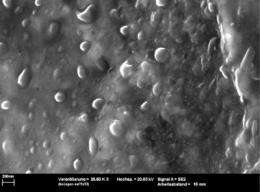
The nano-capsules in the electroplated layer contain a fluid. If the layer is scratched, the layers burst, the fluid escapes and repairs the scratch. Credit: Fraunhofer IPA

The engineers' dream of self-healing surfaces has taken another step towards becoming reality -- researchers have produced a electroplated layer that contains tiny nanometer-sized capsules. If the layer is damaged, the capsules release fluid and repair the scratch.

Human skin is a phenomenon - small scratches and cuts heal quickly, leaving no trace of a scar after just a few days. It's a different matter with materials, such as metals - if the electroplated layer protecting the metals from corrosion is scratched, rust protection is lost. Engineers are working on transferring the self-healing effect of skin to materials. The idea behind this is to introduce evenly distributed fluid-filled capsules into the electroplated layer - rather like raisins in a cake. If the layer is damaged, the pellets at the point of damage burst, the fluid runs out and 'repairs' the scratch. Until now, these plans have failed due to the size of the capsules - at 10 to 15 micrometers they were too large for the electroplated layer, which is around 20 micrometers thick. The capsules altered the of the layer.

Researchers from the Fraunhofer Institute for Manufacturing Engineering and Automation IPA in Stuttgart, together with colleagues from Duisburg-Essen University, have developed a process for producing electroplated layers with nano-capsules, in a project being financed by the Volkswagen Foundation. At only a few hundred in diameter, the capsules are measured on another scale entirely, compared with previous results. "The challenge lies in not damaging the capsules when producing the electroplated layer", says Dr. Martin Metzner, Head of Department at IPA. "The smaller the capsules, the thinner and more sensitive their casing. The electrolytes used for these electroplated-technical processes are extremely aggressive chemically and can easily destroy the capsules". The researchers therefore had to find a compatible material for the capsule casing depending on the electrolytes used.

Mechanical bearings are one example of possible applications - the materials of the bearings usually have a electroplated coating, in which the capsules can be embedded. If there is a temporary shortage of lubricant, part of the bearing's coating is lost, the capsules at the top of the layer burst and release lubricant. The bearing is not therefore damaged if it temporarily runs dry. The researchers have produced the first copper, nickel and zinc coatings with the new capsules, although surface coverage does not extend beyond the centimeter scale. Experts estimate that it will be another one and a half to two years before whole components can be coated. In a further step the team worked on more complex systems - involving differently filled capsules, for example, whose fluids react with one another like a two component adhesive.

Source: Fraunhofer-Gesellschaft (news : web)


print this article email this article download pdf blog this article bookmark this article     Stumble it Digg this share on Facebook retweet share on Reddit add to delicious
Rate this story - 5 /5 (4 votes)


August 3, 2009 all stories

Comments: 0

5 /5 (4 votes)
  • Stumble this up

  • Digg this

  • share this

  • hide
  • Related Stories

  • Wrinkled membranes create novel drug-delivery system
    created Feb 13, 2006 | popularity not rated yet | comments 0
  • FDA issues Spiriva and Foradil advisory
    created Mar 03, 2008 | popularity not rated yet | comments 0
  • Nanoparticles create biocompatible capsules
    created Mar 06, 2006 | popularity not rated yet | comments 0
  • Yet another use found for nanoparticles
    created Mar 14, 2006 | popularity not rated yet | comments 0
  • Shark cartilage capsules are recalled
    created May 17, 2007 | popularity not rated yet | comments 0


  • hide
  • Relevant PhysicsForums posts

  • photoconductivity of polymers
    created 13 hours ago
  • Heat pipe for high temperature
    created Nov 24, 2009
  • Robot built out of acrylic
    created Nov 24, 2009
  • Thickness or Ga. of Stainless steel water tank?
    created Nov 24, 2009
  • More from Physics Forums - Materials & Chemical Engineering

Other News

Fast, easy, and highly sensitive arsenic detection with gold nanoparticles

Nanotechnology / Nanomaterials

created 20 hours ago | popularity 5 / 5 (1) | comments 0

(PhysOrg.com) -- Mention of arsenic poisoning usually brings to mind underhanded murder. However, the danger of arsenic poisoning from contaminated drinking water is far greater. Low concentrations of arsenic are found in ...


Water droplets direct self-assembly process in thin-film materials

Nanotechnology / Nanomaterials

created Nov 23, 2009 | popularity 5 / 5 (4) | comments 2

You can think of it as origami - very high-tech origami. Researchers at the University of Illinois have developed a technique for fabricating three-dimensional, single-crystalline silicon structures from thin films by coupling ...


Nanotube defects equal better energy and storage systems

Nanotube defects equal better energy and storage systems

Nanotechnology / Nanomaterials

created Nov 19, 2009 | popularity 4.4 / 5 (10) | comments 2

(PhysOrg.com) -- Most people would like to be able to charge their cell phones and other personal electronics quickly and not too often. A recent discovery made by UC San Diego engineers could lead to carbon ...


Nanotech in Space: Experiment To Weather the Trials of Orbit

Nanotech in Space: Experiment To Weather the Trials of Orbit

Nanotechnology / Nanomaterials

created Nov 24, 2009 | popularity 4 / 5 (2) | comments 0

Novel nanomaterials developed at Rensselaer were sent into orbit on Nov. 16 aboard Space Shuttle Atlantis.


Peptides control crystal growth with 'switches, throttles and brakes'

Peptides control crystal growth with 'switches, throttles and brakes'

Nanotechnology / Bio & Medicine

created Nov 23, 2009 | popularity 4.8 / 5 (4) | comments 0

(PhysOrg.com) -- By producing some of the highest resolution images of peptides attaching to mineral surfaces, scientists have a deeper understanding how biomolecules manipulate the growth crystals. This research ...