Giant marine worms lived 475 million years ago: scientists
August 3, 2009
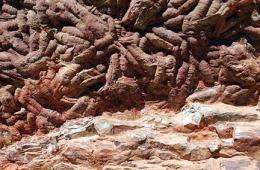
This undated picture released by the Spanish National Research Council (CSIC) shows fossilised tracks of the giant worm

Enlarge

This undated picture released by the Spanish National Research Council (CSIC) shows fossilised tracks in the Cabaneros National Park of central Spain, lasting evidence of a type of an ancient giant worm that lived 475 million years ago and was up to one metre (three feet) in length.

Spanish researchers said Monday they have discovered evidence of a type of giant worm that lived 475 million years ago and was up to one metre (three feet) in length.

The fossilised tracks of the marine worms were found in the Cabaneros National Park in central Spain in an area that was a seabed during the Lower Ordovician period, the Spanish National Research Council (CSIC) said.

It said the creatures lived in horizontal galleries of five metres in length and 15-20 centimetres in diameter under the seabed.

The galleries were lined "with mucous secretions to harden them and prevent their collapse, which has facilitated their preservation," said paleontologist Juan Carlos Gutierrez Marco.

They are the "oldest tracks of giant worms" ever discovered, pre-dating those found in Devon, England, this year and which dated from 200 million years ago, the CSIC quoted him as saying.

He explained why the , which were up to one metre in length and 15 centimetres in diameter, could attain such great size.

"For more than 450 millions years ago our country was part of a marine platform of an ancient continent called Gondwana," Gutierrez Marco said.

"The Iberian Peninsula was then near the south pole of the era. Organisms living in very cold water have a metabolism that allows them to grow bigger -- what is known as polar gigantism."

(c) 2009 AFP

4.3 /5 (8 votes)  

Filter


Move the slider to adjust rank threshold, so that you can hide some of the comments.


Display comments: newest first

QubitTamer
Aug 03, 2009

Rank: 3.5 / 5 (4)
i for one welcome our ancient wormy masters!!!!
Rank 4.3 /5 (8 votes)
Related Stories
Relevant PhysicsForums posts
  • Pertubance in a model
    created5 hours ago
  • Cancer drugs and Alzheimer's, Oh my!
    created13 hours ago
  • Squishing cells
    created14 hours ago
  • Any books/articles for evolutionary stable strategy models in humans?
    createdFeb 09, 2012
  • Science behind the bore feeling?
    createdFeb 09, 2012
  • Homo Sapien vs. Chimpanzee - Divergence Timeline
    createdFeb 09, 2012
  • More from Physics Forums - Biology

More news stories

A frank discussion of the power law and linking correlation to causation

(PhysOrg.com) -- Michael Stumpf a mathematics professor at Imperial College in London, and Mason Porter a lecturer at Oxford have teamed together to write and publish a perspective piece in Science regarding the in ...

Other Sciences / Mathematics

created 5 hours ago | popularity 5 / 5 (1) | comments 2 | with audio podcast report

Sonic Cradle lands spot in TED exhibition

A Simon Fraser University graduate student project that melds music, meditation and modern technology has landed a rare spot as an exhibit at TEDActive 2012 in Palm Springs, California this month.

Other Sciences / Other

created 1 hour ago | popularity not rated yet | comments 0

The question of life in the ancient world

There’s a general feeling that we don’t get the Greeks – ancient or modern. Many, including heads of state like Angela Merkel, visibly shake their head in exasperation, rightly or wrongly, at ...

Other Sciences / Archaeology & Fossils

created 5 hours ago | popularity 1 / 5 (1) | comments 2

US workers are 'giving away the store,' costing firms billions

Nearly 70 percent of the nation's service employees give away free goods and services – from hamburgers to cable TV – costing companies billions of dollars a year, according to a groundbreaking study.

Other Sciences / Economics & Business

created 23 hours ago | popularity 4.5 / 5 (2) | comments 10

Chilean miners' rescue capsule on show in London

The capsule used to rescue Chilean miners trapped underground for two months goes on display Saturday at the Science Museum in London -- the first time it has been seen in Europe.

Other Sciences / Other

created 4 hours ago | popularity not rated yet | comments 0


Hovering not hard if you're top-heavy, researchers find

Top-heavy structures are more likely to maintain their balance while hovering in the air than are those that bear a lower center of gravity, researchers at New York University's Courant Institute of Mathematical Sciences ...

Grass to gas: Researchers' genome map speeds biofuel development

Researchers at the University of Georgia have taken a major step in the ongoing effort to find sources of cleaner, renewable energy by mapping the genomes of two originator cells of Miscanthus x giganteus, a large perenn ...

Drug halts organ damage in inflammatory genetic disorder

A new study shows that Kineret (anakinra), a medication approved for the treatment of rheumatoid arthritis, is effective in stopping the progression of organ damage in people with neonatal-onset multisystem inflammatory disease ...

Cochlear implants may be safe, effective for organ transplant patients

Cochlear implants may be a safe, effective option for some organ transplant patients who've lost their hearing as an unfortunate consequence of their transplant-related drug regime, researchers report.

Researchers develop new method for creating tissue engineering scaffolds

Researchers at Northwestern University have developed a new method for creating scaffolds for tissue engineering applications, providing an alternative that is more flexible and less time-intensive than current technology.

Molecular profiling reveals differences between primary and recurrent ovarian cancers

There is a need to analyze tumor specimens at the time of ovarian cancer recurrence, according to a new study published in Molecular Cancer Therapeutics. Researchers used a diagnostic technology called molecular profiling to examine ...