MIT commercial property price index posts record drop
August 3, 2009
MIT commercial property price index posts record drop

Enlarge

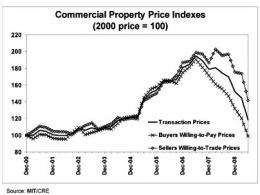
Commerical Property Price Indexes Graphic / MIT/CRE

(PhysOrg.com) -- Transaction prices of commercial property sold by major institutional investors fell by 18 percent in the second quarter of 2009, according to an index developed and published by the MIT Center for Real Estate (MIT/CRE).

The 18.1 percent drop in the transactions-based index (TBI) for the is by far the biggest quarterly decline in the gauge's 25-year history. (The second-biggest down quarter was the fourth quarter of last year, at -10.6 percent.) This was the fifth consecutive quarterly drop and the seventh in the past eight quarters. The index is now down 22 percent year-to-date, down 32 percent from where it was a year ago and down 39 percent from its mid-2007 peak -- far greater in nominal terms than the 27 percent drop the index experienced in the previous major commercial property in the late 1980s and early 1990s (the two drops are now tied in real terms, net of , at 41 percent), and substantially greater than the current drop in national housing prices (about 30 percent).

"The big news this quarter is not just the magnitude of the drop, but the fact that transaction volume actually increased in the presence of this decline, the first volume increase since last summer," said Professor David Geltner, director of research at MIT/CRE. "Perhaps most important, the supply-side index of the prices property owners are willing to sell at plunged a record 18.5 percent, suggesting a degree of 'capitulation' which may help to bring market prices finally to a bottom; this is the kind of thing that could begin to rebuild liquidity in the market."

MIT/CRE publishes not only the price index based on closed deals, but also compiles indices that separately gauge movements on the demand side and the supply side of the market that it tracks. The demand-side index tracks the changes in prices that potential buyers are willing to pay (sometimes called a "constant-liquidity" index of the market, because it tracks how much prices would have to change to keep a constant ability to sell as many properties at the same rate of trading volume). That index has now fallen steadily for all of the past eight quarters. It fell again in the second quarter, almost in lock-step with the supply-side index, bringing the demand index now to a level 48 percent below its mid-2007 peak.

"As is generally the case, the results posted by our index are corroborated by recent evidence from another commercial property price index whose methodology was developed at the MIT/CRE: the Moody's/REAL Commercial Property Price Index, produced by Moody's Investors Service," said MIT/CRE Research Technician Holly Horrigan. "The Moody's/REAL report released by Moody's on July 20 indicated that index dropped 16 percent during April and May alone, which by May put it already down 22 percent year-to-date and 35 percent below its 2007 peak," Horrigan noted.

The TBI tracks the prices that institutions such as pension funds pay or receive when transacting commercial properties like shopping centers, apartment complexes and office towers. The MIT Center's TBI is based on prices of National Council of Real Estate Investment Fiduciaries (NCREIF) properties sold each quarter from the property database that underlies the NCREIF Property Index (NPI), and also makes use of the appraisal information for all of the currently 6,000 NCREIF properties. Such an index -- national, quarterly, transaction-based and by property type -- had not been previously constructed prior to MIT's development of it in 2006. NCREIF supported development of the index as a useful tool for research and decision-making in the industry.

Provided by Massachusetts Institute of Technology (news : web)


Rank 4 /5 (1 vote)
Relevant PhysicsForums posts
  • Can I forget a language?
    createdFeb 10, 2012
  • The Biggest Lie Ever
    createdFeb 09, 2012
  • What are the limits of learning?
    createdFeb 06, 2012
  • Isn't that grammatically wrong?
    createdFeb 06, 2012
  • What does it mean when traders are indifferent?
    createdFeb 04, 2012
  • Peak of Our Civilization
    createdFeb 04, 2012
  • More from Physics Forums - Social Sciences

More news stories

A frank discussion of the power law and linking correlation to causation

(PhysOrg.com) -- Michael Stumpf a mathematics professor at Imperial College in London, and Mason Porter a lecturer at Oxford have teamed together to write and publish a perspective piece in Science regarding the in ...

Other Sciences / Mathematics

created Feb 10, 2012 | popularity 5 / 5 (5) | comments 11 | with audio podcast report

US workers are 'giving away the store,' costing firms billions

Nearly 70 percent of the nation's service employees give away free goods and services – from hamburgers to cable TV – costing companies billions of dollars a year, according to a groundbreaking study.

Other Sciences / Economics & Business

created Feb 09, 2012 | popularity 3 / 5 (5) | comments 11

Employers feel no love for unscrupulous practice of 'service sweethearting'

A new study led by two Florida State University marketing professors finds that some frontline service employees who are rewarded for hikes in customer loyalty and satisfaction also may engage in "service ...

Other Sciences / Economics & Business

created Feb 10, 2012 | popularity 3.3 / 5 (3) | comments 10

New insights into how to correct false knowledge

The abundance of false information available on the Internet, in movies and on TV has created a big challenge for educators.

Other Sciences / Social Sciences

created Feb 07, 2012 | popularity 4.9 / 5 (7) | comments 9 | with audio podcast

Neanderthal demise due to many influences, including cultural changes: study

As an ice age crept upon them thousands of years ago, Neanderthals and modern human ancestors expanded their territory ranges across Asia and Europe to adapt to the changing environment.

Other Sciences / Archaeology & Fossils

created Feb 07, 2012 | popularity 4.4 / 5 (5) | comments 8 | with audio podcast


Japan's Fukushima reactor may be reheating: operator

Temperature readings at one of the crippled Fukushima nuclear reactors have risen above Japan's stringent new safety standard but there was no immediate danger, its operator said Sunday.

Scientists discover molecular secrets of 2,000-year-old Chinese herbal remedy

For roughly two thousand years, Chinese herbalists have treated Malaria using a root extract, commonly known as Chang Shan, from a type of hydrangea that grows in Tibet and Nepal. More recent studies suggest that halofuginone, ...

New method to examine batteries -- MRI from the inside

There is an ever-increasing need for advanced batteries for portable electronics, such as phones, cameras, and music players, but also to power electric vehicles and to facilitate the distribution and storage of energy derived ...

Google might launch Drive for cloud storage soon

(PhysOrg.com) -- Google's next big move, according to the Wall Street Journal, is a cloud storage service called Drive. Hardly first to the plate, Google is simply catching up to introducing its cloud reposi ...

A mitosis mystery solved: How chromosomes align perfectly in a dividing cell

Although the process of mitotic cell division has been studied intensely for more than 50 years, Whitehead Institute researchers have only now solved the mystery of how cells correctly align their chromosomes during symmetric ...

Lab study raises questions over nano-particle impact

Tests involving chickens have raised questions about the impact on health from engineered nano-particles, the ultra-fine grains commonly used in drugs and processed foods, scientists said on Sunday.