What Hit Jupiter?

August 3, 2009 by Dr. Tony Phillips What Hit Jupiter?

Enlarge

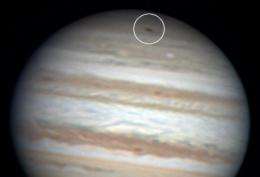
South is up in this July 19th discovery image taken by Anthony Wesley using a 14.5-inch telescope in Murrumbateman, Australia.

(PhysOrg.com) -- It began with a furrowed brow, a moment of puzzlement, quickly dismissed.

The date was July 19, 2009. Amateur astronomer Anthony Wesley was photographing from his backyard observatory in Murrumbateman, Australia, when something odd caught his eye.

"My attention was fixed on the Great Red Spot, which was setting beautifully over Jupiter's horizon," recalls Wesley. "I almost didn't notice the dark blemish near Jupiter's south pole, and when I did, I put it out of my mind."

It's just another dark storm on Jupiter.

"That's what I thought at first, but something about the dark mark puzzled me, it didn't look right, and I couldn't stop stealing glances at it."

Slowly, Jupiter's rotation turned the blemish toward Earth, Wesley got a better look at it, and the truth struck him like a thunderbolt.

It was an impact mark. Something hit the giant planet!

"I had seen the scars caused by fragments of Comet Shoemaker-Levy 9 hitting Jupiter in 1994, so I knew what an impact looked like," he says. "After I'd convinced myself that this was real, I could hardly use the computer. My hands were shaking. It was quite unbelievable."

He quickly emailed his photos to friends and colleagues around the world, and within hours telescopes great and small were turning toward Jupiter to photograph the aftermath of a powerful collision.

"We believe it was a comet or asteroid measuring perhaps a few hundred meters wide," says Don Yeomans of NASA's Near-Earth Object Office at JPL. "If something of similar size hit Earth—we're talking about 2000 megatons of energy--there would be serious regional devastation or a tsunami if it hit the ocean."

In a stroke of luck almost as big as Wesley's, JPL astronomers Glenn Orton and Leigh Fletcher were already scheduled to observe Jupiter on July 20th, barely a day after impact, using NASA's Infra-red Telescope Facility (IRTF) atop Mauna Kea in Hawaii. The 3-meter telescope revealed a fresh cloud of debris about the size of Mars floating among Jupiter's clouds.

"The object, whatever it was, exploded in Jupiter's upper atmosphere," says Orton. "It blew itself to smithereens. What we're seeing now are bits and pieces of the impactor and possibly some strange aerosols formed by shock-chemistry during the impact."

On July 23rd, the Hubble Space Telescope took its first pictures of the blast site. Hubble was still undergoing checkout and calibration following the STS-125 servicing mission in May, but this event was too big to skip. Space Telescope Science Institute director Matt Mountain allocated emergency telescope time to a team of astronomers led by Heidi Hammel of the Space Science Institute in Boulder, Colorado.

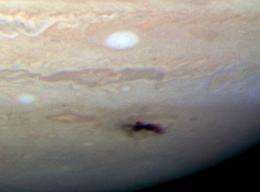
As usual, Hubble photos stole the show. They revealed a swirling maelstrom of dark cindery debris jostling with natural storms near the top of Jupiter's atmosphere:
What Hit Jupiter?
Enlarge

A Hubble Space Telescope image of the Jupiter impact scar taken on July 23, 2009, taken using Hubble's new camera, the Wide Field Camera 3 (WFC3).

"The debris cloud is lumpy because of atmospheric turbulence," explains planetary scientist Amy Simon-Miller of the Goddard Space Flight Center. "Polar winds blowing 25 m/s (~55 mph) are causing it to spread out and grow larger. This will make the cloud even easier to see through backyard telescopes."

Judging from the behavior of the impacts fifteen years ago, she estimates that the 'Wesley debris cloud' could remain visible for many weeks to come. Researchers will put the time to good use. Further studies of the cloud might yet reveal the great unknown:

What hit Jupiter?

"We just don't know," says Yeomans. "No one saw the object prior to impact."

Indeed, there was no warning. The object emerged from darkness, unknown and uncatalogued, and—wham!—before anyone could photograph the body intact, it had become a cloud of debris. (There is a lesson here for Earth, but that is another story.)

The cloud's chemical composition holds clues to the nature of the impactor. Orton says ground-based observers are now analyzing light reflected from the cloud to figure out what it is made of. "If the spectra contain signs of water, that would suggest an icy comet. Otherwise, it's probably a rocky or metallic asteroid."

Meanwhile, it's a big dark mystery—the kind that Wesley can't take his eyes off of. "I am still observing Jupiter almost every night using my 14.5 inch telescope," he says. "The cloud is expanding and taking on some interesting shapes."

"I wonder," he says, "what will happen next?"

Source: by Dr. Tony Phillips, Science@NASA


print this article email this article download pdf blog this article bookmark this article     Stumble it Digg this share on Facebook retweet share on Reddit add to delicious
Rate this story - 4.7 /5 (15 votes)

Rank Filter

Move the slider to adjust rank threshold, so that you can hide some of the comments.


Display comments: newest first

  • omatumr - Aug 03, 2009
    • Rank: 2 / 5 (5)
    CERTAIN IT'S AN IMPACT?

    One impact event has been observed on Jupiter.

    Perhaps Jupiter is chemically layered and different layers reflect different colors of light when exposed to sunlight.

    Could the colored spot be caused by an eruption rather than an impact?

    With kind regards,
    Oliver K. Manuel
    http://www.omatumr.com
  • lomed - Aug 03, 2009
    • Rank: 5 / 5 (1)
    I would think that an upwelling from within Jupiter would not have such a sharply defined boundary or have appeared so suddenly (though I do not know if there is any indication of the time the mark first appeared.) I would expect an upwelling (especially on Jupiter) to continue for awhile, while an impact plume is apparently expected to dissipate within a few weeks. So, it should be apparent (even if one does not believe the claims in the article) very soon which scenario is/had been the case.
  • Shootist - Aug 04, 2009
    • Rank: 5 / 5 (1)
    It had every indicator of an impactor. Look to the photo archives, the concentric rings, characteristic of the pebble into the pool analogy, are clearly present. Compare the photos to the Shoemaker-Levi 9 photos too. The obvious is obvious.

August 3, 2009 all stories

Comments: 3

4.7 /5 (15 votes)
  • Stumble this up

  • Digg this

  • share this

  • hide
  • Related Stories

  • New Images Indicate Object Hits Jupiter
    created Jul 21, 2009 | popularity not rated yet | comments 0
  • Aus amateur tells of 'one in a million' Jupiter spot
    created Jul 22, 2009 | popularity not rated yet | comments 0
  • Hubble captures rare Jupiter collision
    created Jul 25, 2009 | popularity not rated yet | comments 0
  • Surprise Collision on Jupiter Captured by Gemini Telescope
    created Jul 23, 2009 | popularity not rated yet | comments 0
  • Hubble Catches Jupiter Changing Its Stripes
    created Jun 29, 2007 | popularity not rated yet | comments 0


  • hide
  • Relevant PhysicsForums posts

  • Question about 2-body gravity
    created 9 hours ago
  • life on Mars
    created 11 hours ago
  • Semi-major axis from cartesian co-ordinates
    created Nov 23, 2009
  • Primary Mirror grinding
    created Nov 23, 2009
  • dark energy can escape black holes.
    created Nov 23, 2009
  • Are there green, purple and pink stars?
    created Nov 22, 2009
  • More from Physics Forums - General Astronomy

Other News

CO2 emissions continue significant climb

Space & Earth / Environment

created 7 minutes ago | popularity not rated yet | comments 0

The annual rate of increase in carbon dioxide emissions from fossil fuels has more than tripled in this decade, compared to the 1990s, reports an international consortium of scientists, who paint a bleak picture of the Earth's ...


Infrared Image of Circumstellar Disk Illuminates Massive Star Formation Process

Infrared Image of Circumstellar Disk Illuminates Massive Star Formation Process

Space & Earth / Astronomy

created 9 minutes ago | popularity not rated yet | comments 0

(PhysOrg.com) -- A team of astronomers from Ibaraki University, Japan Aerospace Exploration Agency, Kanagawa University, University of Tokyo, Academica Sinica, and National Astronomical Observatory of Japan ...


Cassini Captures Ghostly Dance of Saturn's Northern Lights

Cassini Captures Ghostly Dance of Saturn's Northern Lights (w/ Video)

Space & Earth / Space Exploration

created 1hour ago | popularity 5 / 5 (1) | comments 0

(PhysOrg.com) -- In the first video showing the auroras above the northern latitudes of Saturn, Cassini has spotted the tallest known "northern lights" in the solar system, flickering in shape and brightness ...


The e-waste dilemma

The e-waste dilemma

Space & Earth / Environment

created 1hour ago | popularity not rated yet | comments 0

(PhysOrg.com) -- Electronic devices could create significant environmental and health problems after they are thrown away. UC Irvine researchers are working with engineers, manufacturers and public health ...


First black holes may have incubated in giant, starlike cocoons, says CU-Boulder study

First black holes may have incubated in giant, starlike cocoons

Space & Earth / Astronomy

created 4 hours ago | popularity 4.9 / 5 (7) | comments 7

(PhysOrg.com) -- The first large black holes in the universe likely formed and grew deep inside gigantic, starlike cocoons that smothered their powerful x-ray radiation and prevented surrounding gases from ...