Students develop cane with e-tags to guide blind
August 3, 2009 By DAVID N. GOODMAN , Associated Press Writer
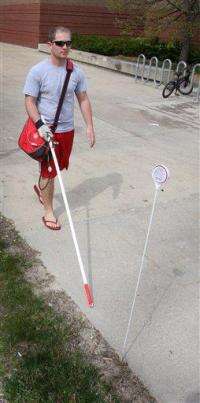
This May 6, 2009 photo released by Central Michigan University shows Kevin Rock wearing glasses that simulate visual impairment to test a Smart Cane on the school's campus in Mount Pleasant, Mich. The cane is able to detect electronic navigational aid tags and help the blind avoid obstacles and reach their destinations. (AP Photo/Robert Barclay)
(AP) -- A cane equipped with the technology that retailers use to tag merchandise could help blind people avoid obstacles.
An engineering professor and five students at Central Michigan University have created a "Smart Cane" to read electronic navigational tags installed between buildings to aid the blind in reaching their destinations more easily.
"This project started as a way for me to teach students to see and understand the ways that engineering can be used for the greater good," said Kumar Yelamarthi, the professor and project leader. "We wanted to do something that would help people and make our campus more accessible."
During the spring term, Yelamarthi and five senior engineering students tested the cane, which is equipped with Radio Frequency Identification technology, similar to what retailers put on products to keep them from being stolen.
The Smart Cane contains an ultrasonic sensor that is paired with a miniature navigational system inside a messenger-style bag worn across the shoulder.
For the test, the students installed identification tags between two buildings on the campus in Mount Pleasant, Mich.. A speaker located on the bag strap gave audio alerts when the system detected an obstacle and told the user which direction to move.
Students wearing glasses that simulate visual impairment tested the cane.
The students also created a vibrating glove to assist those who are both visually and hearing-impaired.
Yelamarthi said it's one of the first outdoor applications of RFID and said he plans for students in upcoming classes to further refine the system while he seeks grants to speed the research.
The next step probably involves using the system in a wider area. Down the line, Yelamarthi wants to work toward integrating the Smart Cane's data with GPS.
©2009 The Associated Press. All rights reserved. This material may not be published, broadcast, rewritten or redistributed.
-
Engineering students use smart materials to design a smart wing
Nov 12, 2007 |
not rated yet |
0
-
Assistive technologies for the blind
Dec 15, 2004 |
not rated yet |
0
-
New Bluetooth system orients blind and sighted pedestrians
Sep 18, 2008 |
not rated yet |
0
-
NASA helps visually impaired students
Jul 14, 2006 |
not rated yet |
0
-
'Smart' device to help elderly people avoid falls
Jul 20, 2005 |
not rated yet |
0
-
Engineers build first sub-10-nm carbon nanotube transistor
Feb 01, 2012 |
4.9 / 5 (33) |
30
-
Something old, something new: Evolution and the structural divergence of duplicate genes
Jan 31, 2012 |
4.6 / 5 (7) |
1
-
The hidden nanoworld of ice crystals: Revealing the dynamic behavior of quasi-liquid layers
Jan 30, 2012 |
5 / 5 (4) |
1
-
Stock market network reveals investor clustering
Jan 27, 2012 |
3.9 / 5 (23) |
8
-
Of microchemistry and molecules: Electronic microfluidic device synthesizes biocompatible probes
Jan 26, 2012 |
5 / 5 (2) |
0
-
How to calculate total compressibility in liquid porous solid system
5 hours ago
-
Need help reading 3-D
Feb 11, 2012
-
A way to send and receive wireless data
Feb 11, 2012
-
Calling function with no input argument
Feb 10, 2012
-
Force free body diagram problem on gym equipment
Feb 10, 2012
-
Empirical data regarding shower heads and water
Feb 10, 2012
- More from Physics Forums - General Engineering
More news stories
Google might launch Drive for cloud storage soon
(PhysOrg.com) -- Google's next big move, according to the Wall Street Journal, is a cloud storage service called Drive. Hardly first to the plate, Google is simply catching up to introducing its cloud reposi ...
Iran blocks email, restricts net access: reports
Iran has further restricted access to the Internet and blocked popular email services for the past few days, in a move a top lawmaker said could "cost the regime dearly," media reports said on Sunday.
6 hours ago |
5 / 5 (2) |
3
Love a click away in Indonesia's Twitter Republic
He was a geeky kid from Yogyakarta, she a glamorous city girl in Jakarta. In a country with one of the world's most vibrant social networking scenes they fell in love on Twitter.
14 hours ago |
4 / 5 (1) |
0
Walney offshore wind farm is world's biggest (for now)
(PhysOrg.com) -- The Walney wind farm on the Irish Sea--characterized by high tides, waves and windy weather--officially opened this week. The farm is treated in the press as a very big deal as the Walney ...
Navy to begin tests on electromagnetic railgun prototype launcher
The Office of Naval Research (ONR)'s Electromagnetic (EM) Railgun program will take an important step forward in the coming weeks when the first industry railgun prototype launcher is tested at a facility ...
Feb 06, 2012 |
4.5 / 5 (19) |
94
|
Scientists discover molecular secrets of 2,000-year-old Chinese herbal remedy
For roughly two thousand years, Chinese herbalists have treated Malaria using a root extract, commonly known as Chang Shan, from a type of hydrangea that grows in Tibet and Nepal. More recent studies suggest that halofuginone, ...
New method to examine batteries -- MRI from the inside
There is an ever-increasing need for advanced batteries for portable electronics, such as phones, cameras, and music players, but also to power electric vehicles and to facilitate the distribution and storage of energy derived ...
Overeating may double risk of memory loss
New research suggests that consuming between 2,100 and 6,000 calories per day may double the risk of memory loss, or mild cognitive impairment (MCI), among people age 70 and older. The study was released today and will be ...
A mitosis mystery solved: How chromosomes align perfectly in a dividing cell
Although the process of mitotic cell division has been studied intensely for more than 50 years, Whitehead Institute researchers have only now solved the mystery of how cells correctly align their chromosomes during symmetric ...
Lab study raises questions over nano-particle impact
Tests involving chickens have raised questions about the impact on health from engineered nano-particles, the ultra-fine grains commonly used in drugs and processed foods, scientists said on Sunday.
Starve a virus, feed a cure? Findings show how some cells protect themselves against HIV
A protein that protects some of our immune cells from the most common and virulent form of HIV works by starving the virus of the molecular building blocks that it needs to replicate, according to research published online ...