NYU physicists make room for oddballs
August 3, 2009
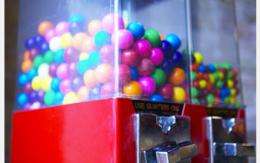
Physicists at the Materials Research Science and Engineering Center at New York University recently developed a new way to determine how many odd-shaped particles can fit into a container of a given size. The results could be used to solve a variety of industrial packing problems from packing gumballs in vending machines to producing more effective medicines that are smaller and easier to swallow. Credit: © 2009 Jupiter Images Corporation
(PhysOrg.com) -- Here's a question. How many gumballs of different sizes can fit in one of those containers at the mall so as to reward a well-spent quarter? It's hard to believe that most people never consider it even when guessing the number of candies in a bowl at Halloween.
But physicists at the Materials Research Science and Engineering Center at New York University recently developed a new way to help answer the question. They say the solution is found in how the particles pack in terms of many neighboring gumballs a single gumball can randomly touch within a given container.
Though it may seem intuitive, confirming the answer has long proven elusive because of super complex geometry when dealing with three-dimensional objects of mixed sizes and shapes. But in a recent breakthrough, researchers Maxime Clusel, Eric Corwin and Alex Siemens led by NYU physics professor Jasna Brujic, derived and tested a statistical model that potentially could help industry sort through a variety of packing problems from gumballs in vending machines to grain storage in silos or dry clothes detergent in retail boxes.
"We have discovered a simple organizing principle for particulate packing that predicts our experimental findings," said Brujic. The latest issue of the journal Nature reports the findings. The National Science Foundation funds the research.
The new model predicts the geometry of randomly packing spheres of different sizes in terms of how many nearest neighbors a particle can have, how far apart those neighbors can be and how free space is distributed throughout the packing. It does all this by determining geometric possibilities from the viewpoint of a single particle, which the authors term the "granocentric" view.
"Bigger particles pack with more neighbors, while smaller particles have on average fewer neighbors," said Corwin, a postdoctoral research fellow. "By combining this simple insight with probabilistic mathematics we created an accurate model demonstrating how this organizing rule gives rise to packings where particles have a wide range or distribution of contacts, neighbors and local densities."
The research team used a two step process to verify the model. First they used a 3-D microscope to spy how oil droplets packed together in water. The research enabled the team to determine the number of nearest neighbors the oil droplets could have and other parameters. Then they compared what they found to what was predicted by the statistical model.
"We were surprised to find that such a simple model, based on physical intuition alone, could capture the properties of a complex packing of droplets in an emulsion," Brujic said.
The model predicted the percentage of space occupied by the particles in a container, such that researchers could statistically estimate the number of particles without knowing all the positions of the particles.
The structure of a packing of spheres of equal size is an old problem, whose complexity has challenged mathematicians and physicists for centuries. At first one would think that the structure of packings of spheres of random sizes is even more complex, but surprisingly, the researchers discovered that this is not the case.
The results could be used in a variety of industrial packing processes. For example, the model could be used to determine how finely to mill medicines that pharmaceutical companies pack into drug capsules, producing more effective pills that are smaller and easier to swallow.
"Packing problems are ubiquitious in industry," said Corwin. "An unexpected area of application might be to the world of paint creation. Paint is composed of small particles of pigment suspended in a fluid. As the fluid evaporates the particles are packed tighter and tighter, slowing down the evaporation of the fluid. Thus, one could tune the distribution of particle sizes to achieve paint with particular drying characteristics."
-
Physicists show way to count sweets in a jar -- from inside the jar
Jul 29, 2009 |
not rated yet |
0
-
Scientists Demonstrate Microscale System to Study Frustration in Buckled Monolayers of Microspheres
Dec 17, 2008 |
not rated yet |
0
-
Physicists determine density limit for randomly packed spherical materials
Jun 02, 2008 |
not rated yet |
0
-
Nanoscale Cubes and Spheres
Jan 03, 2007 |
not rated yet |
0
-
Fluid Particles Irreversible in Some Circumstances, Physicists Report in Nature
Dec 14, 2005 |
not rated yet |
0
-
Engineers build first sub-10-nm carbon nanotube transistor
Feb 01, 2012 |
4.9 / 5 (31) |
30
-
Something old, something new: Evolution and the structural divergence of duplicate genes
Jan 31, 2012 |
4.6 / 5 (7) |
1
-
The hidden nanoworld of ice crystals: Revealing the dynamic behavior of quasi-liquid layers
Jan 30, 2012 |
5 / 5 (3) |
1
-
Stock market network reveals investor clustering
Jan 27, 2012 |
3.9 / 5 (23) |
8
-
Of microchemistry and molecules: Electronic microfluidic device synthesizes biocompatible probes
Jan 26, 2012 |
5 / 5 (1) |
0
-
how to scale this expression
11 hours ago
-
Trying to find or similar problems (objects travelling across slots)
13 hours ago
-
A discrete logarithm Question
Feb 09, 2012
-
What does it mean to solve a problem 'analytically'?
Feb 09, 2012
-
Heisenberg Nilpotent Lie Group
Feb 09, 2012
-
Operator precedence for: 1/-2/3
Feb 09, 2012
- More from Physics Forums - General Math
More news stories
A frank discussion of the power law and linking correlation to causation
(PhysOrg.com) -- Michael Stumpf a mathematics professor at Imperial College in London, and Mason Porter a lecturer at Oxford have teamed together to write and publish a perspective piece in Science regarding the in ...
Employers feel no love for unscrupulous practice of 'service sweethearting'
A new study led by two Florida State University marketing professors finds that some frontline service employees who are rewarded for hikes in customer loyalty and satisfaction also may engage in "service ...
Other Sciences / Economics & Business
10 hours ago |
4 / 5 (1) |
4
The question of life in the ancient world
Theres a general feeling that we dont get the Greeks ancient or modern. Many, including heads of state like Angela Merkel, visibly shake their head in exasperation, rightly or wrongly, at ...
Other Sciences / Archaeology & Fossils
15 hours ago |
1.3 / 5 (3) |
4
Sonic Cradle lands spot in TED exhibition
A Simon Fraser University graduate student project that melds music, meditation and modern technology has landed a rare spot as an exhibit at TEDActive 2012 in Palm Springs, California this month.
12 hours ago |
not rated yet |
0
Chilean miners' rescue capsule on show in London
The capsule used to rescue Chilean miners trapped underground for two months goes on display Saturday at the Science Museum in London -- the first time it has been seen in Europe.
14 hours ago |
not rated yet |
0
Google users warned of threat to smartphone wallets
Users of Google smartphone wallets were being warned on Friday that there is a way to crack pass codes intended to thwart thieves from going on illicit shopping sprees.
Anonymous knocks CIA website offline (Update)
The website of the Central Intelligence Agency was inaccessible on Friday after the hacker group Anonymous claimed to have knocked it offline.
New error-correcting codes guarantee the fastest possible rate of data transmission
Error-correcting codes are one of the triumphs of the digital age. Theyre a way of encoding information so that it can be transmitted across a communication channel such as an optical fiber o ...
Complex wiring of the nervous system may rely on a just a handful of genes and proteins
Researchers at the Salk Institute have discovered a startling feature of early brain development that helps to explain how complex neuron wiring patterns are programmed using just a handful of critical genes. ...
Humans may have helped the decline of African rainforests 3000 years ago
(PhysOrg.com) -- Large areas of rainforests in Central Africa mysteriously disappeared over three thousand years ago, to be replaced by savannas. The prevailing theory has been that the cause was a change ...
New power source discovered
(PhysOrg.com) -- Researchers at the Massachusetts Institute of Technology (MIT) and RMIT University have made a breakthrough in energy storage and power generation.