August 4, 2009 feature
Virtual Worlds May Be the Future Setting of Scientific Collaboration
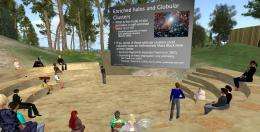
(PhysOrg.com) -- Normally, virtual worlds are the setting of many online games and entertainment applications, but now they’re becoming a place for scientific collaboration and outreach, as well. A team of scientists from the California Institute of Technology, Princeton, Drexel University, and the Massachusetts Institute of Technology have formed the first professional scientific organization based entirely in virtual worlds. Called the Meta Institute for Computational Astrophysics (MICA), the organization conducts professional seminars and popular lectures, among other events, for its growing membership.
As MICA’s founders explain in a recent published paper, MICA is currently based in Second Life where participants use avatars to explore and interact with their surroundings, and will expand to other virtual worlds when appropriate. As of this past March, MICA had about 40 professional members and 100 members of the general public interested in learning about science, specifically astronomy. MICA is also establishing collaborative partnerships with the IT industry, including Microsoft and IBM, and plans to further develop industrial partnerships.
“Virtual worlds are already a very fruitful arena for research in social sciences and humanities, including sociology, economics, psychology, etc.,” lead author George Djorgovski told PhysOrg.com. “They are already a superb educational and outreach platform, and should be used much more. We are trying to find out what else we can do with these technologies in the natural sciences, such as physics and astronomy.”
In addition to getting people together in a free and convenient way, virtual worlds can offer new possibilities for scientific visualization or “visual analytics.” As data sets become larger and more complex, visualization can help researchers better understand different phenomena. Virtual worlds not only offer visualization, but also enable researchers to become immersed in data and simulations, which may help scientists think differently about data and patterns. Multi-dimensional data visualization can provide further advantages for certain types of data. The researchers found that they can encode data in spaces with up to 12 dimensions, although they run into the challenge of getting the human mind to easily grasp the encoded content.
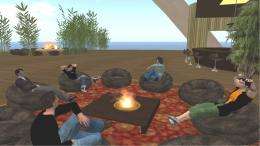
“The slow adoption of these virtual reality technologies by the academic (or any other professional) community is probably largely due to a widely held misperception that this is ‘just games,’” Djorgovski said. “This is incorrect; while these technologies got developed largely by the gaming industry, and there is certainly a lot of gaming going on, virtual worlds are something bigger: a general platform for all kinds of activities, ranging from entertainment to purely professional. Just like the Web itself.”
Djorgovski and his coauthors see virtual reality as the next step in the continuing evolution of the ways we use information and computation technology to interact with each other. They predict that, in the future, virtual reality will become more synthesized with the Web by serving as an interface and replacing today’s browsers.
“One can think of immersive virtual reality as the next generation browser technology, which will be as qualitatively different from the current, flat desktop and web page paradigm, as the current browsers were different from the older, terminal screen and file directory paradigm for information display and access,” the authors explained in their overview.
As Djorgovski added, immersive virtual reality (including virtual worlds) seems currently to be roughly at a stage of development of the Web in 1992, with limited reach but huge growth potential. “Possibly the overall societal impact of these technologies would be as big as that of the Web itself - or even bigger,” he said.
One part of this possible next generation application of virtual reality is an open source program called “OpenSimulator” (or “OpenSim”), which enables users to create their own 3D virtual worlds and applications. The authors predict that the synthesis of the Web and virtual reality could involve individuals managing their own virtual reality environment in a way that is analogous to hosting and managing websites today.
In the meantime, MICA’s virtual events for a general audience include a series of popular talks called “Dr. Knop talks astronomy” and weekly “Ask an Astronomer” sessions. The authors have also started experimenting with regular student classes, graduate seminars, class discussions, and hybrids in which students read lecture materials on their own and use class time for an open discussion in the virtual world setting. They also plan to conduct a series of international “summer schools” on topics including numerical stellar dynamics, computational science and others, in an immersive and interactive virtual world venue.
More information:
MICA Website: www.mica-vw.org/
S. G. Djorgovski, P. Hut, S. McMillan, E. Vesperini, R. Knop, W. Farr and M. J. Graham. “Exploring the Use of Virtual Worlds as a Scientific Research Platform: The Meta-Institute for Computational Astrophysics (MICA).” To appear in the refereed proceedings of Facets of Virtual Environments. arxiv.org/abs/0907.3520 .
Copyright 2009 PhysOrg.com.
All rights reserved. This material may not be published, broadcast, rewritten or redistributed in whole or part without the express written permission of PhysOrg.com.


