Expanding Spot on Venus Puzzles Astronomers
August 4, 2009 by Miranda Marquit Venus

Enlarge

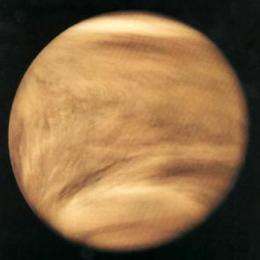
Astronomers are trying to determine the cause of an expanding spot seen in Venus' atmosphere.

(PhysOrg.com) -- The expanding spot discovered on Venus last month may not have garnered as much attention as the meteor impact with Jupiter, but its cause is certainly more puzzling.

While astronomers are pretty sure that the new spot seen in Jupiter's landscape is caused by impact, there is evidence that this is not true of the spot seen on Venus. New Scientist reports on why astronomers don't think the spot of Venus was caused by a meteor:

"The spot is bright at ultraviolet wavelengths, which may argue against a meteoroid impact as a cause. That's because rocky bodies, with the exception of objects very rich in water ice, should cause an impact site to darken at ultraviolet wavelengths as it fills with debris that absorbs such light, says Sanjay Limaye of the University of Wisconsin-Madison and a member of the Venus Express team."

Some of the reasons being advanced for the spot in Venus' atmosphere include:

* . (This option is considered unlikely, since the thick atmosphere would likely block most from being visible to us.)

* Charged particles from solar interaction with Venus' atmosphere.

* Atmospheric turbulence concentrating bright material in a confined area.

The other interesting point about the bright spot is that it -- like the Jupiter "scar" -- was first noticed by an amateur astronomer. The fact that astronomy is so accessible to a wide range of people is interesting in terms of encouraging interest in the sciences.

© 2009 PhysOrg.com


print this article email this article download pdf blog this article bookmark this article     Stumble it Digg this share on Facebook retweet share on Reddit add to delicious
Rate this story - 4.2 /5 (30 votes)

Rank Filter

Move the slider to adjust rank threshold, so that you can hide some of the comments.


Display comments: newest first

  • anonperson - Aug 04, 2009
    • Rank: 4.8 / 5 (4)
    I'd love to know if there is a way to get networked amateur robotic controlled telescopes with digital cameras to all focus in on the same spot and then transmit that image to a central image processor for crunching? Is there anybody / any telescope in the amatuer price range, say ~$300 capable of above?
  • zealous - Aug 04, 2009
    • Rank: 5 / 5 (2)
    Oooooh distributed amatuer astronomy
  • dirk_bruere - Aug 04, 2009
    • Rank: 3.5 / 5 (2)
    What it really means is that professional astronomers do not spend time on looking at stuff in the solar system.
  • Ethelred - Aug 05, 2009
    • Rank: 5 / 5 (2)
    Is there anybody / any telescope in the amatuer price range, say ~$300 capable of above?


    No. The price range you give is way too low. The camera will cost more the scope will cost more and the controls will all cost more than or at least 300 EACH.

    The concept is interesting its just the price would be higher.

    Ethelred
  • Soylent - Aug 05, 2009
    • Rank: 4 / 5 (1)
    No. The price range you give is way too low. The camera will cost more the scope will cost more and the controls will all cost more than or at least 300 EACH.


    If you could get millions of people interested in owning one they wouldn't cost so much.

    There are bigger problems than cost though.

    Like distributed computing you'd want to have control of your own telescope when you want it and you'd want to lend your telescope to whatever pool you decide to join when you're not using it.

    You want the telescopes somewhere nice like Mauna Kea, the telescopes would be physically pooled as well and that takes some charm out of it. A telescope anywhere near a city is as good as useless.

    These telescopes need to be protected from bad weather and their action coordinated; you'd want something like a hangar full of amateur telescopes that is opened whenever the wind, moisture and lack of sunshine allows it to be. You'd want to hook up all these telescopes to a fast internet access and weather forecasting services and you'd need to develop some standardized framework that allows individual telescopes to jump in and out of desired pools.

    You want expert users to be able to create a pool of telescopes with related information and schedules that regular users can join. E.g. users may want to join the pool that searches the sky for new asteroids or follows the latest comet when they're not using their telescope.

    It's a cool idea, but I believe all these related infrastructure and maintenance expenses kill it deader than a dodo.
  • CaptBarbados - Aug 05, 2009
    • Rank: not rated yet
    The advent of commercialized cloud computing like Amazon's EC2 environment would lessen server costs drastically for such an undertaking. While high image quality is the paramount objective, many images taken from various locations could significantly influence the resulting output of a community of low-cost telescopes. But $300 is not a serious benchmark to expect when much more is spent by any individual on ski equipment or a paintball gun. It's dependent on an individual's passion.
  • Ethelred - Aug 06, 2009
    • Rank: 5 / 5 (2)
    Keep an open mind. But not so far open your brain falls out.

    Ethelred

August 4, 2009 all stories

Comments: 7

4.2 /5 (30 votes)
  • Stumble this up

  • Digg this

  • share this

  • hide
  • Related Stories

  • The light and dark of Venus
    created Feb 21, 2008 | popularity not rated yet | comments 0
  • Venus comes to life at wavelengths invisible to human eyes
    created Dec 03, 2008 | popularity not rated yet | comments 0
  • STAR TRAK for November
    created Nov 03, 2008 | popularity not rated yet | comments 0
  • Astronomers marvel at 'Red Spot Jr'
    created May 05, 2006 | popularity not rated yet | comments 0
  • Venus Express searching for life – on Earth
    created Oct 10, 2008 | popularity not rated yet | comments 0


  • hide
  • Relevant PhysicsForums posts

  • Question about 2-body gravity
    created Nov 24, 2009
  • life on Mars
    created Nov 24, 2009
  • Semi-major axis from cartesian co-ordinates
    created Nov 23, 2009
  • Primary Mirror grinding
    created Nov 23, 2009
  • More from Physics Forums - General Astronomy

Other News

Obama to plead US case at global warming summit (AP)

Obama to plead US case at global warming summit

Space & Earth / Environment

created 48 minutes ago | popularity not rated yet | comments 0

(AP) -- President Barack Obama will commit the United States to substantial cuts in greenhouse gas pollution over the next decade - despite resistance in Congress over higher costs - when he travels to a ...


Russia: no space for space tourists (AP)

Russia: no space for space tourists

Space & Earth / Space Exploration

created 2 hours ago | popularity 4 / 5 (1) | comments 1

(AP) -- A top Russian space official says there is no space for tourists wishing to fly to the International Space Station.


Thanksgiving last full day in space for shuttle (AP)

Thanksgiving last full day in space for shuttle

Space & Earth / Space Exploration

created 1hour ago | popularity not rated yet | comments 0

(AP) -- Space shuttle Atlantis' astronauts will spend Thanksgiving checking their ship for the ride home.


Monster Waves on the Sun are Real

Monster Waves on the Sun are Real (w/ Video)

Space & Earth / Astronomy

created 14 hours ago | popularity 4.8 / 5 (12) | comments 1

Sometimes you really can believe your eyes. That's what NASA's STEREO (Solar Terrestrial Relations Observatory) spacecraft are telling researchers about a controversial phenomenon on the sun known as the "solar ...


Cosmic 'dig' reveals vestiges of the Milky Way's building blocks

Cosmic 'Dig' Reveals Vestiges of the Milky Way's Building Blocks

Space & Earth / Astronomy

created 19 hours ago | popularity 4.9 / 5 (15) | comments 1

(PhysOrg.com) -- Peering through the thick dust clouds of our galaxy's "bulge" (the myriads of stars surrounding its center), a team of astronomers has unveiled an unusual mix of stars in the stellar grouping ...