Trapped! Scientists Immobilize Bacteria in Fibrous Hydrogel
August 4, 2009
Trapped! Scientists Immobilize Bacteria in Fibrous Hydrogel

Enlarge

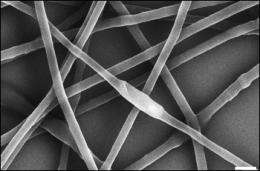
This scanning electron micrograph shows rod-shaped Pseudomonas fluorescens bacterium completely encased within the polymer fibers of an open-weave, porous hydrogel formed by electrospinning. In these bio-hybrid materials, the bacteria remain immobilized but viable for applications in biotechnology. The white scale bar in the lower right corner measures 1 micrometer."

(PhysOrg.com) -- Bacteria play a role in myriad industrial processes from fermentation to cleaning up environmental pollution. But floating freely in solution, the microbial cells constantly multiply, generating biomass that must be removed periodically, causing downtime. Additionally, the microorganisms cannot be localized to a specific region of interest.

Now, scientists at the U.S. Department of Energy’s Brookhaven National Laboratory and Stony Brook University have devised a way to encapsulate in a synthetic polymer hydrogel. These new, stable, bio-hybrid materials maintain the microbes’ ability to exchange nutrients and metabolic products with their environment, and could find widespread applications, for example, as biosensors, catalysts, drug-delivery systems, or in wastewater treatment. The method and results are described in a paper published online by the the week of August 3, 2009.

“In many ways, our research is trying to mimic the biofilms many microorganisms form in nature,” said Brookhaven Lab materials scientist Dev Chidambaram, corresponding author on the study. “These complex and dynamic communities form when microbes encapsulate themselves in an extracellular polymer matrix, which offers them considerable protection from environmental challenges such as changes in acidity or salinity, and even antimicrobial agents.

“Our goal is to develop synthetic biofilms, in the form of bioactive materials that could be produced reliably on an industrial scale, and used or reused continuously for a range of applications. This study, which reports the generation of a very thin polymeric fibrous material in which microbes maintain their ability to function, represents a significant step toward achieving that goal.”
Trapped! Scientists Immobilize Bacteria in Fibrous Hydrogel
Enlarge

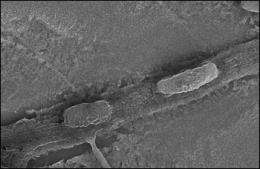
This scanning electron micrograph shows rod shaped Zymomonas mobilis in the cross-linked polymer fibers. These bio-hybrid materials are insoluble in water, and the bacteria remain immobilized but viable for applications in biotechnology. This particular microbe is used in the production of bioethanol.

Previous attempts to encapsulate viable bacteria in insoluble materials suffered from several shortcomings, according to the researchers. Foremost, the encapsulating materials were usually orders of magnitude larger than thin films. Because nutrients or reactants had to diffuse far into these materials to reach the microbes, activity — and microbe viability — suffered as a consequence.

To overcome these problems, the Brookhaven-Stony Brook team used a technique called electrospinning, which uses electrostatic force to produce polymer filaments. In this process, a polymer solution containing the microorganism of interest is spun to create fibers.

One challenge was developing a polymer-solvent system that would not be toxic to the bacteria. Another was achieving a structure with enough porosity to facilitate the transfer of materials such as nutrients and waste products between the microbes and their environment. Additionally, the final material must be made insoluble so it would remain intact in the watery environments envisioned for many potential applications.

The scientists met these challenges through a series of experiments to develop a method for producing their fibers. They achieved their objective — an insoluble, fibrous polymeric material in which industrially relevant bacteria were successfully encapsulated and remained viable — using a nontoxic, non-biodegradable, water-soluble polymer known as FDMA as the encapsulating agent, and by cross-linking the fibers in a glycerol solution after encapsulation to prevent the material from dissolving in aqueous environments.

Scanning electron microscope and fluorescent microscopy images reveal the rod-shaped bacteria completely encased within the tiny polymer fibers. The fibers form a mesh-like random weave with an open pore structure ideal for use as electrodes, membranes, or filters. Additional tests showed that a high percentage of the bacteria remained viable for up to several months, and their metabolic activity was not affected by immobilization. Yet the encapsulated bacterial cells do not replicate. Therefore no removal of accumulated biomass would be necessary.

The bacteria chosen for this study — from the genera Pseudomonas, Zymomonas, and Escherichia — already have industrial applications, such as fermenting glucose to produce ethanol (a key reaction of biofuel production from plant matter). Insoluble materials containing such bacteria could also be used to develop sophisticated, reusable biosensors, stable drug-delivery systems, and permeable reactive barriers for cleaning up contaminated groundwater.

Provided by Brookhaven National Laboratory (news : web)

4.9 /5 (10 votes)  

Filter


Move the slider to adjust rank threshold, so that you can hide some of the comments.


Display comments: newest first

superhuman
Aug 04, 2009

Rank: 4 / 5 (1)
If all this works as described and high enough bacteria density can be achieved this may truly revolutionise biotechnology.
ForFreeMinds
Aug 05, 2009

Rank: not rated yet
This is fantastic - this will make new technologies using bacteria to create/destroy chemicals in many applications more feasible. It changes vat systems to process systems that continuously function.
Rank 4.9 /5 (10 votes)
Relevant PhysicsForums posts
  • Flipping a coin
    created4 hours ago
  • coil force to the plunger
    created6 hours ago
  • Can better sensors extract unlimited info from old lens?
    created10 hours ago
  • rate of effusion dependance on pressure
    created10 hours ago
  • Weightlessness in a common swing
    created10 hours ago
  • How would I calculate the centripetal acceleration of a car on an elliptical path?
    created18 hours ago
  • More from Physics Forums - Classical Physics

More news stories

Scientists discover molecular secrets of 2,000-year-old Chinese herbal remedy

For roughly two thousand years, Chinese herbalists have treated Malaria using a root extract, commonly known as Chang Shan, from a type of hydrangea that grows in Tibet and Nepal. More recent studies suggest that halofuginone, ...

Chemistry / Biochemistry

created 8 hours ago | popularity 4.5 / 5 (17) | comments 14 | with audio podcast

New method to examine batteries -- MRI from the inside

There is an ever-increasing need for advanced batteries for portable electronics, such as phones, cameras, and music players, but also to power electric vehicles and to facilitate the distribution and storage of energy derived ...

Chemistry / Analytical Chemistry

created 8 hours ago | popularity 5 / 5 (6) | comments 0 | with audio podcast

Hydrogen from acidic water: Researchers develop potential low cost alternative to platinum for splitting water

A technique for creating a new molecule that structurally and chemically replicates the active part of the widely used industrial catalyst molybdenite has been developed by researchers with the Lawrence Berkeley ...

Chemistry / Materials Science

created Feb 09, 2012 | popularity 4.8 / 5 (16) | comments 21 | with audio podcast

Fool's gold may prove an unlikely alternative to overexploited catalytic materials

Catalytic materials, which lower the energy barriers for chemical reactions, are used in everything from the commercial production of chemicals to catalytic converters in car engines. However, with current catalytic materials ...

Chemistry / Materials Science

created Feb 10, 2012 | popularity 4.4 / 5 (8) | comments 8 | with audio podcast

Research provides octagonal window of opportunity for carbon capture

(PhysOrg.com) -- Filtering carbon dioxide, a greenhouse gas, from factory smokestacks is a necessary, but expensive part of many manufacturing processes. However, a collaborative research team from the National ...

Chemistry / Materials Science

created Feb 08, 2012 | popularity 5 / 5 (2) | comments 5 | with audio podcast


A mitosis mystery solved: How chromosomes align perfectly in a dividing cell

Although the process of mitotic cell division has been studied intensely for more than 50 years, Whitehead Institute researchers have only now solved the mystery of how cells correctly align their chromosomes during symmetric ...

Google might launch Drive for cloud storage soon

(PhysOrg.com) -- Google's next big move, according to the Wall Street Journal, is a cloud storage service called Drive. Hardly first to the plate, Google is simply catching up to introducing its cloud reposi ...

Lab study raises questions over nano-particle impact

Tests involving chickens have raised questions about the impact on health from engineered nano-particles, the ultra-fine grains commonly used in drugs and processed foods, scientists said on Sunday.

Overeating may double risk of memory loss

New research suggests that consuming between 2,100 and 6,000 calories per day may double the risk of memory loss, or mild cognitive impairment (MCI), among people age 70 and older. The study was released today and will be ...

Starve a virus, feed a cure? Findings show how some cells protect themselves against HIV

A protein that protects some of our immune cells from the most common and virulent form of HIV works by starving the virus of the molecular building blocks that it needs to replicate, according to research published online ...

Researchers find extensive RNA editing in human transcriptome

In a new study published online in Nature Biotechnology, researchers from BGI, the world's largest genomics organization, reported the evidence of extensive RNA editing in a human cell line by analysis of RNA-seq data, demons ...