Low-Budget Fusion Reactor Could Generate Energy within a Decade
August 4, 2009 by Lisa Zyga weblog
Fusion Reactor

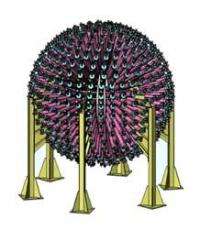
General Fusion's reactor design consists of 220 pistons that simultaneously ram a metal sphere. This creates a shock wave inside the sphere, so that plasma rings in the center create a fusion reaction. Credit: General Fusion.

(PhysOrg.com) -- Currently, most nuclear fusion power plants are large, expensive projects that will take decades to benefit from. But a startup company in Vancouver, Canada, called General Fusion is taking the fast track to fusion, with a plan to build a working prototype fusion power plant within the next decade at a cost of less than a billion dollars.

General has recently raised enough financial support - $13.5 million - from public and private investors to start the project. Rather than using expensive superconducting magnets (tokamaks) like the $14-billion ITER project in France or powerful lasers like those used by the Lawrence Livermore National Laboratory in the US, General Fusion plans to try a relatively low-tech approach called magnetized target fusion.

The reactor consists of a metal sphere with a diameter of three meters. Inside the sphere, a liquid mixture of lithium and lead spins to create a vortex with a vertical cavity in the center. Then, the researchers inject two donut-shaped plasma rings called spheromaks into the top and bottom of the vertical cavity - like "blowing smoke rings at each other," explains Doug Richardson, chief executive of General Fusion.

The last step is mainly well-timed brute mechanical force. 220 pneumatically controlled pistons on the outer surface of the sphere are programmed to simultaneously ram the surface of the sphere one time per second. This force sends an acoustic wave through the spinning liquid that becomes a shock wave when it reaches the spheromaks in the center, triggering a fusion burst. Specifically, the plasma's hydrogen isotopes - and tritium - fuse into helium, releasing neutrons that are trapped by the lithium and lead mixture. The neutrons cause the liquid to heat up, and the heat is extracted through a heat exchanger. Part of the resulting heat is used to make steam to spin a turbine for power generation, while the rest goes back to recharge the pistons.

The biggest challenge with the design will likely be showing that the technique actually works; no one has ever demonstrated that spheromaks can be compressed enough - while maintaining their donut shape - to create fusion. The design also takes advantage of digital control technologies that have only recently been developed, which are required to ensure that all 220 pistons strike the sphere at once.

General Fusion has just started developing simulations of the project, and hopes to build a test reactor and demonstrate net gain within five years. If everything goes according to plan, they will then build a 100-megawatt prototype reactor to be finished five years after that, which would cost an estimated $500 million.

According to fusion experts interviewed in MIT Technology Review, the design will likely face many challenges, but the idea is scientifically sound. As Ken Fowler, professor emeritus of nuclear engineering and plasma physics at the University of California, Berkeley, explained, the culture of a private startup might enable the process to proceed more quickly, with less worry about potential risks.

via: MIT Technology Review

© 2009 PhysOrg.com

4.5 /5 (59 votes)  

Filter


Move the slider to adjust rank threshold, so that you can hide some of the comments.


Display comments: newest first

otto1923
Aug 04, 2009

Rank: not rated yet
I saw this thing awhile ago- would be a noisy sumbitch. I still put my money on some variant of Z-Pinch or laser inertial confinement. More potential room for energy extraction-?
MorituriMax
Aug 04, 2009

Rank: 4.4 / 5 (9)
"Currently, most nuclear fusion power plants are large, expensive projects that will take decades to benefit from."

Uh, not to be picky or anything, but... as far as I know.. isn't fusion power still limited to THE SUN?!?!

The title of this article and the small opening blurb make it sound like there are big expensive fusion power plants all over the place.
otto1923
Aug 04, 2009

Rank: 4.8 / 5 (8)
Like something out of Norse mythology though- hammers and molten metal and star-power. Otto likes it. Sturm und Drang.
Soylent
Aug 04, 2009

Rank: 4.9 / 5 (8)
Uh, not to be picky or anything, but... as far as I know.. isn't fusion power still limited to THE SUN?!?!


No. Plenty of experimental fusion plants of the intertial confinement and magnetic confinement kinds have been built or are being built. They all do achieve fusion, some have even gotten close to Q = 1, this is however far from the continuous operation and energy gains required in a real power-plant.

Q far greater than 1 have been achieved in thermonuclear bombs but only a few slightly mad people have suggested to use them for generating power(by detonating them underground, heating up a large volume of rock and using it as a geothermal reservoir).
NeilFarbstein
Aug 04, 2009

Rank: 2.1 / 5 (7)
Muonic fusion could work if somebody funded it.
jselin
Aug 04, 2009

Rank: 5 / 5 (5)
Uh, not to be picky or anything, but... as far as I know.. isn't fusion power still limited to THE SUN?!?!


I'm surprised so many people think this. Perhaps the whole elusive cold fusion thing threw people off. Would a 30 second google search have really hurt before posting?
Birger
Aug 04, 2009

Rank: 5 / 5 (3)
Muonic fusion could work if somebody funded it.

The trouble is that the energy needed to create a muon exceeds the energy from the fusion events the muon can induce before it decays... maybe some genius one day can find out a way to "cheat" and increase the number of fusions per muon, but today the outlook seems dark.
Branden520
Aug 04, 2009

Rank: 5 / 5 (2)
The reactor at LLNL has produced 100% output for over a year now. That was at less than 80% of the full input. Unfortunately, it is for less than a second and any output will be wasted. This is a research facility to study conditions within a supernova. The fusion reaction is possible and has occured on this planet. The hard part is harnessing the energy or heat to be used and converted into a viable source of electricity and still maintain that greater than 100% efficiency.
etabeta
Aug 04, 2009

Rank: 4.3 / 5 (3)
Even if this thing works, where is all that tritium going to come from? At present the only viable source of tritium is from fission reactors
showme
Aug 04, 2009

Rank: 5 / 5 (5)
"Currently, most nuclear fusion power plants are large, expensive projects that will take decades to benefit from."


Uh, not to be picky or anything, but... as far as I know.. isn't fusion power still limited to THE SUN?!?!


The title of this article and the small opening blurb make it sound like there are big expensive fusion power plants all over the place.


As noted above, we do have controlled fusion reactions on earth in laboratories, but to call any of these devices "power plants" as the article does is at best naive and at worst disingenuous.
Ethelred
Aug 04, 2009

Rank: 3 / 5 (2)
Muonic fusion could work if somebody funded it.


Its been funded. The muons were used up too fast. There is a 1 percent chance in each reaction of the muon being captured by an alpha particle. The reaction needs it be around one in 500 for it to become feasible.

Ethelred
Sean_W
Aug 04, 2009

Rank: 5 / 5 (1)
Ten years from now they say. They might have said eleven or nine years just to avoid the whole "cheap fusion power is only ten years away and it always will be" reaction but no. Ten. Always ten.
froggy
Aug 05, 2009

Rank: 5 / 5 (3)
This was my introductory reading on this site and it was enough to put me off the rest of the site. How can we take seriously a site that uses such loose wording in its articles?
Soylent
Aug 05, 2009

Rank: 5 / 5 (7)
Even if this thing works, where is all that tritium going to come from?


Li-6 n -> He-4 H-3.
Li-7 n(fast) -> He-4 H-3 n(slow).

Use liquid salt FLiBe coolant(lithium fluoride mixed with beryllium fluoride) to transfer heat, shield the walls of the reactor from very fast 14 MeV fusion neutrons and breed slightly more tritium than you need with both of the above reactions with lithium.

If you can't get the energy gain high enough, use a fission-fusion hybrid with depleted uranium(can be fissioned effectively with fast neutrons from D-T fusion) or trans-uraniucs separated from spent LWR fuel; this gives some extra neutrons to breed tritium, unfortunately they're not very fast neutrons and you'll need to enrich in lithium-6.

Each fission releases some 190 MeV, each D-T fusion some 17 MeV, greatly amplifying the energy released.

This to is how thermonuclear weapons work(fission neutrons from a uranium-235 "spark plug" in the secondary stage breed tritium from lithium-6 deuteride; 14 MeV fusion neutrons induce fission in the natural or depleted uranium casing).

Eventually you want to produce T and He-3 fuel from D-D fusion. You're not going to be able to grab the tritium, but possibly the He-3; D-T and D-D is going to occur alongside each other, consuming most tritium produced.

There's no rush. In a breeder regime there's enough uranium and thorium for 10^10 americans for the next billion years(even average crust is eventually worth mining; 3 ppm U and 10 ppm Th corresponds to ~140 barrels of oil equivalent per tonne of crust). At 20 ppm average crustal abundance lithium is even more abundant.

The only thing that's really pressing is in the short term, phasing out coal and stepping down oil demands post peak(oil will be with us for a long time, just a percent or two less every year).
kasen
Aug 05, 2009

Rank: not rated yet
Those pistons are going to be a key issue, I think. I imagine they'd have to be almost perfectly identical in all aspects. If the sphere is 3m, the pistons themselves are probably around that length, or at least that's what the picture makes it seem like. 220 heavy-duty pieces of hydraulic hardware set in a spherical pattern, that have to strike at the same time, with the same force. That's a lot of precision work on a relatively big scale. How small a deviation would be acceptable for the reaction to occur?

Also, it seems to me that this wouldn't be a directly self-sustaining reaction, since the shockwave from the pistons is what triggers the fusion, once every second. Did I get this right?
Soylent
Aug 05, 2009

Rank: 4.7 / 5 (3)
Kasen, the pistons don't have to be exactly identical and the main driver, compressed gas, does not need to be very precise.

The trick is to continously and accurately measure the position of the pistons and do numerous small corrections to bring all pistons into sync.

This wouldn't have been doable 20 years ago, but today DSP is really cheap and really fast.

Yes, the reaction is pulsed. Not a problem since the lead-lithium liquid coolant can act as a heat buffer as well as tritium breeding-blanket.
kasen
Aug 05, 2009

Rank: 5 / 5 (2)
Thanks for the clarifications. I guess I'm more of a Soviet-type when it comes to engineering, don't really trust computers over good ol' fashion mechanical/analog design. Especially with stuff like nuclear fusion.

Then again, with the reaction being pulsed and intermediated in this particular case, there shouldn't be any major safety issues. Save for the occasional reactor getting loose and rolling away from the plant in a wacky fashion. They probably shouldn't build them on elevated terrain.
Alexa
Aug 05, 2009

Rank: 3 / 5 (4)
Pistons could be based on piezoelectric principle..
Smellyhat
Aug 05, 2009

Rank: not rated yet
So, what are the operating conditions of the pistons, what percentage of them need to be functioning at any given to for the rector to generate a net power gain, and how long will it take to replace a broken piston?

kasen
Aug 05, 2009

Rank: 5 / 5 (2)
Obviously, the guys over at General Fusion(friend of Field Marshall Von Eisotope) are the only ones capable to answer those kinds of questions. Just tell them you're a potential investor and add/subtract 20-30% from any numbers they give you.

I assume it's more a matter of position rather than number, though. The reactor might work with 10 broken pistons spread evenly across the sphere, but might fail if they're all close to each other. If I'm not mistaken, some sort of symmetry needs to be maintained and changing a piston might even require shutting the whole thing down.

I just remembered there's an old Simpsons episode where Mr. Burns reminisces about the first nuclear powerplant of his family, where people would just hammer atoms on anvils. I wonder if this is where they got the idea.
otto1923
Aug 05, 2009

Rank: 5 / 5 (1)
By Odin's Beard! Primeval Fire of the Gods! The Forge of Asgard!! (sorry)
otto1923
Aug 05, 2009

Rank: not rated yet
So we might some day have piston-driven fusion engines in our vehicles? How ironic.
Soylent
Aug 05, 2009

Rank: not rated yet
So we might some day have piston-driven fusion engines in our vehicles? How ironic.


No, not unless your vehicle is a container ship or a freight locomotive.
otto1923
Aug 05, 2009

Rank: 4 / 5 (1)
I could envisage a small acoustic-driven device of some sort using exotic materials and direct neutron to electricity conversion. The chamber could be shaped to reflect assymetric acoustic waves much like backpack nukes reflect neutrons. Use your imagination and speculate. This sonic implosion kind of reminds one of bubble fusion claims, a little? Wouldn't work on 'boomer' subs- too noisy.
otto1923
Aug 05, 2009

Rank: not rated yet
Although shipping would be good-
http://www.guardi...ollution
MorituriMax
Aug 05, 2009

Rank: 1 / 5 (2)
Uh, not to be picky or anything, but... as far as I know.. isn't fusion power still limited to THE SUN?!?!


I'm surprised so many people think this. Perhaps the whole elusive cold fusion thing threw people off. Would a 30 second google search have really hurt before posting?


Ohhhhhh, I don'ttttt know... maybe the whole thing about there not being any power plants on earth actually making and SELLING fusion generated power might have a teensy bit to do with why I don't googling stuff like flat earth, kinko foot pads cure cancer and remove heavy metals selectively from the body, power plants making cheap fusion energy that is being sold today... you knowwwwww... little nit picky things like that.
Soylent
Aug 05, 2009

Rank: 5 / 5 (1)
I could envisage a small acoustic-driven device of some sort using exotic materials and direct neutron to electricity conversion.


No.

Q-value scales rapidly with size, it's very hard to shrink it.

You need a certain amount of lithium surrounding the reaction to breed tritium. If you don't get enough tritium you can't use D-T; D-D is much harder and the reactor has to be far bigger.

Neutrons have only a magnetic moment, no charge; it's very hard to imagine any kind of direct conversion into electricity.

Neutrons just barrel straight through matter until they get close enough to a nuclei to interact via the strong force. It's very hard to adequately shield neutrons without adding a lot of weight. Shortly after world war II the US and soviets were both trying to develop reactors for aircraft that could stay aloft for weeks at a time.

It was not difficult to design a reactor with the power to weight ratio to get air-borne, but even if you put the reactor(s) as far away from the pilots as possible and used the minimal amount of shielding possible to just protect the pilots in the cockpit it could not have got airborne. A fission gives ~190 MeV of usable energy and 10 MeV of energy carried away by an antineutrino that interacts only via the weak force; the ~2.5 average neutrons get ~2 MeV each. D-T fusion gives 14 MeV neutrons; much harder still to shield.

You're not going to directly drive an aircraft with this reactor, not on the D-T fuel cycle anyway, and you're definetly not going to fit it inside a car.
bgF2
Aug 05, 2009

Rank: not rated yet
A more benign design is under construction fusing hydrogen and boron in a plasma field. It will emit an electron beam and has no fission by-products. See the Focus Fusion web site:
http://focusfusion.org/

otto1923
Aug 05, 2009

Rank: not rated yet
You need a certain amount of lithium surrounding the reaction to breed tritium.
Breed tritium elsewhere.
Neutrons have only a magnetic moment, no charge; it's very hard to imagine any kind of direct conversion into electricity.
OK, how about neutrons to heat to electricity in a multilayered material? I keep coming back to thermoelectrics. Gotta be possible. Just trying, you obviously know lots more about this than me. You can change a neutrons direction, yes? Maybe the vessel configuration reflects neutrons back the same way it does sonic pulses. OR perhaps Mr. Fusion emits more useful particles than neutrons. Compress pellets full of ultra dense deuterium :-)
david_42
Aug 05, 2009

Rank: 5 / 5 (1)
The fusor approach (electrostatic confinement) has produced working reactors since the 1950s. They are even manufactured and used as neutron sources. The US Navy has recently let a contract for the WB8 reactor, which will be a net power producing system. And only $200M.
otto1923
Aug 05, 2009

Rank: not rated yet
-Like bgF2 was suggesting:
Aneutronic fusion is any form of fusion power where no more than 1% of the total energy released is carried by neutrons.[citation needed] Since the most-studied fusion reactions release up to 80% of their energy in neutrons, successful aneutronic fusion would greatly reduce problems associated with neutron radiation such as ionizing damage, neutron activation, and requirements for biological shielding, remote handling, and safety issues. Some proponents also see a potential for dramatic cost reductions by converting the energy of the charged fusion products directly to electricity.
Ethelred
Aug 05, 2009

Rank: 3 / 5 (2)
You can change a neutrons direction, yes?


With what? They aren't charged.

Ethelred
otto1923
Aug 05, 2009

Rank: not rated yet
With what? They aren't charged
Neutron reflection, deflection, scattering; I was thinking a suitably-shaped chamber could stream neutrons in some safe direction, as opposed to stopping them with shielding.

I watched bussards presentation to google earlier- this shows how unpopular science does get funded (or is left to die). The navy funded 4 people for 10yrs. Odd that, as clever as bussard was, he missed some fairly obvious but crucial issues- electrons in corners, square magnet cross-sections. Even if there is a better form of fusion production out there, the tokamak must have some important function to be funded as it is. I think it's plasma storage- how else can bulk long-term storage of materials in plasma form be accomplished? The tokamak gets a lot simpler if you're not actually trying to fuse anything in it.
otto1923
Aug 05, 2009

Rank: not rated yet
otto1923
Aug 05, 2009

Rank: not rated yet
"Otto, are you saying that bussard might have actually been trying to slow the development of the Polywell concept by discounting obvious design shortcomings, so that the tokamak programs (which he started while working for the govt) weren't derailed?"

I'm saying that no disruptive technologies will be released before their time. Bohr was apparently doing the same thing in Germany with nuclear weapons technologies.
Soylent
Aug 06, 2009

Rank: not rated yet
Neutron reflection, deflection, scattering; I was thinking a suitably-shaped chamber could stream neutrons in some safe direction, as opposed to stopping them with shielding.


Neutron reflection, deflection and scattering all describe the same basic things, random scattering against nuclei. There's no such thing as a neutron mirror.

It's an inherently probabilistic process. Atomic nuclei have quite small neutron scattering cross-sections so you need a really thick layer to ensure that nearly all neutrons are scattered. Worse, since scattering is in a random direction with a wide angular distribution you can't direct it as you'd wish.

You can't dump any significant amount of neutrons in the nearby environment, you need most of those neutrons to find a lithium nuclei so you can make tritium. There needs to be a lot of lead in the molten alloy surrounding the reaction to get a good impedance match against the steel striking surface(you can't use exotic light-weight materials like beryllium, it is highly toxic, expensive and hard to work with). You need to contain nearly all of your surplus neutrons because even if you could direct them into the pavement or something, you'd create a lot of thermalized neutrons bouncing around randomly in the environment until they find a nuclei that captures them(most would not decay). Nuclei with radioactive neutron activation products exist everywhere, in the pavement, in people, in building materials, dirt and plants.

If the reactor is thick enough to absorb most of these neutrons internally it is much too big to fit in a car.
Birger
Aug 06, 2009

Rank: not rated yet
For individual ships (and possibly train engines) molten salt fission reactors might be compact enough (see wikipedia for details). Fusion reactors will probably always be too bulky to be moved.
-One possibility I find intriguing is to use a fusion power plant as a source of fast neutrons, to "breed" fissionable material from thorium or U-238.
Nature magazine (vol 460, p25) has an article about the possibility of a fusion-fission hybrid concept that would also burn through most of the long-lived fissile waste by bombarding it with neutrons.
otto1923
Aug 06, 2009

Rank: 5 / 5 (2)
@soylent
Think stranger...
Neutron Optics
http://nop.kek.jp...dex.html
-There are diagrams of parabolic neutron mirrors or somesuch as used on more exotic weapons; I will post if I find them-

In that Bussard/Google presentation on YouTube someone asked a question about whether metamaterials could be used in his polywell machines. He says he thinks the environment would be too hostile, and that that is the only answer he could give. Damn clever fellow. 
otto1923
Aug 06, 2009

Rank: 5 / 5 (1)
@soylent
-Somehow I lost the guts of that last post, which was:
Here is a greenpeace nuke for when they get serious about saving the planet:
http://www.fas.or...e037.gif
-Note neutron lens. Nuclear winter would be one solution to global warming.
otto1923
Aug 06, 2009

Rank: 5 / 5 (1)
@soylent
-Or google "neutron mirror"
kasen
Aug 06, 2009

Rank: 5 / 5 (2)
The link with neutron optics talks about using less neutrons for research/imaging purposes, from what I can tell. They're looking for precision measurement, not the large-scale stuff needed for reactors. And by large-scale I mean anything bigger than an old CRT monitor.

Now, perhaps with sufficiently advanced nanotech, we could make tiny reactor-bots that would extract energy one atom at a time and would only have to deal with a few neutrons, which could maybe be caught by breeder-bots using (nano)cloud computing to predict their path. You'd basically have a cloud of radioactive, swarm-AI driven nanobots ready to provide cheap energy, or death, for all mankind. If they do turn on us, we'll just name the project Firefly and FOX will take care of the rest.
RJ32
Aug 06, 2009

Rank: 5 / 5 (1)
Wake me when it's over.
Soylent
Aug 06, 2009

Rank: 5 / 5 (1)
Total internal reflection at a fraction of a degree only helps you when you have a well-behaved point-source or collimated beam of neutrons.

General fusion's reactor is necessarily a diffuse source of neutrons because it needs a big blob of liquid lithium/lead mixture. If the neutron was channeled out of the reactor, you would neither be able to capture its kinetic energy(which is 80% of the energy from D-T fusion) nor would you be able to breed enough tritium to break even.
otto1923
Aug 06, 2009

Rank: not rated yet
oy
GaryB
Aug 06, 2009

Rank: 5 / 5 (3)
Ten years from now they say. They might have said eleven or nine years just to avoid the whole "cheap fusion power is only ten years away and it always will be" reaction but no. Ten. Always ten.


I thought it was well understood that "ten years from now" is slang for "hell if I know".
Ethelred
Aug 07, 2009

Rank: 3.7 / 5 (3)
In drug research ten years seems to mean that there is something that works in a petri dish and hasn't killed TOO many rats so far when they overdosed them so maybe its nearly time to test on dogs. But in fusion search the number of years tends to be significantly longer than ten years.

I have been seeing articles saying it will be 50 years for over forty years. Never seen one before that claimed a mere 10. Makes me suspicious of fraud but in this case there aren't the severe practical engineering problems that a tokomak has.

If its going to work at all ten years seems possible. Since there is no need for magic spells and human sacrifice on altars cooled with liquid helium ten inches or less from fusing plasma at millions of degrees. Those sorts of things tend call more for Agamemnon than engineers.

The link bgF2 posted looked very interesting. Looked highly speculative.

Ethelred
otto1923
Aug 07, 2009

Rank: 5 / 5 (5)
"Norse mythology- Greek mythology for heterosexuals."
otto1923
Aug 07, 2009

Rank: 5 / 5 (1)
Those sorts of things tend call more for Agamemnon than engineers.
Try king Otto (of Germany- not Greece)
NeilFarbstein
Aug 08, 2009

Rank: 2.8 / 5 (5)
Muonic fusion could work if somebody funded it.


The trouble is that the energy needed to create a muon exceeds the energy from the fusion events the muon can induce before it decays... maybe some genius one day can find out a way to "cheat" and increase the number of fusions per muon, but today the outlook seems dark.


Hi. How are you doing? The linting factor is that helium in the fusion reactor attracts the muons and they glom onto them and the muons are not free to interact with deuterium molecules. Stripping is the process of muons coming off the helium nuclei freeing them to catalyze fusion reactions. A long time ago I figured out that if you shown laser light onto helium bound muons the stripping rate would go up. I planned to use x ray lasers. Although one of the pioneers in muonic fusion at sandia national laboratory told me he though my idea would work, I have been unable to find funding. Nobody is interested.
NeilFarbstein
Aug 08, 2009

Rank: 2.3 / 5 (6)
Muonic fusion could work if somebody funded it.


The trouble is that the energy needed to create a muon exceeds the energy from the fusion events the muon can induce before it decays... maybe some genius one day can find out a way to "cheat" and increase the number of fusions per muon, but today the outlook seems dark.

Muonic fusion could work if somebody funded it.


The trouble is that the energy needed to create a muon exceeds the energy from the fusion events the muon can induce before it decays... maybe some genius one day can find out a way to "cheat" and increase the number of fusions per muon, but today the outlook seems dark.


Hi. How are you doing? The limiting factor is that helium in the fusion reactor attracts the muons and they glom onto them and the muons are not free to interact with deuterium molecules. Stripping is the process of muons coming off the helium nuclei freeing them to catalyze fusion reactions. A long time ago I figured out that if you shown laser light onto helium bound muons the stripping rate would go up. I planned to use x ray lasers. Although one of the pioneers in muonic fusion at sandia national laboratory told me he thought my idea would work, I have been unable to find funding. Nobody is interested.
Ethelred
Aug 08, 2009

Rank: 1 / 5 (1)
Did Otto sacrifice his own daughter?

That is what Agamemnon did just to get good winds to cross the Aegean Sea. Nasty bugger. When my brother saw Time Bandits in the theater he said the people around him wondered why Agamemnon's wife kept looking at him with hatred since he was a Hero in that movie.

Ethelred
Ethelred
Aug 08, 2009

Rank: 3.7 / 5 (3)
Nobody is interested.


Uh, Neil I think the reason is pretty clear.

I planned to use x ray lasers.


And how were you planning to pump the x-ray lasers? One method is with an atomic bomb.

Ethelred
otto1923
Aug 08, 2009

Rank: not rated yet
That is what Agamemnon did just to get good winds to cross the Aegean Sea.
The question is 'Did it work?' Lets see, from here we could link this to overpopulation or religion. These threads do tend to wander dont they? I remember the early x-ray laser setup at PPL. They had a series of IR plasma lasers to pump the final gadget. Dont know if they got results. That was looong ago.
otto1923
Aug 08, 2009

Rank: not rated yet
Heres one- the LCLS at Stanford SLAC National Accelerator Laboratory:
http://lcls.slac.stanford.edu/
X-ray lasers would make excellent diagnostics tools for the thumper machine above:
https://www.llnl....95.2.pdf
-thereby completing the circle.
http://www.thumpertalk.com/
-for other large cylinder machines.
Adam
Aug 09, 2009

Rank: not rated yet
Even if this thing works, where is all that tritium going to come from? At present the only viable source of tritium is from fission reactors


The tritium is bred in the lead/lithium jacket via reactions with the neutrons. Similar to how tokamaks like ITER are expected to breed the stuff.
otto1923
Aug 09, 2009

Rank: 5 / 5 (2)
The trouble is that the energy needed to create a muon exceeds the energy from the fusion events the muon can induce before it decays
Hi Neil. Sounds like you need To find a muon catalyst. And also a funding catalyst.
N_O_M
Aug 10, 2009

Rank: 3.4 / 5 (5)
The trouble is that the energy needed to create a muon exceeds the energy from the fusion events the muon can induce before it decays
Hi Neil. Sounds like you need To find a muon catalyst. And also a funding catalyst.

Add to that a spelling catalyst and a personality catalyst.
Rank 4.5 /5 (59 votes)
Related Stories
Relevant PhysicsForums posts

More news stories

Explained: Sigma

It's a question that arises with virtually every major new finding in science or medicine: What makes a result reliable enough to be taken seriously? The answer has to do with statistical significance -- but ...

Physics / General Physics

created 21 hours ago | popularity 5 / 5 (12) | comments 32

Borexino Collaboration succeeds in spotting pep neutrinos emitted from the sun

(PhysOrg.com) -- To learn more about how the sun works, scientists study particles that are emitted from it into space due to thermonuclear reactions that occur inside; by applying known physics principles, ...

Physics / General Physics

created 21 hours ago | popularity 4.6 / 5 (7) | comments 0 | with audio podcast report

Physics research suggests new pathways for cancer progression

Observing that certain cancer cells may exhibit greater flexibility than normal cells, some scientists believe that this capability promotes rapid tumor growth. Now computer simulations developed by Boston University Biomedical ...

Physics / General Physics

created 19 hours ago | popularity 5 / 5 (1) | comments 0

Quantum physicist explains $100K offer for proof scaled-up quantum computing is impossible

(PhysOrg.com) -- MIT researcher Scott Aaronson has certainly riled the physics community with his offer this past Friday, of $100,000 to anyone who can prove that scaled-up quantum computing is impossible. ...

Physics / Quantum Physics

created Feb 08, 2012 | popularity 4.1 / 5 (11) | comments 32 | with audio podcast weblog

Physicists 'record' magnetic breakthrough

An international team of scientists has demonstrated a revolutionary new way of magnetic recording which will allow information to be processed hundreds of times faster than by current hard drive technology.

Physics / General Physics

created Feb 07, 2012 | popularity 4.5 / 5 (39) | comments 14 | with audio podcast


Fighting crimes against biodiversity: How to catch a killer weed

Invasive species which have the potential to destroy biodiversity and influence global change could be tracked and controlled in the same way as wanted criminals, according to new research from Queen Mary, University of London.

Metastatic breast cancer hitches a free ride from the immune system

Inflammatory breast cancer (IBC) is the most lethal form of breast cancer . It spreads easily through the lymphatic and blood vessels, forming metastasis which can lead to multi-organ failure. New research published in BioMed ...

A novel method for simultaneously measuring blood pressure and arterial stiffness

Arterial stiffness due to is a major contributor to cardiovascular disease but is very difficult to measure. It also can influence blood pressure readings since these rely on the time taken for arteries to return to normal ...

India's global pharmacy role threatened by EU pact

(AP) -- Efforts by India and the European Union to strengthen trade are threatening India's ability to deliver lifesaving medicines to the world's poorest, analysts say as the two sides push through protracted ...

US video game sales fall 34 percent in January

(AP) -- U.S. retail sales of video game hardware, software and accessories fell 34 percent in January from a year earlier to $751 million due to the lack of new game titles, according to market researcher NPD Group.

Study finds that red blood cell transfusion decreases fatigue in women with acute postpartum anemia

In a study to be presented today at the Society for Maternal-Fetal Medicine's annual meeting, The Pregnancy Meeting ™, in Dallas, Texas, researchers will report findings that show that in women with acute postpartum ...