Khmer Rouge trials offer baseline study for mental health impact to a society of war crimes tribunal (w/ Video)
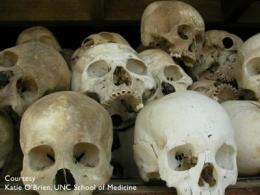
As leaders of the former Khmer Rouge regime testify in a human rights tribunal, in harrowing detail, for the killing of more than a million Cambodians from 1975 to 1979 a central medical question remains unanswered: will the trials help a society heal or exacerbate the lingering affects of widespread trauma?
A new study offers insight, but sustains the paradox: more than 75 percent of Cambodians believe the Khmer Rouge trials, formally called the Extraordinary Chambers in the Courts of Cambodia, will provide justice and promote reconciliation, but more than 87 percent of people old enough to remember the torture and murder during the Khmer Rouge era say the trials will rekindle "painful memories."
"Cambodians have high hopes that the Khmer Rouge trials will deliver justice. However, they also have great fears of revisiting the past," says Jeffrey Sonis, M.D., M.P.H., an associate professor in the departments of Social Medicine and Family Medicine at the University of North Carolina at Chapel Hill School of Medicine, lead author of the study that appears in the Aug. 6 issue of the Journal of the American Medical Association.
"We just don't know how tribunals affect a society, whether they increase mental and physical disabilities or relieve them," Sonis says. Sonis and colleagues are now conducting a longitudinal study, funded by the National Institute of Mental Health, to measure the effects of the trials on Cambodians over time.
Preparation for the trials, co-sponsored by the Cambodian government and the United Nations, began in 2006, 26 years after the collapse of the Khmer Rouge under its leader, Pol Pot. The first public trial, of Kaing Guek Eav, leader of the notorious Tuol Sleng prison, where thousands were tortured and killed, began earlier this year. Accounts of the genocide estimate between 1 million and 2 million people were killed to create an "agrarian collectivism" a communist concept for an ideal society.
Between December 2006 and August 2007 Sonis and an international team of colleagues, including researchers from the Center for Advanced Study in Phnom Penh, conducted a national survey of more than 1,000 Cambodians age 18 and older; 813 were 35 and older and would have been at least 3 years old when the killings began.
More than 14 percent of respondents over age 35, and 7.9 percent of people 18 to 35, suffered from "probable postraumatic stress disorder" (respondents met criteria on a common questionnaire, but did not receive an official clinical diagnosis), which resulted in significant rates of mental and physical disabilities. Previous studies have reported higher rates of PTSD in Cambodians, but were mostly conducted among Cambodia refugees. The rate (11 percent) of probable PTSD among all Cambodians over the age of 18 was more than 5 times the rate among U.S. adults, based on the National Comorbidity Survey.
Among the older group, half said they were close to death during the Khmer Rouge era and 31 percent reported physical or mental torture.
Respondents who did not believe justice had been served, up to the time of the survey, and those who felt the need for revenge were more likely to have PTSD. Also, people who had more knowledge of the trial had higher rates of PTSD. Yet most Cambodians had highly positive attitudes about the trials.
Another paradox emerged from the respondents: Almost half of the respondents in this overwhelmingly Buddhist country thought the trials "go against the teachings of Buddha." However, when asked about attitudes toward the Khmer Rouge, 63 percent of respondents strongly agreed, and 21 percent agreed with the statement, "I would like to make them suffer."
Tribunals to assess crimes of war and crimes against humanity are becoming more common. In June, Charles Taylor, former president of Liberia, answered questions in an international courtroom in Paris about his alleged role in genocide in Sierra Leone in the 1990s. The International Criminal Tribunal for the Former Yugoslavia, a UN-sponsored trial, has been underway since 1993 and the International Criminal Tribunal for Rwanda since 1995. The Nuremberg Trials is perhaps the most well known.
The Khmer Rouge trials offer the opportunity to better gauge the efficacy of these trials, and those lessons hold relevance across a spectrum of injustice.
"The larger question raised by our study is whether attempts to promote justice for survivors of violence - whether en masse or inflicted by one individual to another - can help lessen its psychological toll," Sonis says. "We simply don't know the answers yet."
More information: JAMA. 2009;302[5]:527-536.
Source: University of North Carolina School of Medicine (news : web)


