Experts predict quieter Atlantic hurricane season
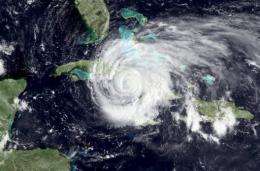
August 4, 2009 This NOAA satellite image shows Hurricane Ike in 2008

Enlarge

This NOAA satellite image shows Hurricane Ike in 2008. Weather experts on Wednesday reduced the number of projected hurricanes in the north Atlantic this season to four, two of them major hurricanes with winds above 178 kilometers (111 miles) per hour.

Weather experts on Wednesday reduced the number of projected hurricanes in the north Atlantic this season to four, two of them major hurricanes with winds above 178 kilometers (111 miles) per hour.

After one of the calmest starts to the in a decade, the experts from Colorado State University said the development of an effect in the Pacific had caused them to scale back their projections for the Atlantic.

The El Nino phenomenon, which involves changes in in the southern Pacific, occurs every three to six years, disrupting global weather patterns.

In the Atlantic, El Nino events are associated with decreased levels of hurricane activity, said Philip Klotzbach and William Gray of Colorado State University.

"We continue to call for a below-average Atlantic basin tropical cyclone season in 2009. We also anticipate a below-average probability of United States and Caribbean major hurricane landfall," they said.

They now project that there will be 10 named tropical storms this season, of which four will become hurricanes, and two of those major hurricanes.

Their earlier forecast in June had predicted 11 tropical storms and five hurricanes.

"This is the quietest start for more than a decade. The last time a storm didn't form until August 5 was back in 1992," Klotzbach said.

He added, however, that "a quiet start of the season doesn't necessarily mean that the remainder of the season is going to be quiet."

"Obviously people in Florida need to be prepared for the hurricane season as every year. 1992 was a very quiet hurricane season but then hurricane Andrew formed and did... tremendous damage," he said.

Meanwhile, two tropical storms have formed in the Pacific off the coast of Mexico, according to Stormpulse.com, a website that tracks weather patterns.

The more powerful of the two, Enrique, was traveling in a northwesterly direction with speeds of 120 kilometers (60 miles) per hour.

Farther out, a tropical stormed named Felicia also was traveling in a northwesterly direction toward Hawaii with winds of 72 kilometers (45 miles) per hour.

(c) 2009 AFP


print this article email this article download pdf blog this article bookmark this article     Stumble it Digg this share on Facebook retweet share on Reddit add to delicious
Rate this story - 4.3 /5 (4 votes)


August 4, 2009 all stories

Comments: 0

4.3 /5 (4 votes)
  • Stumble this up

  • Digg this

  • share this

  • hide
  • Related Stories

  • El Nino may calm 2006 hurricane season
    created Sep 07, 2006 | popularity not rated yet | comments 0
  • Meteorologists revise hurricane forecast
    created Aug 03, 2006 | popularity not rated yet | comments 0
  • Busy Atlantic storm season predicted
    created Aug 02, 2005 | popularity not rated yet | comments 0
  • Forecasters predict 6 Atlantic hurricanes for 2009
    created Apr 07, 2009 | popularity not rated yet | comments 0
  • Prediction of major hurricanes lowered
    created Aug 04, 2007 | popularity not rated yet | comments 0


  • hide
  • Relevant PhysicsForums posts

  • The IPCC and the term "most"
    created Nov 23, 2009
  • Is global warming a fact?
    created Nov 23, 2009
  • Random variability of wind patterns
    created Nov 23, 2009
  • Record precipitation in the UK
    created Nov 22, 2009
  • More from Physics Forums - Earth

Other News

Aqua satellite sees Tropical Storm Bongani approaching Mozambique Channel

Aqua satellite sees Tropical Storm Bongani approaching Mozambique Channel

Space & Earth / Earth Sciences

created 1hour ago | popularity not rated yet | comments 0

NASA's Aqua satellite flew over Cyclone Bongani today and provided some important data that have helped forecasters figure out where the storm is headed, and helped them see that it has changed course.


Cosmic 'dig' reveals vestiges of the Milky Way's building blocks

Cosmic 'Dig' Reveals Vestiges of the Milky Way's Building Blocks

Space & Earth / Astronomy

created 3 hours ago | popularity 5 / 5 (6) | comments 0

(PhysOrg.com) -- Peering through the thick dust clouds of our galaxy's "bulge" (the myriads of stars surrounding its center), a team of astronomers has unveiled an unusual mix of stars in the stellar grouping ...


Oceanic crust formation is dynamic after all

Oceanic crust formation is dynamic after all

Space & Earth / Earth Sciences

created 2 hours ago | popularity 4 / 5 (1) | comments 0

Imagine the Earth's crust as the planet's skin: Some areas are old and wrinkled while others have a fresher, more youthful sheen, as if they had been regularly lathered with lotion.


Mars Reconnaissance Orbite

Mars Reconnaissance Orbite Team Plans Uplink of Protective Files

Space & Earth / Space Exploration

created 8 hours ago | popularity 5 / 5 (1) | comments 0

(PhysOrg.com) -- The team operating NASA's Mars Reconnaissance Orbiter plans to uplink protective files to the spacecraft next week as one step toward resuming the orbiter's research and relay activities.


NASA's Aqua satellite sees Nida explode into a category 5 Super typhoon

NASA's Aqua satellite sees Nida explode into a category 5 Super typhoon

Space & Earth / Earth Sciences

created 2 hours ago | popularity 5 / 5 (1) | comments 0

Typhoon Nida is in a favorable environment that has enabled it to intensify faster and stronger than previously forecast, and has now exploded into a Super typhoon. NASA's Aqua satellite passed over Nida and ...