Fire Meets Ice: Superhot And Supercold Remarkably Similar In The 'Fermion' World (w/ Video)
August 4, 2009 By Monte Basgall Fire Meets Ice: Superhot And Supercold Remarkably Similar In The 'Fermion' World (w/ Video)

Enlarge

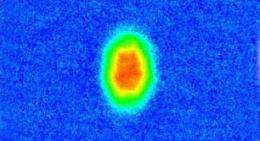
A small blob of Lithium-6 gas, chilled ultracold by a laser light trap, does an unexpected thing when the trap is released.

Trapping and cooling a microscopic clump of gas and then suddenly releasing it would normally result in the gas rapidly expanding outward in all directions, like a spherical bubble.

But what if it doesn’t? When a result doesn’t turn out as anticipated, nature may be revealing its secrets. And when the result also sheds light on Big Scientific Questions that weren’t even part of the experiment, researchers sit up and pay even closer attention.

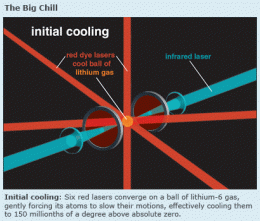
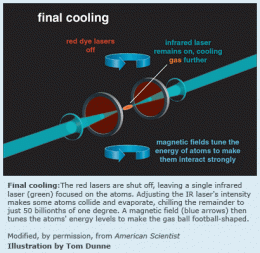
That’s what’s been happening since Duke physicist John Thomas did this experiment with lithium-6. The key was using only light to chill the gas to almost absolute zero and adding the right amount of magnetic energy, a combination pioneered in Thomas’s lab.

Instead of expanding evenly, the gas blob took the shape of a cigar standing on its tip. It then morphed asymmetrically within milliseconds into “this funny flow that stood still in one direction but expanded rapidly in the other,” recalls Thomas, an expert on the physics of ultracold temperatures and the university’s Fritz London Professor of Physics.

The stand-up stogie didn’t grow any taller, as Thomas noted with the aid of a microscope and time-freezing camera. But it bulged topsy-turvily in the middle, swelling into a kind of melon shape that shifted the overall orientation from vertical to horizontal.

In a much-cited report published in the Nov. 13, 2002 issue of the journal Science, Thomas’s research group suggested this phenomena pointed to a never-before-observed form of group behavior among this kind of gas’s frigid atoms.

It’s a condition that might help explain important phenomena that have been difficult to study, such as the flow of electrons in high-temperature superconductors, or the tightly bound nuclear matter in neutron stars, they said.Subsequent reports in Science and other journals firmed up the notion that the gas could be exhibiting the coordinated flow of a special kind of superfluidity — a strange in which very cold substances seem to move so effortlessly that nothing can stop them, in some cases even climbing walls.

At about the same time, researchers at the Brookhaven National Laboratory’s Relativistic Heavy Ion Collider (RHIC) were getting intriguing results from their attempts to recreate the dawn of creation’s first white-hot microseconds. They did so by smashing together gold atoms propelled to nearly light speed, producing temperatures 150,000 times hotter than the sun’s interior within a time interval too fleet to measure.

This big bash at RHIC was supposed to liberate quarks — the fundamental units of all matter — from the gluons that normally hold them together, creating a hyper-energized gas called a quark-gluon plasma.

Using statistics and simulations to visualize what could not be seen, scientists discovered the plasma actually acts like a superhot fluid. And it behaves a lot like Thomas’s frozen cigars and melons. Both exhibit what the scientists called an “elliptic flow,” ballooning preferentially in only one direction. Thomas calls this “anisotropic expansion.” Soon illustrations from Thomas’s journal reports on the cold temperature experiment were being displayed at quark-gluon symposia — literally bridging the gap separating the very coldest from the very hot.
Fire Meets Ice: Superhot And Supercold Remarkably Similar In The 'Fermion' World (w/ Video)
Enlarge


Fire Meets Ice: Superhot And Supercold Remarkably Similar In The 'Fermion' World (w/ Video)
Enlarge


Further research suggested that although the systems exist at opposite extremes of temperature, both behave like “nearly perfect” fluids, flowing with practically no impeding viscosity.

Theorists involved in superstring physics have taken notice of this remarkable convergence. Some have begun using their complicated mathematical tools to bridge quantum mechanics and general relativity and explain why Thomas’s supercold world bears similarities to the superhot. Already some of their calculations have yielded insights.

“RHIC’s system is at about 2 trillion degrees, while we’re typically at one-tenth of a microdegree above absolute zero — 19 orders of magnitude difference in temperature!” Thomas says. In terms of density, “there is also about 25 orders of magnitude difference between theirs and ours.”

And yet, Thomas, the experts on quark-gluon plasma and string theorists came together in a single session at this year’s annual meeting of the American Association for the Advancement of Science in Chicago to describe “the surprising confluence of such different physics fields as a sort of perfect storm,” according to the magazine Science News.

To have a system that connects cold, condensed gases to high-temperature superconductors and and then to quark-gluon matter and even string theory is pretty amazing,” Thomas said.

Various researchers are still exploring what these very different phenomena might have in common. But Thomas said the special behavior of his Lithium-6 gas is related to the nature of its atoms.

Lithium-6 is among many atomic isotopes classified as “fermions.” Greta Garbos of the atomic world because they “vant to be alone,” fermions are loners compared to their chummier alter-ego counterpart atoms, the “bosons.”

The key is the state of their “spins,” an electromagnetic trait that all fundamental particles possess. Fermions have an “odd” spin of 1/2, which means they cannot share the same energy states with each other. Bosons, on the other hand, actually prefer getting together. Previously only certain boson type atoms were known to exhibit the group behavior of superfluidity.

Protons, neutrons and electrons — the constituents of atoms — are fermions, too. Were it not for their mutual repulsions, “we would collapse,” says Duke theoretical physicist Berndt Mueller. “We’re made up of positively charged nuclei and negative charged , which should attract,” he explains. “But those are also all fermions, so they try to keep away from each other.”

Thomas’s experiments test the limits of this repulsion by making fermions very cold. Cooled to 50 billionths of a degree above and influenced by the weird principles of quantum mechanics, the atoms’ spheres of influence balloon to an incredible large millionths of a meter. They also crowd up as closely as nature allows.

His group was the first to both chill fermions low enough with laser beams and also trick them into behaving for a short time like they’re part of one big molecule. Turning up a magnetic field to just the right level makes them want to collide and pair up into what he calls a “strongly interacting system.” It’s their exceptional interactivity that produces the exploding-cigar effect and also makes his fermions flow like a nearly perfect fluid. They enter a realm known as “universal behavior,” where they emulate traits of other very different systems.That’s why scientists are now using strongly interactive fermions to model how work.

“You can test the theory,” Thomas says. “It’s easier using our gas because it’s a very controlled system.”Universally behaving fermions also let researchers model microscopic properties within the densest of nuclear matter - something not readily tested on a distant neutron star.

This article by Monte Basgall has originally appeared in Duke Research. Reprinted with permission of Monte Basgall.


print this article email this article download pdf blog this article bookmark this article     Stumble it Digg this share on Facebook retweet share on Reddit add to delicious
Rate this story - 4.9 /5 (14 votes)

Rank Filter

Move the slider to adjust rank threshold, so that you can hide some of the comments.


Display comments: newest first

  • Slotin - Aug 04, 2009
    • Rank: 3.4 / 5 (5)
    ..Theorists involved in superstring physics have taken notice of this remarkable convergence. Some have begun using their complicated mathematical tools..
    The explanation is way way more prosaic, though.. When particles are compressed, their repulsive forces will compensate mutually, which effectively leads into free chaotic motion of particles inside of droplet, i.e. into superfluous boson condensate state. And this is a quite common behavior, which is used for example for high pressure shaping of metals or in cumulative warheads, like bazooka, and nothing very surprising is about it - it's an explanation based on classical Newtonian mechanics.

    http://aetherwave...ith.html
  • Slotin - Aug 04, 2009
    • Rank: 3.4 / 5 (5)
    Here's a video of real boson condensate evaporation at the moment, when magnetic trap was released. Individual atoms are sometimes visible by naked eye in real experiments like tiny glowing dots...

    http://www.aether...apor.avi
  • deatopmg - Aug 04, 2009
    • Rank: not rated yet
    and no quarks. Hmmmm!??
  • JukriS - Aug 05, 2009
    • Rank: 1 / 5 (2)

    Could it be possible that the particles of a laserbeam absorb the energy
    radiating from the expanding qvarks with them?
    This way energy radiating from the separate atomcores can not reach the
    expanding atomcores nextby?

    After that expanding qvarks of the separately expanding atomcores overlapp.

    An energyconcentration that has composed of very dense energy has born and its hot / dense energy is able to keep itself hot / dense.
    This way the energy of Bosen-Einstein condensate does not radiate nearly at all its energy away from itself!

    (Maybe later The expanding qvarks have locked themselves to expand side by side?)

    In the area between the expanding qvarks the moving photon meets so much dense energy that its movement slows down significantly.

    For example the speed of a runner slows down involuntarily when the runner meets a traffic jam, but as soon as the runner meets a less dense space that does not transform, he can accelerate his speed. To accelerate his speed the runner must transform his body energyto a less dense energy! In other words the runner must make the substance that he consists of to transform faster than usually in a certain area to a less dense energy.

    If the energy f a photon passing through the Bosen-Einstein condensate does not transform it is based on the fact that the particules are able to recycle the energy they meet! Also the cores of expanding atoms are able to recycle the energy coming towards the core!
  • chelovek - Aug 05, 2009
    • Rank: 1 / 5 (1)
    Very interesting paper with title INHERENT SPIN VERSUS HIDDEN VARIABLES THEOREM: (Abstract): "The paper proves that spinless solutions to the Scrödinger equation do not exist, and at once deduces the inherent fermion spin from Schrödinger representation by a parity gauge transformation." Follow this link: http://works.bepr...zaros/29 Enjoy!
  • chelovek - Aug 05, 2009
    • Rank: 1 / 5 (2)
    A very interesting paper with title INHERENT SPIN VERSUS HIDDEN VARIABLES THEOREM: (Abstract): "The paper proves that spinless solutions to the Scrödinger equation do not exist, and at once deduces the inherent fermion spin from Schrödinger representation by a parity gauge transformation." Follow this link: http://works.bepr...zaros/29 Enjoy!
  • Torbjorn_Larsson_OM - Aug 05, 2009
    • Rank: not rated yet

    And this is a quite common behavior, which is used for example for high pressure shaping of metals


    No AFAIU, these are perfect superfluids, not viscous ones.
  • E_L_Earnhardt - Aug 05, 2009
    • Rank: 3 / 5 (2)
    A case of beer in a dorm room at 2:00 AM! HUSH! The
    professor made an interesting discovery you kids could NEVER understand! I hope he continues his important work! "Laser cooling!" Hummm! 'Could be a
    way to control cancer!
  • sender - Aug 06, 2009
    • Rank: not rated yet
    Beautiful, first glimpses at the Semi-Dirac Monopole?
  • sender - Aug 06, 2009
    • Rank: not rated yet
    If this is a semi-dirac monopole, what effects do opposing monopoles collapsing into each other have? I envision some monopole collision experiments coming from this, hopefully not another nuclear weapon :|
  • gwrede - Aug 07, 2009
    • Rank: not rated yet
    Suppose the RHIC plasma particles perceive "150 000 times hotter than the core of the Sun's interior" as "still quite cold". And lesser temperatures (what we see in nature around us) as ultra cold.

    The similarity between the two experiments is then less surprising.

    But it still opens up entirely new avenues for thinking and research.


  • gwrede - Aug 07, 2009
    • Rank: not rated yet
    I have a problem with Tom Dunne's latter illustration for the article. In it he has drawn the magnetic field like that of a vertical lead going through the center. If that literally is the case, then that would warrant some explaining in the caption since constructing such a field externally is difficult.

    Now the reader is left wondering whether the circular arrows try to depict rotation of the applied magnetic field, or something entirely different.
  • Torbjorn_Larsson_OM - Aug 10, 2009
    • Rank: not rated yet
    qwrede, I don't see "the magnetic field like that of a vertical lead going through the center". The magnetic fields are schematic, to say the least, it's not the form of them that are interesting.

    @ Alexa:

    "the more, the more such system is compressed."

    Sorry, you are here describing some form of viscous behavior. (By trying to equivocate on the meaning of "moving freely".)

August 4, 2009 all stories

Comments: 13

4.9 /5 (14 votes)
  • Stumble this up

  • Digg this

  • share this

  • hide
  • Related Stories

  • Ultracold gas mimics ultrahot plasma
    created Feb 15, 2009 | popularity not rated yet | comments 0
  • Evidence for high temperature superfluidity in cold 'fermion' gas
    created Feb 02, 2005 | popularity not rated yet | comments 0
  • Current theories can't explain observed spin segregation
    created Oct 16, 2008 | popularity not rated yet | comments 0
  • Unbalanced Superfluid Could Be Akin to Exotic Matter Found in Quark Star
    created Mar 14, 2006 | popularity not rated yet | comments 0
  • MIT physicists shed new light on superfluidity
    created Jul 20, 2006 | popularity not rated yet | comments 0


  • hide
  • Relevant PhysicsForums posts

  • Speed of light : missing energy
    created 2 hours ago
  • Can light produce darkness and can noise procude quiteness 4
    created 4 hours ago
  • Magnetic Oscillation Equations
    created 11 hours ago
  • US Physics Test Eligibility
    created 12 hours ago
  • Are Active Noise Control Stereo Possible?
    created 16 hours ago
  • New Supercomputer at Brown University
    created Nov 20, 2009
  • More from Physics Forums - General Physics

Other News

Quick restart of Big Bang machine stuns scientists (AP)

Quick restart of Big Bang machine stuns scientists

Physics / General Physics

created 2 hours ago | popularity 4.4 / 5 (10) | comments 2

(AP) -- Scientists moved Saturday to prepare the world's largest atom smasher for exploring the depths of matter after successfully restarting the $10 billion machine following more than a year of repairs.


A view of a superconducting solenoid magnet at the European Organization for Nuclear Research (CERN) near Geneva

CERN atom-smasher restarts after 14-month hiatus: official

Physics / General Physics

created 22 hours ago | popularity 4.6 / 5 (22) | comments 0

The world's biggest atom-smasher, shut down after its inauguration in September 2008 amid technical faults, restarted on Friday, a spokesman for the European Organisation for Nuclear Research said.


Tapering a Free-Electron Laser to Extract More Juice

Tapering a Free-Electron Laser to Extract More Juice

Physics / General Physics

created 22 hours ago | popularity 4 / 5 (1) | comments 0

(PhysOrg.com) -- Researchers from the NSLS and Science Applications International Corporation (SAIC) have demonstrated a technique that could be used to significantly improve the quantity and quality of light ...


Ultra-Powerful Laser Reproduces How Star's Jets Travel through Interstellar Space

Ultra-Powerful Laser Reproduces How Star's Jets Travel through Interstellar Space

Physics / General Physics

created 23 hours ago | popularity 4.4 / 5 (7) | comments 0

(PhysOrg.com) -- A multi-trillion-watt laser at the University of Rochester has simulated a stellar jet -- an outpouring of matter from a fledgling star -- with unprecedented realism.


nuclear power plant

Doubts raised on nuclear industry viability

Physics / General Physics

created Nov 19, 2009 | popularity 3.2 / 5 (17) | comments 18

(PhysOrg.com) -- The investment in nuclear power has been growing around the world over the last few years, being viewed as a means for countries to control their energy security, avoid the price fluctuations ...