Scary ancient spiders revealed in 3-D models, thanks to new imaging technique (w/ Video)
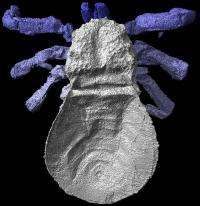
Early relatives of spiders that lived around 300 million years ago are revealed in new three-dimensional models, in research published today in the journal Biology Letters.
Scientists at Imperial College London have created detailed 3D computer models of two fossilised specimens of ancient creatures called Cryptomartus hindi and Eophrynus prestvicii, closely related to modern-day spiders. The study reveals some of the physical traits that helped them to hunt for prey and evade predators.
The researchers created their images by using a CT scanning device, which enabled them to take 3,000 x-rays of each fossil. These x-rays were then compiled into precise 3D models, using custom-designed software.
Both Cryptomartus hindi and Eophrynus prestivicii were around the size of a 50 pence piece and they roamed the Earth during the Carboniferous period, 359 - 299 million years ago. This was a time before the dinosaurs, when life was emerging from the oceans to live on land. During this period, the world's continents were merging together near the equator to form one supercontinent and the first tropical rainforests were playing host to a diverse range of species.
Previous studies of the fossilised remains of Cryptomartus hindi allowed scientists to see some features of the creature, which had four pairs of legs and looked similar to a spider.
In the new study, the researchers' computer models reveal that Cryptomartus hindi's first two legs were angled towards the front of the body, which suggests that it used its legs to grab its prey before killing them. The researchers believe this find suggests the Cryptomartus hindi was an ambush predator, living in logs and fronds, waiting for prey such as insects to walk by before catching and killing them. This stance is seen in modern day crab spiders, which sit on the edge of flowers and wait for insects to land so that they can grab them.
The scientists also discovered that Cryptomartus hindi had ball-like growths at the base of its limbs, called coxal endites. The scientists believe the coxal endites could be an evolutionary hang-over from their last common ancestor, who probably used the growths at the base of their limbs to help them grind their food. These coxal endite-type growths can still be seen today in species such as horseshoe crabs, which use them to grind up their prey before pushing it into their backward-facing mouths.
The computer models also revealed that Cryptomartus hindi's mouth appendages, called pedipalps, had tiny 'tarsal' claws attached at the end to help the creature to manipulate its prey. These claws are seen in rare modern-day arachnids such as the Ricinulei. The researchers say that the existence of this common physical feature, shared by the Cryptomartus hindi and the Ricinulei, lends further weight to the theory that they are closely related.
The models also reveal new information about Eophrynus prestivicii. Previous studies of fossilised remains of this creature suggested that it could have hunted on the open forest floor. It had long legs that enabled it to run through leaf litter to chase, catch and kill its prey.
The new models reveal, for the first time, that Eophrynus prestivicii had defensive spikes on its back. The researchers say that the spikes may have been a defensive adaption by Eophrynus prestivicii, to make them a less tempting meal for the amphibians that would have recently emerged from the oceans onto land.
The study's lead author, Mr Russell Garwood, PhD student from the Department of Earth Science and Engineering at Imperial College London, says:
"Our models almost bring these ancient creatures back to life and it's really exciting to be able to look at them in such detail. Our study helps build a picture of what was happening during this period early in the history of life on land. We think one creature could have responded to increasing predation from the amphibians by growing spikes, while the other responded by becoming an ambush predator, hiding away and only exposing itself when it had to come out to eat."
At present, most palaeontologists analyse fossils by splitting open a rock and looking at the creatures encased inside. This means that scientists can often only see part of the fossil and cannot explore all of the fossil's physical features.
The researchers believe their new technique could be used to re-explore previously analysed fossils to provide a much clearer picture of how ancient extinct species survived on early Earth.
More information: "High-fidelity X-ray micro-tomography reconstruction of siderite-hosted Carboniferous arachnids", Biology Letters, Wednesday 05 August 2009.
Source: Imperial College London (news : web)


