UK conservation agency launches plastic beehive
August 5, 2009
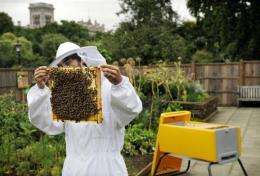
Johannes Paul holds a frame covered in bees taken from a "Beehaus" urban beehive at a garden allotment in central London. The new plastic beehive was launched to encourage people to keep bees in their gardens or on rooftoops to help boost declining honeybee populations.
A new plastic beehive was launched in Britain on Wednesday to encourage people to keep bees in their gardens or on rooftoops to help boost declining honeybee populations.
The bees seemed to like their ultra-modern home as they buzzed happily in and out of the postbox-like slot in the grey and yellow 'beehaus' on the roof of state-backed conservation agency Natural England's London offices.
The agency's chief scientist Tom Tew said if more urban residents kept honeybees, it would increase the insects' numbers and make them more resilient to attacks from disease and pests which threaten their survival.
"We need to recognise that if we want plants to flourish, we need healthy populations of insects to sustain them," Tew said.
"There's no reason why our towns and cities should exist as wildlife deserts -- wildlife can thrive when we design our urban areas with nature in mind and the 'beehaus' is a great example of how easy it is for anyone to bring the natural world closer to their doorstep."
Its makers Omlet claim that at one metre wide and 0.5 metres high (three feet wide and one foot eight inches high), the 'beehaus' is twice as big as a traditional beehive, giving plenty of room for the colony to grow in comfort.
The kit can be bought online starting from 495 pounds.
The number of honeybees in Britain has dropped by up to 15 percent in the past two years, according to government figures, as they face a growing range of diseases and wild flowers they feed on are wiped out by urban development.
(c) 2009 AFP
-
Urban populations to tip scales
Jan 01, 2007 |
not rated yet |
0
-
Bumblebee re-introduced to UK
Jun 13, 2009 |
not rated yet |
0
-
Power lines may become honey bee homes
Dec 15, 2005 |
not rated yet |
0
-
Study: urban black bears 'live fast, die young'
Sep 30, 2008 |
not rated yet |
0
-
Study: City bees better than rural bees
Jan 17, 2006 |
not rated yet |
0
-
Engineers build first sub-10-nm carbon nanotube transistor
Feb 01, 2012 |
4.9 / 5 (30) |
30
-
Something old, something new: Evolution and the structural divergence of duplicate genes
Jan 31, 2012 |
4.6 / 5 (7) |
1
-
The hidden nanoworld of ice crystals: Revealing the dynamic behavior of quasi-liquid layers
Jan 30, 2012 |
5 / 5 (3) |
1
-
Stock market network reveals investor clustering
Jan 27, 2012 |
3.9 / 5 (23) |
8
-
Of microchemistry and molecules: Electronic microfluidic device synthesizes biocompatible probes
Jan 26, 2012 |
5 / 5 (1) |
0
-
Pertubance in a model
3 hours ago
-
Cancer drugs and Alzheimer's, Oh my!
11 hours ago
-
Squishing cells
11 hours ago
-
Any books/articles for evolutionary stable strategy models in humans?
23 hours ago
-
Science behind the bore feeling?
Feb 09, 2012
-
Homo Sapien vs. Chimpanzee - Divergence Timeline
Feb 09, 2012
- More from Physics Forums - Biology
More news stories
The power of estrogen -- male snakes attract other males
A new study has shown that boosting the estrogen levels of male garter snakes causes them to secrete the same pheromones that females use to attract suitors, and turned the males into just about the sexiest ...
1 hour ago |
not rated yet |
0
|
Experts reveal how plants don't get sunburn
(PhysOrg.com) -- Experts at the University of Glasgow have discovered how plants survive the harmful rays of the sun.
1 hour ago |
5 / 5 (1) |
0
|
Miami battling invasion of giant African snails
No one knows how they got there. But an invasion of African giant snails has southern Florida in a panic over potential crop damage, disease and general yuckiness surrounding the slimy gastropods.
5 hours ago |
not rated yet |
2
New drugs schedule makes horse racing a sure thing
What do Gai Waterhouse and Anthony Cummings have in common with Queen Elizabeth II?
1 hour ago |
not rated yet |
0
Ultraviolet protection molecule in plants yields its secrets
Lying around in the sun all day is hazardous not just for humans but also for plants, which have no means of escape. Ultraviolet (UV) radiation from the sun can damage proteins and DNA inside cells, leading ...
19 hours ago |
5 / 5 (5) |
0
|
Fool's gold may prove an unlikely alternative to overexploited catalytic materials
Catalytic materials, which lower the energy barriers for chemical reactions, are used in everything from the commercial production of chemicals to catalytic converters in car engines. However, with current catalytic materials ...
Curry spice component may help slow prostate tumor growth
Curcumin, an active component of the Indian curry spice turmeric, may help slow down tumor growth in castration-resistant prostate cancer patients on androgen deprivation therapy (ADT), a study from researchers ...
What lies beneath: Mapping hidden nanostructures
The ability to diagnose and predict the properties of materials is vital, particularly in the expanding field of nanotechnology. Electron and atom-probe microscopy can categorize atoms in thin sheets of material, ...
Netflix light on flicks as viewers soak up TV shows
Like most fresh faces that arrive in Hollywood, Netflix wanted to be a movie star. But now it's learning what many in Tinseltown have known for decades: Movies are sexy, but the real money is in television.
To avoid early labor and delivery, weight and diet changes not the answer
One of the strongest known risk factors for spontaneous or unexpected preterm birth any birth that occurs before the 37th week of pregnancy, most often without a known cause is already having had one. For women ...
Arthritic knees, but not hips, have robust repair response
Researchers at Duke University Medical Center used new tools they developed to analyze knees and hips and discovered that osteoarthritic knee joints are in a constant state of repair, while hip joints are not.
Aug 05, 2009
Rank: not rated yet
Aug 05, 2009
Rank: not rated yet
Aug 05, 2009
Rank: 3 / 5 (2)
Aug 05, 2009
Rank: 2.5 / 5 (2)
Also, not using insecticides will help the bee population, too....
Aug 05, 2009
Rank: 2.3 / 5 (3)
The reason we don't have bee populations in densly populated areas is very simple, bees sting. People don't want them around, this is why we have pest control. Fail.