New insights into health and environmental effects of carbon nanoparticles
August 5, 2009
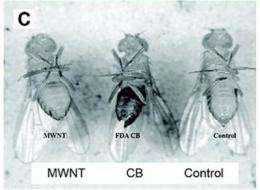
Researchers are reporting that carbon nanoparticles can be transmitted by fruit flies and that certain nanoparticles can be toxic to adult flies. Credit: American Chemical Society
Carbon nanoparticles are widely used in medicine, electronics, optics, materials science and architecture, but their health and environmental impact is not fully understood.
In a series of experiments, researchers at Brown University sought to determine how carbon nanoparticles would affect fruit flies — from the very young to adults.
The scientists found that larval Drosophila melanogaster showed no physical or reproductive effects from consuming carbon nanoparticles in their food. Yet adult Drosophila experienced a different fate. Tests showed adults immersed in tiny pits containing two varieties of carbon nanoparticles died within hours. Analyses of the dead flies revealed the carbon nanoparticles stuck to their bodies, covered their breathing holes, and coated their compound eyes. Scientists are unsure whether any of these afflictions led directly to the flies' death.
A separate experiment showed adult flies transported carbon nanoparticles and then deposited them elsewhere when they groomed themselves.
The findings, published online in Environmental Science & Technology, help to show the risks of carbon nanoparticles in the environment, said David Rand, professor of biology, who specializes in fruit fly evolution.
"The point is these same compounds that were not toxic to the (fruit fly) larvae were toxic to the adults in some cases, so there may be analogies to other toxic effects from fine particles," Rand, a co-corresponding author, said. "It may be like being in a coal mine. You get sick more from the effects of dust particles than from specific toxins in the dust."
The scientists immersed adult Drosophila in a control test tube and test tubes containing four different types of carbon nanoparticles corresponding with their commercial uses — carbon black (a powder much like printer toner), C60 (spherical molecules known as carbon buckyballs, named for Buckminster Fuller's geodesic designs), single-walled carbon nanotubes, and multiwalled carbon nanotubes. Flies in the test tubes with no carbon nanoparticles, C60 and the multiwalled nanotubes climbed up the tubes with few or no difficulties. But the batches of flies immersed in the carbon black and single-walled nanotubes could not escape their surroundings and died within six to 10 hours, the Brown scientists report.
The causes of death are unclear, but detailed analyses led by chemistry graduate student and lead author Xinyuan Liu showed the flies were affected physically. In some, the carbon nanoparticles covered them from wings to legs, which may have impeded their movement or weighted them down too much to climb. In others, the nanoparticles clogged their breathing holes, or spiracles, which may have suffocated them. In other adults, the nanoparticles covered the surface of their compound eyes, which may have blinded them.
The nanoparticles "glom onto the flies," Rand noted while watching a video of flies in the test tubes. "They just can't move. It's like a dinosaur falling into a tar pit." (Note to journalists: Video is available on request.)
Rand and Robert Hurt, director of Brown's Institute for Molecular and Nanoscale Innovation and the other corresponding author, said the findings are important, because they show that permutations of the same material — carbon — can have different effects in the environment.
"It's not the nanoparticle per se (that may be hazardous), but the form the nanoparticle is in," Rand said.
In another experiment led by Daniel Vinson, an undergraduate student in engineering, adult Drosophila coated in multiwalled carbon nanotubes carried the carbon on their bodies from one test tube into another and deposited some of the particles in the clean tube. That test showed how insects could be vectors for transporting nanomaterials, Rand said.
While two generations of fruit fly larvae showed no ill effects from eating carbon nanoparticles, the Brown scientists noticed that some of the particles ended up being stored in the flies' tissue. That means the nanoparticles could accumulate as they are passed up the food chain, Rand said.
The researchers have several related experiments in the works. They plan to test fruit flies' response to nanosilver and other nanomaterials with different chemistries, and they will investigate why the adult Drosophila died from varieties of the carbon nanoparticles.
-
Fruit flies and global warming -- Some like it hot
Jan 26, 2007 |
not rated yet |
0
-
Tiny pest-eating insect fights fruit flies
Dec 06, 2007 |
not rated yet |
0
-
'Drunk' fruit flies could shed light on genetic basis of human alcohol abuse
Oct 20, 2006 |
not rated yet |
0
-
Mammals, fruit flies: same biological clock
Mar 06, 2006 |
not rated yet |
0
-
Scientists get first look at nanotubes inside living animals
Sep 24, 2007 |
not rated yet |
0
-
Engineers build first sub-10-nm carbon nanotube transistor
Feb 01, 2012 |
4.9 / 5 (33) |
30
-
Something old, something new: Evolution and the structural divergence of duplicate genes
Jan 31, 2012 |
4.6 / 5 (7) |
1
-
The hidden nanoworld of ice crystals: Revealing the dynamic behavior of quasi-liquid layers
Jan 30, 2012 |
5 / 5 (5) |
1
-
Stock market network reveals investor clustering
Jan 27, 2012 |
3.9 / 5 (23) |
8
-
Of microchemistry and molecules: Electronic microfluidic device synthesizes biocompatible probes
Jan 26, 2012 |
5 / 5 (2) |
0
-
Factors affecting beet root cell membrane
22 hours ago
-
Stem cell question.
Feb 10, 2012
-
Protease cleavage
Feb 10, 2012
-
Pertubance in a model
Feb 10, 2012
-
Cancer drugs and Alzheimer's, Oh my!
Feb 09, 2012
-
Squishing cells
Feb 09, 2012
- More from Physics Forums - Biology
More news stories
NDSU nano research could impact flexible electronic devices
A discovery by a research team at NDSU and the National Institute of Standards and Technology shows the flexibility and durability of carbon nanotube films and coatings are intimately linked to their electronic properties. ...
Nanotechnology / Nanomaterials
11 minutes ago |
not rated yet |
0
Lab study raises questions over nano-particle impact
Tests involving chickens have raised questions about the impact on health from engineered nano-particles, the ultra-fine grains commonly used in drugs and processed foods, scientists said on Sunday.
Nanotechnology / Bio & Medicine
17 hours ago |
5 / 5 (8) |
4
New kind of solar cell could capture significantly more energy than current cells
New solar cells could increase the maximum efficiency of solar panels by over 25%, according to scientists from the University of Cambridge.
Feb 08, 2012 |
4.5 / 5 (13) |
14
|
'Dark plasmons' transmit energy
Microscopic channels of gold nanoparticles have the ability to transmit electromagnetic energy that starts as light and propagates via "dark plasmons," according to researchers at Rice University.
Feb 09, 2012 |
4.8 / 5 (10) |
1
|
Revealing how a battery material works
Since its discovery 15 years ago, lithium iron phosphate (LiFePO4) has become one of the most promising materials for rechargeable batteries because of its stability, durability, safety and ability to deliver ...
Nanotechnology / Nanomaterials
Feb 08, 2012 |
5 / 5 (6) |
0
|
New molecule has potential to help treat genetic diseases and HIV
(PhysOrg.com) -- Chemists at The University of Texas at Austin have created a molecule that's so good at tangling itself inside the double helix of a DNA sequence that it can stay there for up to 16 days before ...
With climate change, today's '100-year floods' may happen every three to 20 years: research
Last August, Hurricane Irene spun through the Caribbean and parts of the eastern United States, leaving widespread wreckage in its wake. The Category 3 storm whipped up water levels, generating storm surges ...
Social psychologist: Lust makes you smarter and evidence that seven deadly sins are good for you
(Medical Xpress) -- Good news for lovers on Valentine’s Day - the seven deadly sins, including Lust, are good for you. University of Melbourne social psychologist Dr Simon Laham uses modern research to make a compelling ...
The joy of cheques
An electronic cheque which eliminates the need for costly processing by banks but preserves the simplicity and ease of a traditional cheque book has been designed by a team of academics in the UK.
Research shows promise in converting camelina oil into jet fuel
(PhysOrg.com) -- Researchers at Montana State University-Northern have developed a process to convert camelina oil to jet fuel and other high-value chemicals. MSU has applied for a U.S. patent and research is ongoing.
Couples in the same place emotionally stay together, study says
(Medical Xpress) -- Despite lifes ups and downs, couples whose feelings are in sync consistently over time are more likely to stay together, says a University of California, Davis, study.
Aug 05, 2009
Rank: not rated yet
Mankind has been exposed to "nano-particles" since we evolved from an atom and eve (electron volt) - we are completely composed of nano-particles. Look small enough and that is what we are.
Do precautions need to be taken in the manufacturing and disposal environments? Of course. Unless you want to rid yourself of those pesky fruit flies.
Either there is VERY intriguing (and omitted from this article) and compelling evidence to convince of the pending doom of CNT and C60 use or this scare mongers need to take a break - go fishing - smoke up (or not) - watch late night tele (sober) and get truly close to their significant other(s).
As in Chill.
Aug 05, 2009
Rank: 1 / 5 (1)