'Cash for clunkers' effect on pollution? A blip
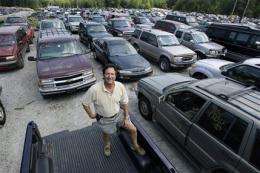
(AP) -- "Cash for clunkers" could have the same effect on global warming pollution as shutting down the entire country - every automobile, every factory, every power plant - for an hour per year. That could rise to three hours if the program is extended by Congress and remains as popular as it is now.
Climate experts aren't impressed.
Compared to overall carbon dioxide emissions in the United States, the pollution savings from cash for clunkers do not noticeably move the fuel gauge. Environmental experts say the program - conceived primarily to stimulate the economy and jump-start the auto industry - is not an effective way to attack climate change.
"As a carbon dioxide policy, this is a terribly wasteful thing to do," said Henry Jacoby, a professor of management and co-director of the Joint Program on the Science and Policy of Global Change at MIT. "The amount of carbon you are saving per federal expenditure is very, very small."
Officials expect a quarter-million gas guzzlers will be junked under the original $1 billion set aside by Congress - money that is now all but exhausted.
Calculations by The Associated Press, using Department of Transportation figures, show that replacing those fuel hogs will reduce carbon dioxide emissions by just under 700,000 tons a year. While that may sound impressive, it's nothing compared to what the U.S. spewed last year: nearly 6.4 billion tons (and that was down from previous years).
That means on average, every hour, America emits 728,000 tons of carbon dioxide. The total savings per year from cash for clunkers translates to about 57 minutes of America's output of the chief greenhouse gas.
Likewise, America will be using nearly 72 million fewer gallons of gasoline a year because of the program, based on the first quarter-million vehicles replaced. U.S. drivers go through that amount of gas every 4 1/2 hours, according to the Department of Energy.
For individuals, the program scores big. Vehicle owners who trade in an older, gas-guzzling truck or car for a newer fuel-efficient vehicle can get $3,500 to $4,500 in rebates. On average each year, they will save 287 gallons of gas, more than $700 in fuel costs and close to 3 tons in carbon dioxide pollution.
The problem is, there aren't enough of these individuals to dent the national or global energy and environmental problems.
"There's 260 million vehicles on the road and you're talking a quarter-million vehicles. It's not even close. It's just a drop in the bucket," said Bruce Belzowski, a scientist at the University of Michigan's Transportation Research Institute. "It's really small numbers. But if you don't start somewhere, where are you going to start? It heads the country in the right direction."
The House has passed a bill at President Barack Obama's request to pump an additional $2 billion into the program. If the Senate follows suit, the potential effect on pollution and energy would triple. But experts say that it is still not much compared to the overall problem.
One benefit of cash for clunkers is that it takes some of the dirtiest cars off the road for good - their engines are immobilized with "liquid glass" and the rest of the vehicle can be recycled. Otherwise, these cars could have been on the road for several more years, polluting more each year. So the pollution reductions keep adding up.
Americans are holding on to their cars longer than they used to, with the median age of cars on the road in 2008 rising to a record high of 9.4 years, according to R.L. Polk & Co.
While some people have worried that there might be an added environmental and energy cost to recycling the metal in the junked cars, experts said that is not the case. Generally, it saves energy to use recycled steel in cars rather than newly made steel, Belzowski said.
The cars being bought aren't just more gas-stingy than what they're replacing - they are 18 percent more efficient on average than other new cars, according to the Department of Transportation.
"This is a win-win program for everybody," said National Highway Traffic Safety Administration spokesman Eric Bolton. "The program is raising the average fuel economy of the fleet while getting the dirtiest vehicles off the roads."
Bolton said there is another benefit to the program: Newer cars "are considerably safer than the old clunkers they are replacing."
But some energy experts say the country is overpaying for the pollution reductions, mostly because cash for clunkers is more about stimulating the economy than cutting pollution.
Paying up to $4,500 per clunker means the government is spending more than $160 for every ton of carbon dioxide removed over 10 years, said MIT's Jacoby, co-author of the book "Transportation in a Climate-Constrained World."
That's five to 10 times more than the estimated per-ton cost of carbon dioxide for power plants in the cap-and-trade system passed earlier this year by the House.
Michael Gerrard, director of the Center for Climate Change Law at Columbia University, who examined the clunkers program in an academic journal, said there are far better ways to cut energy use and greenhouse gases.
"It's not that it's a bad idea; just don't sell it as a cost-effective energy savings method," he said. "From an economic standpoint it seems to be a roaring success. From an environment and energy perspective, it's not where you would put your first dollar."
On the Net:
Cash for Clunkers program: http://www.cars.gov
©2009 The Associated Press. All rights reserved. This material may not be published, broadcast, rewritten or redistributed.


