Seeing the Cosmos Through 'Warm' Infrared Eyes
August 5, 2009 Seeing the Cosmos Through 'Warm' Infrared Eyes

Enlarge

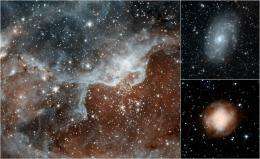
These images are some of the first to be taken during Spitzer's warm mission -- a new phase that began after the telescope, which operated for more than five-and-a-half years, ran out of liquid coolant. The pictures were snapped with the two infrared channels that still work at Spitzer's still-quite-chilly temperature of 30 Kelvin (about minus 406 degrees Fahrenheit). The two infrared channels are part of Spitzer's infrared array camera: 3.6-micron light is blue and 4.5-micron light is orange. The main picture shows a cloud, known as DR22, bursting with new stars in the Cygnus region of the sky. Spitzer's infrared eyes can see dust, and see through dust, giving it a unique view into star-forming nests. The blue areas are dusty clouds, and the orange is mainly hot gas. The picture at upper right shows a relatively calm galaxy called NGC 4145. This galaxy has already made most of its stars and has little star-forming activity. It is located 68 million light-years away in the constellation Canes Venatici. Blue shows starlight and dust. The final picture at lower right shows a dying star called NGC 4361. This star was once a lot like our sun, before it evolved and puffed out its outer layers. The object, called a planetary nebula, is unusual in that it has four lobes, or jets, of ejected material instead of the standard two. Astronomers suspect that there might be two dying stars inside the nebula, each producing a bipolar jet. Orange primarily shows heated gas. Credit: NASA/JPL-Caltech

(PhysOrg.com) -- NASA's Spitzer Space Telescope has taken its first shots of the cosmos since warming up and starting its second career. The infrared telescope ran out of coolant on May 15, 2009, more than five-and-half-years after launch, and has since warmed to a still-frosty 30 Kelvin (about minus 406 Fahrenheit).

New images taken with two of Spitzer's infrared detector channels -- the two that work at the new warmer temperature -- demonstrate that the observatory remains a powerful tool for probing the dusty universe. The images show a bustling star-forming region, the pretty remains of a star like the sun, and a swirling galaxy lined with stars.

"Spitzer continues to provide us with a unique view of stars, and ," said Spitzer Project Scientist Michael Werner, NASA's Jet Propulsion Laboratory, Pasadena, Calif.

"We're thrilled to see Spitzer up and running again, and continuing to provide such spectacular images," added astronomer Giovanni Fazio of the Harvard-Smithsonian Center for Astrophysics. "This new lease on life is a testament to a well-designed spacecraft."

The first of three images shows a cloud bursting with stars in the Cygnus region of our . Spitzer's infrared eyes both peer through and see dust, revealing young stars tucked in dusty nests. A second image shows a nearby dying star -- a called NGC 4361 -- whose outer layers expand outward in the rare form of four jets. And a final picture is of a classic spiral beauty, a galaxy called NGC 4145 located 68 million light-years from Earth.

"With Spitzer's remaining shorter-wavelength bands, we can continue to see through the dust in galaxies and get a better look at the overall populations of stars," said Robert Hurt imaging specialist for Spitzer at NASA's Spitzer Science Center, California Institute of Technology. "All stars are equal in the infrared."

Since its launch from Cape Canaveral, Fla., on August 25, 2003, Spitzer has made countless discoveries: planet-forming disks around stars, the composition of the material making up comets, hidden black holes, galaxies billions of light-years away and more.

Perhaps the most revolutionary and surprising Spitzer finds involve planets around other , called exoplanets. In 2005, Spitzer detected the first actual photons of light from an exoplanet. In a clever technique, now referred to as the secondary-eclipse method, Spitzer was able to collect the light of a hot, gaseous exoplanet and learn about its temperature. Further detailed studies later revealed more about the composition and structure of the atmospheres of these exotic worlds.

Warm Spitzer will address many of the same science questions as before, while tackling new projects, such as: refining estimates of Hubble's constant, or the rate at which our universe is stretching apart; searching for galaxies at the edge of the universe; characterizing more than 700 near-Earth objects, or asteroids and comets with orbits that pass close to our planet; and studying the atmospheres of gas-giant planets expected to be discovered soon by NASA's Kepler mission. As was true during the cold Spitzer mission, these and the other programs are selected via a competition in which scientists from around the world are invited to participate.

Spitzer officially began its warm science mission on July 27, 2009. The new pictures were taken while the telescope was being re-commissioned, on July 18 (NGC 4145, NGC 4361) and July 21 (Cygnus).

More information: For more information about Spitzer, visit http://www.spitzer.caltech.edu/spitzer .

Provided by Harvard-Smithsonian Center for Astrophysics (news : web)


print this article email this article download pdf blog this article bookmark this article     Stumble it Digg this share on Facebook retweet share on Reddit add to delicious
Rate this story - 4.7 /5 (9 votes)

Rank Filter

Move the slider to adjust rank threshold, so that you can hide some of the comments.


Display comments: newest first

  • omatumr - Aug 07, 2009
    • Rank: 1 / 5 (1)
    OBSERVATIONS WITH SPITZER

    Spitzer's infrared detector will provide new information on sources of heat in the cosmos.

    However, these observations cannot compensate for NASA's reluctance to study, consider, and accept or reject several reports since 2001 that the Sun, stars, galaxies, and the cosmos are heated by repulsive interactions between neutrons [1-4].

    The results will be as useless as reports of climate change that ignore cyclic changes in Earth's heat source - the Sun [5].

    With kind regards,
    Oliver K. Manuel
    http://www.omatumr.com

    1. "Attraction and repulsion of nucleons: Sources of stellar energy", Journal of Fusion Energy 19 (2001) 93-98: http://tinyurl.com/mmvomk

    2. "Nuclear systematics: III. The source of solar luminosity", Journal of Radioanalytical & Nuclear Chemistry 252 (2002) 3-7: http://tinyurl.com/n99jvr

    3. "Neutron repulsion confirmed as energy source", Journal of Fusion Energy 20 (2003) 197-201: http://tinyurl.com/mw7mhu

    4. "Fingerprints of a local supernova," in SPACE EXPLORATION RESEARCH (Nova Science Publishers, Inc., Hauppauge, NY, in press, 38 pp, 2009); ISBN: 978-1-60692-264-4: http://arxiv.org/pdf/0905.0684

    5. "EARTH'S HEAT SOURCE - THE SUN", Energy and Environment: SPECIAL ISSUE: Natural drivers of weather and climate, volume 20, numbers 1 & 2, pp. 131-144 (2009): http://arxiv.org/pdf/0905.0704

August 5, 2009 all stories

Comments: 1

4.7 /5 (9 votes)
  • Stumble this up

  • Digg this

  • share this

  • hide
  • Related Stories

  • Spitzer Telescope Warms Up to New Career
    created May 06, 2009 | popularity not rated yet | comments 0
  • Spitzer Witnessed Galactic Collision
    created Sep 10, 2004 | popularity not rated yet | comments 0
  • Spitzer Harvests Dozens of New Stars
    created Nov 16, 2005 | popularity not rated yet | comments 0
  • Mysterious Ring When Star Dies
    created Aug 10, 2004 | popularity not rated yet | comments 0
  • NASA's Spitzer Images Out-of-This-World Galaxy
    created Jul 23, 2009 | popularity not rated yet | comments 0


  • hide
  • Relevant PhysicsForums posts

  • Sideral question
    created 16 hours ago
  • Doppler shifted blackbody spectrum
    created 19 hours ago
  • Earth v. Moon
    created 21 hours ago
  • help me with coordinates and orbits
    created 21 hours ago
  • basic 'our universe' question..
    created Nov 20, 2009
  • deriving keplers law
    created Nov 19, 2009
  • More from Physics Forums - General Astronomy

Other News

Astronauts finish another spacewalk, still no baby (AP)

Astronauts finish another spacewalk, still no baby

Space & Earth / Space Exploration

created 8 hours ago | popularity 3 / 5 (2) | comments 0

(AP) -- A spacewalking astronaut put aside the impending birth of his daughter and blazed through his first-ever venture outside the International Space Station on Saturday.


Unseasonably hot and dry weather combined with strong winds to fan scores of blazes in the country's southeastern states

Australia issues 'catastrophic' alerts as fires rage

Space & Earth / Environment

created 14 hours ago | popularity 4.5 / 5 (2) | comments 0

Australia has issued "catastrophic" alerts after record-breaking temperatures and wild lightning storms sparked more than 100 fires across the country, officials said Saturday.


Commuters wait on the platform shrouded by fog in London

Climate change not man-made, say majority of Britons: poll

Space & Earth / Environment

created Nov 15, 2009 | popularity 3.3 / 5 (15) | comments 46

Less than half of Britons believes that human activity is to blame for global warming, according to a poll carried out for The Times newspaper and published on Saturday.


Mysteriously warm times in Antarctica

Mysteriously warm times in Antarctica

Space & Earth / Earth Sciences

created Nov 18, 2009 | popularity 4.2 / 5 (21) | comments 28

(PhysOrg.com) -- A new study of Antarctica's past climate reveals that temperatures during the warm periods between ice ages (interglacials) may have been higher than previously thought. The latest analysis ...


UN: Fight climate change with free condoms (AP)

UN: Fight climate change with free condoms

Space & Earth / Environment

created Nov 18, 2009 | popularity 3.1 / 5 (11) | comments 24

(AP) -- The battle against global warming could be helped if the world slowed population growth by making free condoms and family planning advice more widely available, the U.N. Population Fund said Wednesday.