Astronomers Find Hyperactive Galaxies in the Early Universe
August 5, 2009 Astronomers Find Hyperactive Galaxies in the Early Universe

Enlarge

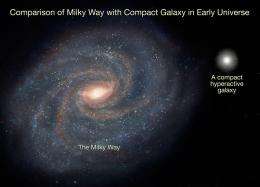
This illustration compares the Milky Way with a compact galaxy in the early universe. Looking almost 11 billion years into the past, astronomers have measured the motions of stars for the first time in a very distant galaxy. They are whirling at a speed of one million miles per hour—about twice the speed of our Sun through the Milky Way. The galaxies are a fraction the size of our Milky Way, and so may have evolved over billions of years into the full-grown galaxies seen around us today. Credit: NASA, ESA, and A. Feild (STScI)

(PhysOrg.com) -- Looking almost 11 billion years into the past, astronomers have measured the motions of stars for the first time in a very distant galaxy and clocked speeds upwards of one million miles per hour, about twice the speed of our Sun through the Milky Way.

The fast-moving stars shed new light on how these distant galaxies, which are a fraction the size of our Milky Way, may have evolved into the full-grown galaxies seen around us today. The results will be published in the August 6, 2009 issue of the , with a companion paper in the .

"This galaxy is very small, but the stars are whizzing around as if they were in a that we would find closer to us and not so far back in time," says Pieter van Dokkum, professor of astronomy and physics at Yale University in New Haven, Conn., who led the study. It is still not understood how galaxies like these, with so much mass in such a small volume, can form in the early and then evolve into the galaxies we see in the more contemporary, nearby universe, which is about 13.7 billion years old.

The work by the international team combined data collected using NASA's Hubble Space Telescope with observations taken by the 8-meter Gemini South telescope in Chile. According to van Dokkum, "The Hubble data, taken in 2007, confirmed that this galaxy was a fraction the size of most galaxies we see today in the more evolved, older universe. The giant, 8-meter mirror of the Gemini telescope then allowed us to collect enough light to determine the overall motions of the stars using a technique not very different from the way police use to catch speeding cars." The Gemini near-infrared spectroscopic observations required an extensive 29 hours on the sky to collect the extremely faint light from the , which goes by the designation 1255-0.

"By looking at this galaxy we are able to look back in time and see what galaxies looked like in the distant past when the universe was very young," says team member Mariska Kriek of Princeton University in Princeton, N.J. 1255-0 is so far away that the universe was only about 3 billion years old when its light was emitted.

Astronomers confess that it is a difficult riddle to explain how such compact, massive galaxies form, and why they are not seen in the current, local universe. "One possibility is that we are looking at what will eventually be the dense central region of a very large galaxy," explains team member Marijn Franx of Leiden University in the Netherlands. "The centers of big galaxies may have formed first, presumably together with the giant black holes that we know exist in today's large galaxies that we see nearby."

To witness the formation of these extreme galaxies astronomers plan to observe galaxies even farther back in time in great detail. By using the Wide Field Camera 3, which was recently installed on the Hubble Space Telescope, such objects should be detectable. "The ancestors of these extreme galaxies should have quite spectacular properties as they probably formed a huge amount of stars, in addition to a massive black hole, in a relatively short amount of time," says van Dokkum.

This research follows recent studies revealing that the oldest, most luminous galaxies in the are very compact yet surprisingly have stellar masses similar to those of present-day elliptical galaxies. The most massive galaxies we see in the local universe (where we don't look back in time significantly) that have a mass similar to 1255-0 are typically five times larger than the young compact galaxy. How galaxies grew so much in the past 10 billion years is an active area of research, and understanding the dynamics in these young compact galaxies is a key piece of evidence in eventually solving this puzzle.

The observations were made with the Near Infrared Camera and Multi-Object Spectrometer (NICMOS).

The Gemini observations were made using the Gemini Near Infrared Spectrograph (GNIRS), which is currently undergoing upgrades and will be reinstalled on the Gemini North telescope on Mauna Kea in 2010.

Provided by European Space Agency (news : web)


print this article email this article download pdf blog this article bookmark this article     Stumble it Digg this share on Facebook retweet share on Reddit add to delicious
Rate this story - 4.6 /5 (8 votes)

Rank Filter

Move the slider to adjust rank threshold, so that you can hide some of the comments.


Display comments: newest first

  • frajo - Aug 05, 2009
    • Rank: 5 / 5 (3)
    It certainly would be interesting to know more about the ratio of "luminous" mass to "dynamically measured" mass in this unusual galaxy.
  • yyz - Aug 05, 2009
    • Rank: 5 / 5 (2)
    An April 2008 initial Hubble study of these galaxies can be found here: http://hubblesite.../pdf.pdf . The STScI 2008 press release (w-images) can be found here: http://hubblesite...2008/15/ . Should be interesting to compare the 2008 paper with the newer Gemini South observations mentioned in the story.
  • Question - Aug 05, 2009
    • Rank: 3.2 / 5 (5)
    What proof do we have that these galaxies are at the distances claimed? Could it be they are actually 2 to 3 times further than 11 billion lightyears?
    If they actually were, there size would correspond to ordinary galaxies in the nearby universe.
    The red-shift yard stick used to measure distance in the universe may not be a parabolic curve, it may be just a straight line. For example, if a red-shift of 1 equals 7 billion lightyears, than a red-shift of 2 would be 14 billion lightyears, etc, etc..
  • brant - Aug 05, 2009
    • Rank: 3.5 / 5 (2)
    No, they just found (a)high red shift galaxies that are brighter than their model calls for....
  • omatumr - Aug 06, 2009
    • Rank: 2 / 5 (4)
    NUELEI OF ATOMS, STARS AND GALAXIES EMIT NEUTRONS & EXPLODE

    http://tinyurl.com/2otxps

    We are further from the nuclei of b.) stars and c.) galaxies than of a.) atoms, so we observe:

    1. An outpouring of the neutron decay-product (Hydrogen) from b.) our Sun and other stars, and c.) galactic centers, and

    2. Violent nuclear fission of a.) neutron-rich nuclei, b.) supernova explosions that expose the central neutron star, and c.) violent cosmic explosions

    This is discussed in more detail on the Naked Scientists forum:

    or http://tinyurl.com/lkj7zw

    With kind regards,
    Oliver K. Manuel
    [url]http://www.omatumr.com[/url]


    With kind regards,
    Oliver K. Manuel
    [url]http://www.omatumr.com[/url]
  • Ethelred - Aug 06, 2009
    • Rank: 2.6 / 5 (5)
    1. An outpouring of the neutron decay-product (Hydrogen) from b.) our Sun and other stars, and c.) galactic centers, and


    Well you constantly claim that we see it. Only you are the only to make that claim. Now how about you tell us where all the neutrons came from and how they manage to decay when we can't find it happening at all anywhere in any experiment that deals with non-free neutrons, as neutrons in a star are not free neutrons and if they were free neutrons there half-life is 15 minutes. Kind of short for objects with multi-billion year lifes.

    This is discussed in more detail on the Naked Scientists forum:


    Where you show the same talents for stonewalling and evasion you show here. Thank you for that link that shows it.

    And I love this hypocritical quote you use so often.

    "Grant me the serenity to accept WHAT IS.
    Courage to challenge my own beliefs toward WHAT IS.
    Wisdom to know that attitudes may distort perception of WHAT IS,But attitudes cannot change WHAT IS."
    - - - adapted from Reinhold Niebuhr


    Yes your attitudes won't change what is. When will you accept the evidence? Or in your case the lack of evidence that must be there for you to be correct.

    Ethelred
  • Ethelred - Aug 06, 2009
    • Rank: 3 / 5 (2)
    Refusing to answer questions is your standard way to do things.

    Lying about why is another. You have NEVER answered ANYONE who asks questions that are difficult.

    WHERE is the evidence that NON free neutrons fission as YOU claim they do. Claiming is not enough you yourself claim we need to go on the evidence. You don't have it.

    I don't need luck just answers to those three questions.

    Ethelred
  • omatumr - Aug 08, 2009
    • Rank: 1 / 5 (2)
    SEEING RED


    I don't need luck just answers to those three questions.

    Ethelred


    I doubt if anything can help you, Ethel, but the historical review posted on this news story may be useful:

    http://www.physor...063.html

    With kind regards,
    Oliver K. Manuel
    http://www.omatumr.com
  • Ethelred - Aug 09, 2009
    • Rank: 1 / 5 (1)
    I doubt if anything can help you, Ethel,


    That is because you doubt that you can answer the questions. So instead you engage in ad homonym attacks, evasions and even lies.

    Just answer the questions. Persoanal attacks are NOT science. AND YOU are hardly the person to attack ANYONE for personal defects. Keep it up and I take the gloves off, yes they have been on. I have tried to keep this attempt at a discussion to reason and evidence and it is YOU that have attacked me and others for having the temerity to question your apparently godlike all knowing ways.

    If you can't answer show some guts and say so. Personal attacks are nothing but intellectual cowardice. Posts that supported by YOUR questionable ideas cannot support your own questionable ideas.

    And the one the two that aren't yours is old.

    1. Peter Toth, "Is the Sun a pulsar?", Nature 270 (1977) 159-160.


    The answer is no. Its been 32 years and that is all there is. One bit of speculation by one man who didn't follow up. Such evidence. Typical of your evidence by the way.

    4. A. Wolszczan, %u201CConfirmation of earth-mass planets orbiting the millisecond pulsar PSR B 1257 12%u201D, Science 264 (1994) 538-542.


    And this one that does nothing to support you at all. Planets around a pulsar simply show that a planet can sometimes survive a supernova. As a bare rock most likely.

    That is a pretty inept effort at support. As per your usual. Sneer about the person asking questions if they don't toady and then post a link to more highly questionable claims of yours.

    WHERE is the evidence that NON free neutrons fission as YOU claim they do. Claiming is not enough you yourself claim we need to go on the evidence. You don't have it.


    Go on. Admit you don't evidence. Its not that hard and your attacks and evasions just make look unwilling to engage in a real effort to think things out. You just make things worse this way.

    I am not kidding about the personal attacks. It has gone on way to long from you. You will not like the results if you do it again.

    Ethelred
  • yyz - Aug 09, 2009
    • Rank: not rated yet
    The 2008 paper on these ultracompact, small distant systems makes three interesting observations: 1) these compact systems weigh in at something like 1.7×10^11 Solar masses and do this 2) in a volume of less than radius(R) 0.9kpc = 900 parsec! 3) The van Dokkum et. al. 2008 paper also gives a preliminary median density of 3×10^11 Solar masses/cubic kpc! Authors of the 2008 paper also note that many of the redshifts are photometric redshifts which have hopefully been redetermined by the more precise ultra-long Gemini South direct spectra.
  • yyz - Aug 09, 2009
    • Rank: not rated yet
    The paper on which the above article was based has been made available at the HST STScI site: http://hubblesite...pdf2.pdf . The authors note an extremely low stellar formation rate (1-3 Solar masses per year) along with a depleted ISM for making new stars. They're still compact and massive, just not furiously forming stars.
  • yyz - Aug 09, 2009
    • Rank: not rated yet
    Does anyone read the comments related to the articles at this site or just the 'water on a duck' commentary?
  • Ethelred - Aug 10, 2009
    • Rank: 3.3 / 5 (3)
    Yes. You do. I do. Some of the people MUST read our posts and other posts because they rate them. Of course personality conflicts tend to catch peoples eyes easier than anything as dense as that PDF you just posted.

    I don't really can't find anything surprising here basically because its all pretty new and ANYTHING that is observed is bound to force changes in models that were pretty much wild assed guesses since they were based on models similar to the famous spherical chicken of uniform density while dealing with things that are most likely non-linear and chaotic.

    Ethelred
  • yyz - Aug 10, 2009
    • Rank: not rated yet
    Maybe this site needs to be re-named Oliver K Manuel vs. Ethelred to the death. No one over 10 need read any further and please no comments. Screw the stories, who's dumb enough to read and reflect on them. BIG waste of time.
  • omatumr - Aug 10, 2009
    • Rank: 1 / 5 (3)
    NUCLEAR EVOLUTION: DISSOCIATION OR FUSION?

    I agree. Personality conflicts are useless. However, the link to the paper on the Hubble site is helpful.

    This story is important in providing observational evidence that nuclear dissociation, rather than nuclear fusion, was the engine that powered the cosmos in the distant past, just as it is today for the Sun and other ordinary stars.

    Hydrogen is a waste product (neutron-decay product) from the engine that powers the Sun and the cosmos.

    As mentioned earlier, this is discussed in the "Big Bang" framework on this Naked Scientists forum:

    http://tinyurl.com/lkj7zw

    With kind regards,
    Oliver K. Manuel
    http://www.omatumr.com/


  • Ethelred - Aug 10, 2009
    • Rank: 1 / 5 (1)
    I agree. Personality conflicts are useless.


    Then why engage in them? Why not just deal with the questions instead.

    This story is important in providing observational evidence that nuclear dissociation, rather than nuclear fusion, was the engine that powered the cosmos in the distant past


    The article says no such thing. Why do you pretend that it does?

    Hydrogen is a waste product (neutron-decay product) from the engine that powers the Sun and the cosmos.


    Hydrogen fuses. All evidence is that it is fusing in the Sun. There is still not a single sign of you posting anything that supports your claims that non-free neutrons are undergo fission. Simply claiming that it occurs is not evidence.

    Screw the stories, who's dumb enough to read and reflect on them. BIG waste of time.


    I read it. I read what you linked to as well. Can't say it was a waste of time but the stuff is pretty preliminary due to the vast distance involved.

    Ethelred
  • yyz - Aug 10, 2009
    • Rank: not rated yet
    The main reason I provide relevant links (where possible)to professional papers is in part response from some readers for more relevant info on a story. What better source for the informed reader to look at the 'real McCoy'. These links are offered for the more advanced reader who may want a detailed account of the observations and the conclusions of the authors of said paper. Of course, other readers may not find this their cup of tea, so ignore the link. Just to set the record straight :)
  • yyz - Aug 10, 2009
    • Rank: not rated yet
    Thanks, Ethelred, at least I've got you and OKM on the same page for once! I do agree that this work is preliminary, as was the 2008 paper by van Dokkum. But that's how science works, incrementally. OTOH, some of these posted papers are incredibly misinterpreted (like...um...OKM) to fit their theories. Mainstream extrgalactic astronomers are all over this story, as it impinges on so many crucial questions about the early universe.
  • yyz - Aug 10, 2009
    • Rank: not rated yet
    Btw: Still no answers to where those first iron cores for future SN came from. And I'm left to guess that OKMs theories are not falsifiable, hence they are the TRUTH and not to be questioned. That sounds more like a religion than a theory to me.
  • omatumr - Aug 10, 2009
    • Rank: 1 / 5 (3)
    WHICH CAME FIRST: THE CHICKEN OR THE EGG?

    Btw: Still no answers to where those first iron cores for future SN came from.


    That issue was discussed on the Naked Scientist forum

    http://tinyurl.com/lkj7zw

    A. If the universe is infinite, there was no "first."

    B. If the universe is finite, then the initial event produced massive neutron stars.

    As concluded on the Naked Scientist Forum:

    "Today we have evidence that the Sun, other stars, and galactic centers are powered by nuclear dissociation that releases Hydrogen to interstellar space as a waste product.

    Therefore if there really was a "Big Bang" then it produced neutrons and compressed them into massive neutron stars -- the most compact, energetic form of nuclear matter -- rather than Hydrogen, the most dispersed form of nuclear matter.

    The concept of a "Big Bang" became more plausible to me after reading the recent paper by Coyne and D. C. Cheng ["A Scenario for Strong Gravity in Particle Physics: An alternative mechanism for black holes to appear at accelerator experiments," http://arxiv.org/...5.1667v1 ]. According to that scenario, neutrons themselves may be considered as particle-sized black holes that were made in the "Big Bang."

    On the other hand if the universe is infinite, then it probably oscillates between:

    a.) The expansion that is observed currently as interstellar space is filled with Hydrogen from neutron decay, and

    b.) A subsequent contraction after the neutron stars have evaporated and gravitational forces become dominant."

    With kind regards,
    Oliver K. Manuel
    http://www.omatumr.com
  • omatumr - Aug 10, 2009
    • Rank: 1 / 5 (2)
    MYSTERIOUS POSITRONS FROM GEMINGA PULSAR !

    Repulsive interactions between neutrons may be the energy source that generates the mysterious positrons that had been considered as the first direct evidence for the existence of dark matter particles!

    See today's news story on Physics World: http://physicswor...ws/40065

    With kind regards,
    Oliver K. Manuel
    http://www.omatumr.com
  • yyz - Aug 10, 2009
    • Rank: not rated yet
    Oliver K Manuel, your previous statement "As concluded on the Naked Scientist Forum:

    "Today we have evidence that the Sun, other stars, and galactic centers are powered by nuclear dissociation that releases Hydrogen to interstellar space as a waste product." Well, by golly, what a better group of 'specialists' commenting on the Naked Scientist forum as to the veracity of your claims. Do you now seek acceptance of your theories on blog and forum sites? How about some new peer-reviewed, published work by third party scientists supporting all aspects of your theory(s)?

August 5, 2009 all stories

Comments: 22

4.6 /5 (8 votes)
  • Stumble this up

  • Digg this

  • share this

  • hide
  • Related Stories

  • Compact galaxies in early universe pack a big punch
    created Apr 29, 2008 | popularity not rated yet | comments 0
  • Stellar birth control in the early universe
    created Oct 01, 2006 | popularity not rated yet | comments 0
  • Survey Reveals Building Block Process For Biggest Galaxies
    created Apr 12, 2006 | popularity not rated yet | comments 0
  • Building-block process in evolution of massive galaxy clusters revealed
    created Apr 05, 2006 | popularity not rated yet | comments 0
  • 'Big baby' galaxy found in newborn Universe
    created Sep 28, 2005 | popularity not rated yet | comments 0


  • hide
  • Relevant PhysicsForums posts

  • Question about 2-body gravity
    created Nov 24, 2009
  • life on Mars
    created Nov 24, 2009
  • Semi-major axis from cartesian co-ordinates
    created Nov 23, 2009
  • Primary Mirror grinding
    created Nov 23, 2009
  • dark energy can escape black holes.
    created Nov 23, 2009
  • Are there green, purple and pink stars?
    created Nov 22, 2009
  • More from Physics Forums - General Astronomy

Other News

Monster Waves on the Sun are Real

Monster Waves on the Sun are Real (w/ Video)

Space & Earth / Astronomy

created 2 hours ago | popularity 5 / 5 (6) | comments 0

Sometimes you really can believe your eyes. That's what NASA's STEREO (Solar Terrestrial Relations Observatory) spacecraft are telling researchers about a controversial phenomenon on the sun known as the "solar ...


Cosmic 'dig' reveals vestiges of the Milky Way's building blocks

Cosmic 'Dig' Reveals Vestiges of the Milky Way's Building Blocks

Space & Earth / Astronomy

created 7 hours ago | popularity 5 / 5 (11) | comments 1

(PhysOrg.com) -- Peering through the thick dust clouds of our galaxy's "bulge" (the myriads of stars surrounding its center), a team of astronomers has unveiled an unusual mix of stars in the stellar grouping ...


No Wheel Stall in Diagnostic Drive

Spirit Mars Rover: No Wheel Stall in Diagnostic Drive

Space & Earth / Space Exploration

created 2 hours ago | popularity 5 / 5 (1) | comments 0

(PhysOrg.com) -- On Sol 2095 (Tuesday, Nov. 24), Spirit performed a set of diagnostic actions related to a stall of the right-rear wheel on the previous drive, three days earlier.


Climate experts debate strategies for reducing atmospheric carbon and future warming

Climate experts debate strategies for reducing atmospheric carbon and future warming

Space & Earth / Environment

created 2 hours ago | popularity 3.7 / 5 (3) | comments 2

(PhysOrg.com) -- Reducing carbon dioxide to safe levels may require extracting carbon from the air, says Cornell climate researcher.


Oceanic crust formation is dynamic after all

Oceanic crust formation is dynamic after all

Space & Earth / Earth Sciences

created 6 hours ago | popularity 4 / 5 (1) | comments 0

Imagine the Earth's crust as the planet's skin: Some areas are old and wrinkled while others have a fresher, more youthful sheen, as if they had been regularly lathered with lotion.