The cosmic comic: Riding early waves
August 5, 2009
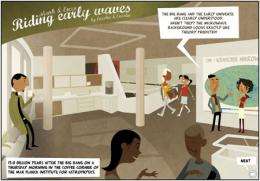
13.8 billion years after the Big Bang: Two scientists arrange to go surfing of a cosmic wave. Image: Jojo Enßlin
(PhysOrg.com) -- Fundamental research in cosmology continues to disclose ever more mysteries of the first millennia of the universe. More detailed knowledge will be delivered by the recently launched Planck Satellite which will measure the microwave background - the so-called echo of the Big Bang. How can we expose the broader public to the complex physics of the early universe? In the "International Year of Astronomy" (2009) the Max Planck Institute for Astrophysics (MPA, Germany) tries an unusual experiment: a comic on the Internet about the physical processes that took place during the first 400,000 years after the Big Bang.
Two fictitious high-spirited scientists of the institute, passionate surfers, take off to visit the early Universe. Not to do serious research there but to experience the ultimate ride on the plasma waves of the big bang. However, they quickly realize that they would be stuck without their knowledge of the physics of the early Universe. This is not meant to replace textbooks or scientific texts but to guide the reader in an amusing way through a series of phenomena of cosmic microwave background. Even one of the unsolved puzzles of cosmology - the strange "Cold Spot" in the microwave background - receives a new explanation.
The knowledge is always passed on casually via the story. The internet comic contains short, interactively selectable background information on the early Universe which leads to more detailed external internet pages about physics and cosmology. In this way a broader audience can be reached: youth that could be attracted by the unusual surfer story; interested amateurs who get an entertaining introduction into microwave background; and finally teachers who may use the material for illustrating their lessons.
This comic was created by the Ensslin brothers Torsten and Jojo. Torsten Ensslin is a cosmologist at MPA and heads the German participation in the Planck Satellite mission. Jojo Enßlin is a freelance illustrator, surfer and cofounder of the "Galerie Revolver" in Duesseldorf. MPA is one of the leading research institutes for theoretical astrophysics, and cosmology is one of its major research areas.
More information: The cosmic comic: Riding early waves
Provided by Max Planck Institute
-
Planck Satellite ready to measure the Big Bang
May 11, 2009 |
not rated yet |
0
-
Looking Back 13.8 Billion Years: The countdown for Planck satellite has started
Feb 05, 2009 |
not rated yet |
0
-
Universe in crisis as experts question Big Bang model
Jul 07, 2005 |
not rated yet |
0
-
ESA's Planck satellite builds on Nobel-prize-winning science
Oct 04, 2006 |
not rated yet |
0
-
Could the Universe be tied up with cosmic string?
Jan 18, 2008 |
not rated yet |
0
-
Engineers build first sub-10-nm carbon nanotube transistor
Feb 01, 2012 |
4.9 / 5 (33) |
30
-
Something old, something new: Evolution and the structural divergence of duplicate genes
Jan 31, 2012 |
4.6 / 5 (7) |
1
-
The hidden nanoworld of ice crystals: Revealing the dynamic behavior of quasi-liquid layers
Jan 30, 2012 |
5 / 5 (4) |
1
-
Stock market network reveals investor clustering
Jan 27, 2012 |
3.9 / 5 (23) |
8
-
Of microchemistry and molecules: Electronic microfluidic device synthesizes biocompatible probes
Jan 26, 2012 |
5 / 5 (2) |
0
-
Never ending outer space.....
20 hours ago
-
Neutron Star fragments?
22 hours ago
-
stationary or not?
Feb 11, 2012
-
Scale of the Universe
Feb 10, 2012
-
Titan's lack of impact craters
Feb 09, 2012
-
Real pictures of black hole eating a star?
Feb 08, 2012
- More from Physics Forums - General Astronomy
More news stories
Salvage workers begin pumping fuel from Italian shipwreck
Salvage workers Sunday began pumping fuel from the shipwrecked Italian cruise liner Costa Concordia, a day ahead of schedule, officials said.
5 hours ago |
not rated yet |
0
Latin America mining boom clashes with conservation
Latin America is experiencing a mining boom as prices rise fuelled by a hike in global demand, but the region is also being hit by a wave of violent protests, strikes and rallies by environmentalists.
13 hours ago |
5 / 5 (1) |
1
Political leaders play key role in how worried Americans are by climate change: study
More than extreme weather events and the work of scientists, it is national political leaders who influence how much Americans worry about the threat of climate change, new research finds.
Feb 06, 2012 |
5 / 5 (6) |
73
NASA budget will axe Mars deal with Europe: scientists
US President Barack Obama's budget proposal to be submitted next week for 2013 will cut NASA's budget by 20 percent and eliminate a major partnership with Europe on Mars exploration, scientists said Thursday.
Space & Earth / Space Exploration
Feb 10, 2012 |
5 / 5 (3) |
58
Humans may have helped the decline of African rainforests 3000 years ago
(PhysOrg.com) -- Large areas of rainforests in Central Africa mysteriously disappeared over three thousand years ago, to be replaced by savannas. The prevailing theory has been that the cause was a change ...
Scientists discover molecular secrets of 2,000-year-old Chinese herbal remedy
For roughly two thousand years, Chinese herbalists have treated Malaria using a root extract, commonly known as Chang Shan, from a type of hydrangea that grows in Tibet and Nepal. More recent studies suggest that halofuginone, ...
Overeating may double risk of memory loss
New research suggests that consuming between 2,100 and 6,000 calories per day may double the risk of memory loss, or mild cognitive impairment (MCI), among people age 70 and older. The study was released today and will be ...
New method to examine batteries -- MRI from the inside
There is an ever-increasing need for advanced batteries for portable electronics, such as phones, cameras, and music players, but also to power electric vehicles and to facilitate the distribution and storage of energy derived ...
A mitosis mystery solved: How chromosomes align perfectly in a dividing cell
Although the process of mitotic cell division has been studied intensely for more than 50 years, Whitehead Institute researchers have only now solved the mystery of how cells correctly align their chromosomes during symmetric ...
Lab study raises questions over nano-particle impact
Tests involving chickens have raised questions about the impact on health from engineered nano-particles, the ultra-fine grains commonly used in drugs and processed foods, scientists said on Sunday.
Starve a virus, feed a cure? Findings show how some cells protect themselves against HIV
A protein that protects some of our immune cells from the most common and virulent form of HIV works by starving the virus of the molecular building blocks that it needs to replicate, according to research published online ...