Crows can use 'up to three tools'
August 5, 2009
(PhysOrg.com) -- New experiments by Oxford University scientists reveal that New Caledonian crows can spontaneously use up to three tools in the correct sequence to achieve a goal, something never before observed in non-human animals without explicit training.
Sequential tool use has often been interpreted as evidence for advanced cognitive abilities, such as planning and analogical reasoning, but this has never been explicitly examined.
The researchers set out to investigate what the crows really understood about the tasks and their own actions with tools. A report of their research appears in this week’s edition of the open-access journal PLoS One.
In the wild, New Caledonian crows use a range of tool types for extracting invertebrate prey from holes and crevices, and in captivity, they have been shown to make, or select, tools to retrieve food rewards. In previous experiments, the Oxford team reported that a crow (named ‘Betty’) was capable of spontaneously inventing new tool designs according to what was required by the tasks. In all these cases, however, objects were used to act on pieces of food.
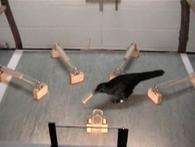
This video was made during previous experiments. In the Brevia section of the 9 August 2002 issue of Science, Weir et al. report a remarkable observation: The toolmaking behavior of New Caledonian crows. In the experiments, a captive female crow, confronted with a task that required a curved tool (retrieving a food-containing bucket from a vertical pipe), spontaneously bent a piece of straight wire into a hooked shape -- and then repeated the behavior in nine out of ten subsequent trials.
Using tools to act on non-food objects - for example, to make or retrieve other tools - is considered to be a hallmark of human intelligence, and may have been a crucial step in our evolution. One form of this behaviour, ‘sequential tool use,’ has been observed in a number of non-human primates, and has recently been reported for New Caledonian crows by a research team from Auckland University, New Zealand.
In their new study, the Oxford scientists tested seven captive New Caledonian crows on a range of tasks requiring the use of up to three different tools in a sequence to retrieve food. Five crows successfully used tools in a sequence (four from their very first trial), and four repeatedly solved the most demanding three-tool condition. In this, food was placed at a depth so that it was only reachable with one particular tool, but getting that tool required the use of two other others. The crows had to use a short, available tool to drag in a longer, otherwise out-of-reach tool, and then use that longer tool to retrieve the correct, longest one. They could then use the longest tool to reach for the food morsel.
Pre-training on each element in the sequence was not required for successful sequential tool use - an explanation that could not be ruled out in earlier studies on primates and crows. Painstaking analysis of tool choices, tool swapping and improvement over time allowed the team to conclude that successful crows did not probe for tools at random: for example, when birds swapped tools, it was usually to get a longer one. At the same time, however, they could find no firm evidence to support previous claims that sequential tool use demonstrates analogical reasoning or human-like planning.
While the ability of crows to use three tools in sequence reveals a competence beyond that observed in any other non-human species, including non-human primates, this study also emphasises the importance of a cautious approach in comparative cognitive science. Seemingly intelligent behaviour can be achieved without the involvement of high-level mental faculties, and detailed analyses are necessary before accepting claims for complex cognitive abilities.
Provided by Oxford University (news : web)


And quick learners too....hahahahaha
Primates, parrots and crows not only stand out in "brain power", they represent two quite different ways of organizing the brain. This has consequences for the probability of finding intelligent life outside Earth. More than one type of advanced brain structure is possible.
Birger: The search for intelligent life has been very restricted to 'extra terrestrial' for far too long. Perhaps a lateral search across the different existing and more recently extinct species will reveal more signs of intelligent life than we humans have previously ... 'devined'?
Perhaps we ought to open up to alternative gene migrations other than inheritance? "Did you hear the one about a chimp who ate a crow while riding a dolphin?" Why is it thought that when a crow attacks a human, they go for the eyes first? What is the nest step in that sequence?
Just because it is cliché, it does not mean it is wrong:
"It is not size that counts, it is how you use it"
I'm well versed in all the mainstream religions. That is exactly why I have drawn the conclusions I have.
Show me any verifiable, repeatable evidence of a soul and I'll change my mind in less than a heartbeat.
God could end all speculation of his existence if he'd just show us a copy of his legal birth certificate.
Okay you are right everyone; my pet crow is called Muriel and is not a 'he' at all.
Seems like we want to keep up a distinction between ourselves and all other species, no matter what.
The day scientists discover that a dolphin does higher math, we'll define Intelligent Thinking as not including higher math. Oh and, to be safe, we also explain that the dolphin is just following its natural instincts, and therefore actually isn't doing higher math at all, it just appears to.
Oh, and about the soul. We think we have a soul simply because we look at the world from inside of our heads. That gives an illusion of a "me", which translates to a belief that this "me" actually is something, a soul. -- Don't think a dog or a frog has this "me" illusion, too? Well, I have news for you: a narcissist genuinely feels that other *people* don't have a "me" (and therefore no soul). But it's a secret.
A scientist who believes in the soul has no business in biology. Just as a scientist who believes in god has no business in cosmology. These two things simply hamper their grasp of what's relevant, and how to conduct crystal clear analytic thinking and research.
http://en.wikiped...Miracles and RJ Fogelins defence of his argument. Thus:
1. We can conclude that 290163's bird did not build his house (without a lot of help)
2. Souls do not exist.
3. 'Fogelin' is an anglicized version of the German 'Vogeln' which means 'birds'.
4. Synchronicity is not evidence for the existance of God.
I have a certain jozytsql(hell if I know what it is) and you don't. Therefor I'm uniquely superior to you and justified in treating you any way I wish without further justification or remorse.
Likewise, souls are just a necessary fiction to justify narcissistic fantasies.
I cant agree more, u completely hit the nail on the head. I really have nothing to add, its superbly spoken.
Yeah, einstein should never have done more than file patents.
It was, of course, a lie what you read about my religious convictions, a lie which is being systematically repeated. I do not believe in a personal God and I have never denied this but have expressed it clearly. If something is in me which can be called religious then it is the unbounded admiration for the structure of the world so far as our science can reveal it.
- Albert Einstein, letter to an atheist (1954), quoted in Albert Einstein: The Human Side, edited by Helen Dukas & Banesh Hoffman
I received your letter of June 10th. I have never talked to a Jesuit priest in my life and I am astonished by the audacity to tell such lies about me. From the viewpoint of a Jesuit priest I am, of course, and have always been an atheist.
- Albert Einstein, letter to Guy H. Raner Jr, July 2, 1945, responding to a rumor that a Jesuit priest had caused Einstein to convert from atheism; quoted by Michael R. Gilmore in Skeptic, Vol. 5, No. 2
I have repeatedly said that in my opinion the idea of a personal God is a childlike one. You may call me an agnostic, but I do not share the crusading spirit of the professional atheist whose fervor is mostly due to a painful act of liberation from the fetters of religious indoctrination received in youth. I prefer an attitude of humility corresponding to the weakness of our intellectual understanding of nature and of our own being.
- Albert Einstein, letter to Guy H. Raner Jr., Sept. 28, 1949, quoted by Michael R. Gilmore in Skeptic, Vol. 5, No. 2
Gosh even SPAMMERS can adapt. Only two posts out of four that have wow or dude in them in this, its fourth, incarnation.
And two sentences. That may be a first.
Still its SPAM.
So go away, just go away.
Words and lyrics by Blondie
Ethelred